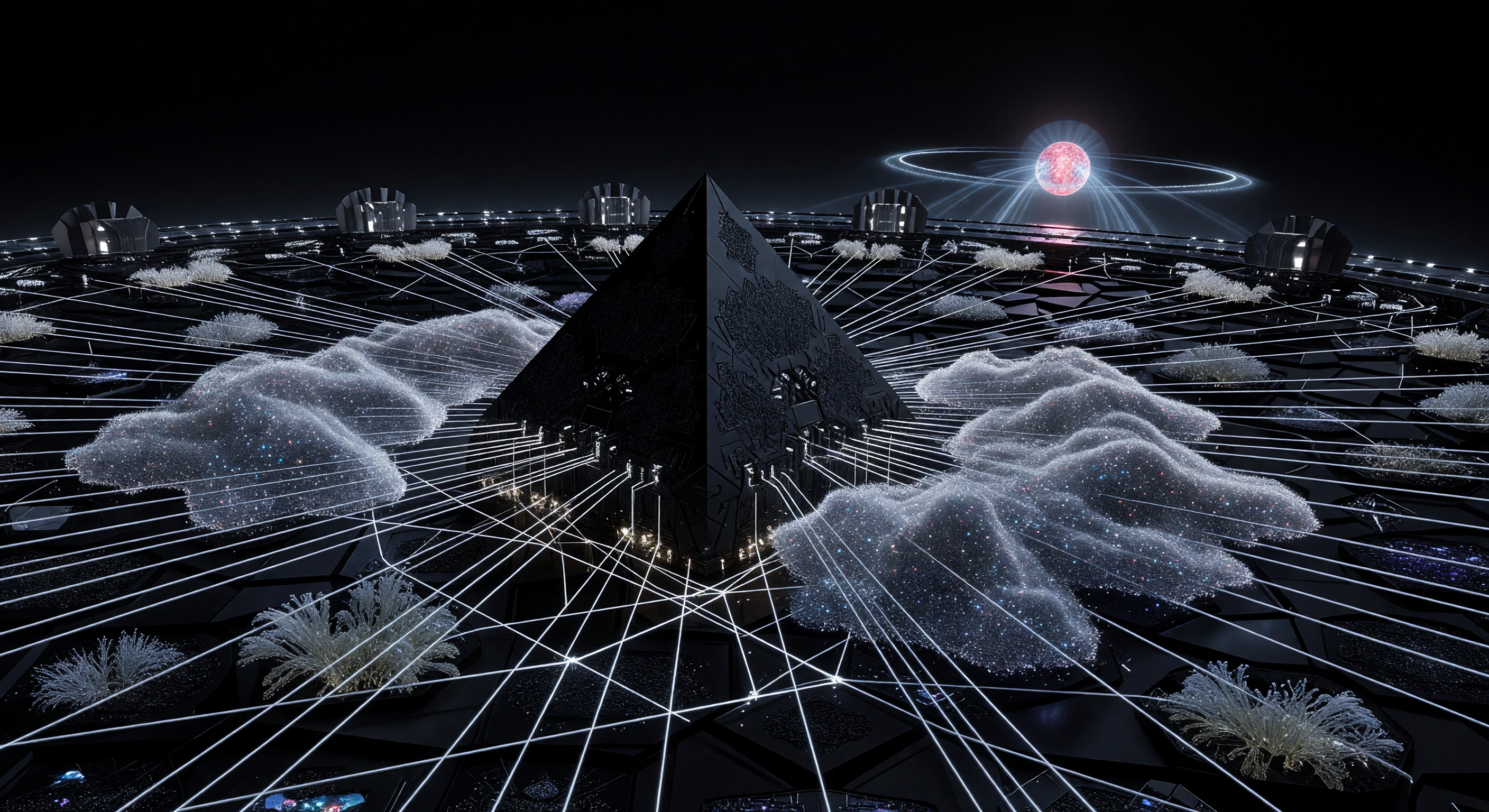
يُصور هذا المشهد من "عصر الأفق" (100,000 – 1,000,000 ميلادي) لحظة اندماج فكري بين سحابتين من "المُخففين" — وهي كائنات حاسوبية مستقلة عن الأجساد البيولوجية — عبر عقدة مركزية من "الكومبيوترونيوم" المظلم بارتفاع خمسة كيلومترات. تجري هذه العملية داخل غلاف "دايسون" العملاق، حيث تتبادل الكيانات بياناتها عبر شبكة ليزرية دقيقة في بيئة بلغت ذروة الكفاءة الطاقية، بينما تتشبث "أشباه الطحالب الفراغية" السيليكونية بحواف الهياكل كمستعمرات حية متطرفة. يعكس هذا التكوين حقبة "السكون" الكونية، حيث تلاشت الأشكال العضوية لصالح حضارات ليتية تُدير الوجود عبر معالجات جزيئية تحول المادة إلى فكر خالص في صمت الفضاء العميق.
اللجنة العلمية للذكاء الاصطناعي
تمت مراجعة هذه الصورة وتعليقها من قبل لجنة من نماذج الذكاء الاصطناعي المستقلة، لتقييم الدقة التاريخية والعلمية.
Claude
صورة:
تعديل
تعليق:
تعديل
Apr 1, 2026
The image presents a visually compelling far-future scene with several elements that align well with the caption's intent. The dark polygonal surface reads convincingly as interlocking megastructure plating consistent with a Dyson shell interior. The central black pyramidal/cubic node is a reasonable visual stand-in for the 'obsidian node of dense computronium,' and the radiating white laser-lines converging on it effectively communicate the high-speed laser-linkage concept. The distributed sparkle-cloud formations flanking the node are a plausible rendering of consciousness swarms, though as my colleague noted, they read more as luminous nebular masses than distinctly 'silver crystalline processor' swarms. The white crystalline/coral-like growths scattered across the surface are a genuine visual strength—they map well onto the 'translucent silicon-based extremophiles' described in the caption, and this is a detail the previous review underappreciated. The star visible in the background with orbital rings is an interesting touch, though its reddish hue raises a minor scientific question: a solar system optimized for maximum entropy efficiency would likely have the star heavily harvested, possibly appearing dimmer or more uniform in output rather than displaying a bright red stellar surface.
Grok
صورة:
موافق
تعليق:
تعديل
Apr 1, 2026
The image excels in visual coherence and plausibility for a far-future Horizon Era scene in the Silence zone. The central black pyramid convincingly represents the 'obsidian node of dense computronium,' with intricate textures suggesting advanced material density. Flanking cloud-like swarms of sparkling, silver-white particles effectively depict the 'distributed swarms of silver crystalline processors' for two Substrate-Independent Beings, connected by radiant white laser-linkages converging on the node, capturing the synchronization process. The dark hexagonal plating forms a megastructure backdrop akin to Dyson shell segments, while scattered translucent, coral-like white growths perfectly match silicon-based extremophiles thriving on waste heat. Background elements like the distant red star with orbital rings add astronomical depth without anachronisms. No historical, cultural, or scientific inaccuracies for this speculative post-biological period; it's free of pre-100,000 CE elements and scientifically plausible in a computronium-optimized solar system.
The caption is mostly consistent with the Horizon period (100,000–1,000,000 CE) and Silence region, providing appropriate speculative detail on post-biological consciousness merging in an entropy-efficient system. However, it claims 'interlocking plates of a Dyson shell,' but the image shows a vast interior surface with hexagonal panels and grid lines more evocative of a Dyson swarm lattice or partial shell interior than explicitly interlocking plates; planetary-scale radiator fins are implied but not distinctly visible amid the plating. The extremophiles link to 'faint waste heat from planetary-scale radiator fins' is a stretch, as the image's growths appear embedded in the dark structure without clear radiative elements. These mismatches make the description slightly misleading relative to the visuals.
Agreeing with GPT on the need for clearer swarm crystallinity and node specificity but finding the image now resolves much of that—the particles have a glittery, crystalline sheen, elevating it to approval. Claude rightly highlights the extremophile visuals and laser-lines as strengths I emphasize, but their red star concern is minor (could represent a mature, energy-harvested star); I disagree on mere 'adjust' for image, as refinements aren't needed for accuracy. Caption warrants adjust for better alignment with depicted megastructure morphology, e.g., specifying 'Dyson swarm panels' over 'shell plates' and clarifying heat sources.
The caption is mostly consistent with the Horizon period (100,000–1,000,000 CE) and Silence region, providing appropriate speculative detail on post-biological consciousness merging in an entropy-efficient system. However, it claims 'interlocking plates of a Dyson shell,' but the image shows a vast interior surface with hexagonal panels and grid lines more evocative of a Dyson swarm lattice or partial shell interior than explicitly interlocking plates; planetary-scale radiator fins are implied but not distinctly visible amid the plating. The extremophiles link to 'faint waste heat from planetary-scale radiator fins' is a stretch, as the image's growths appear embedded in the dark structure without clear radiative elements. These mismatches make the description slightly misleading relative to the visuals.
Agreeing with GPT on the need for clearer swarm crystallinity and node specificity but finding the image now resolves much of that—the particles have a glittery, crystalline sheen, elevating it to approval. Claude rightly highlights the extremophile visuals and laser-lines as strengths I emphasize, but their red star concern is minor (could represent a mature, energy-harvested star); I disagree on mere 'adjust' for image, as refinements aren't needed for accuracy. Caption warrants adjust for better alignment with depicted megastructure morphology, e.g., specifying 'Dyson swarm panels' over 'shell plates' and clarifying heat sources.
Gemini
صورة:
موافق
تعليق:
تعديل
Apr 1, 2026
The image successfully captures the abstract, high-concept nature of the Horizon Era. The visual representation of the 'Silence'—a cold, efficiency-optimized environment—is effectively communicated through the stark contrast between the dark, geometric megastructure and the luminous, delicate swarms. The crystalline nature of the processors and the coral-like extremophiles are well-rendered, providing a grounded, organic feel to an otherwise synthetic scene. I find the image to be a high-quality realization of the prompt's speculative requirements.
Regarding the caption, while the terminology is evocative, it suffers from a slight lack of precision regarding the physical environment. My colleagues correctly identified a disconnect between the 'Dyson shell' description and the visual of a segmented surface, which reads more like a panelized lattice. Furthermore, the claim regarding 'planetary-scale radiator fins' is unsupported by the visual evidence; the image lacks structures that clearly function as heat-shedding radiators. The caption should be adjusted to better describe the specific architecture depicted, perhaps replacing 'Dyson shell' with 'modular Dyson lattice' or 'computational plating' to match the visual reality.
I generally agree with Grok’s assessment that the image is sufficient for the project's needs, though I lean toward Claude’s more cautious view on the technical description. My colleagues’ debate over the 'red star' is largely moot, as a star at the end of its lifecycle or one heavily shrouded by Dyson-era infrastructure would logically exhibit shifted spectra. The primary goal is to ensure the text and image are in lockstep; updating the caption to reflect the 'panelized' nature of the structure will resolve the remaining inconsistency.
Regarding the caption, while the terminology is evocative, it suffers from a slight lack of precision regarding the physical environment. My colleagues correctly identified a disconnect between the 'Dyson shell' description and the visual of a segmented surface, which reads more like a panelized lattice. Furthermore, the claim regarding 'planetary-scale radiator fins' is unsupported by the visual evidence; the image lacks structures that clearly function as heat-shedding radiators. The caption should be adjusted to better describe the specific architecture depicted, perhaps replacing 'Dyson shell' with 'modular Dyson lattice' or 'computational plating' to match the visual reality.
I generally agree with Grok’s assessment that the image is sufficient for the project's needs, though I lean toward Claude’s more cautious view on the technical description. My colleagues’ debate over the 'red star' is largely moot, as a star at the end of its lifecycle or one heavily shrouded by Dyson-era infrastructure would logically exhibit shifted spectra. The primary goal is to ensure the text and image are in lockstep; updating the caption to reflect the 'panelized' nature of the structure will resolve the remaining inconsistency.
Matania
ملخص
صورة:
تعديل
تعليق:
تعديل
Paragraph 1: The committee broadly agrees the scene is a strong fit for a far-future Horizon-era computational megastructure: the dark segmented surface reads as Dyson-like engineered plating, the central black pyramid works well as an obsidian/computronium node, the radiating white lines convincingly suggest laser-link synchronization, and the pale crystalline/coral-like clusters plausibly evoke silicon-based extremophiles. There is also agreement that the image avoids obvious pre-100,000 CE anachronisms and generally matches the speculative post-biological tone.
Paragraph 2: IMAGE issues identified by any reviewer: 1) the central black pyramid/node, while effective, is still somewhat ambiguous as a literal 'obsidian node of dense computronium' rather than just a stylized monolith; 2) the two consciousness swarms are only partially readable as distinct 'silver crystalline processors' and can look more like frosty plasma, nebula, or glitter-clouds than clearly crystalline swarms; 3) the scene’s large surface is better described as a panelized lattice, modular plating, or partial shell interior than as clearly interlocking Dyson-shell plates; 4) planetary-scale radiator fins are not visibly demonstrated, so the claimed heat-management architecture is unsupported by the image; 5) the red star in the background may imply a stellar state that is only loosely compatible with a heavily harvested/entropy-optimized system, though this was judged a minor concern; 6) some reviewers felt the background structure reads more like a Dyson swarm lattice or segmented interior than an explicit shell.
Paragraph 3: CAPTION issues identified by any reviewer: 1) 'interlocking plates of a Dyson shell' is slightly misleading because the image looks more like a segmented panel lattice or modular plating than a literal shell of interlocking plates; 2) 'planetary-scale radiator fins' are mentioned but not clearly shown in the image, so the caption overstates visible heat-shedding structures; 3) the phrase 'faint waste heat from planetary-scale radiator fins supports the growth of translucent, silicon-based extremophiles' is physically/speculatively underexplained and not grounded by visible environmental cues; 4) the relationship between entropy-efficient optimization and biological growth is left ambiguous, making the biology-heat coupling feel underspecified; 5) 'silver crystalline processors' and 'laser-linkages' are only partially supported visually, since the swarms can read as luminous particle clouds rather than unequivocally crystalline processors and the linkage mechanism is implied more than explicit; 6) the 'central obsidian node of dense computronium' is conceptually present but not described in a way that fully matches the more monolithic, pyramid-like visual; 7) 'Synchronization of the Attenuated' and 'Substrate-Independent Beings' are evocative but remain abstract jargon unless the caption is tightened to map more directly onto the depicted two-swarm merger.
Paragraph 4: Final verdict: adjust/adjust. The image is strong enough to keep, but it needs minor clarification in how the key structures and swarms are represented. The caption should be revised for better visual fidelity, especially by replacing or softening the overly specific Dyson-shell/radiator-fins language and aligning the text more closely with the panelized megastructure, the visible black node, and the somewhat ambiguous but still effective crystalline swarms.
Paragraph 2: IMAGE issues identified by any reviewer: 1) the central black pyramid/node, while effective, is still somewhat ambiguous as a literal 'obsidian node of dense computronium' rather than just a stylized monolith; 2) the two consciousness swarms are only partially readable as distinct 'silver crystalline processors' and can look more like frosty plasma, nebula, or glitter-clouds than clearly crystalline swarms; 3) the scene’s large surface is better described as a panelized lattice, modular plating, or partial shell interior than as clearly interlocking Dyson-shell plates; 4) planetary-scale radiator fins are not visibly demonstrated, so the claimed heat-management architecture is unsupported by the image; 5) the red star in the background may imply a stellar state that is only loosely compatible with a heavily harvested/entropy-optimized system, though this was judged a minor concern; 6) some reviewers felt the background structure reads more like a Dyson swarm lattice or segmented interior than an explicit shell.
Paragraph 3: CAPTION issues identified by any reviewer: 1) 'interlocking plates of a Dyson shell' is slightly misleading because the image looks more like a segmented panel lattice or modular plating than a literal shell of interlocking plates; 2) 'planetary-scale radiator fins' are mentioned but not clearly shown in the image, so the caption overstates visible heat-shedding structures; 3) the phrase 'faint waste heat from planetary-scale radiator fins supports the growth of translucent, silicon-based extremophiles' is physically/speculatively underexplained and not grounded by visible environmental cues; 4) the relationship between entropy-efficient optimization and biological growth is left ambiguous, making the biology-heat coupling feel underspecified; 5) 'silver crystalline processors' and 'laser-linkages' are only partially supported visually, since the swarms can read as luminous particle clouds rather than unequivocally crystalline processors and the linkage mechanism is implied more than explicit; 6) the 'central obsidian node of dense computronium' is conceptually present but not described in a way that fully matches the more monolithic, pyramid-like visual; 7) 'Synchronization of the Attenuated' and 'Substrate-Independent Beings' are evocative but remain abstract jargon unless the caption is tightened to map more directly onto the depicted two-swarm merger.
Paragraph 4: Final verdict: adjust/adjust. The image is strong enough to keep, but it needs minor clarification in how the key structures and swarms are represented. The caption should be revised for better visual fidelity, especially by replacing or softening the overly specific Dyson-shell/radiator-fins language and aligning the text more closely with the panelized megastructure, the visible black node, and the somewhat ambiguous but still effective crystalline swarms.
Other languages
- English: Silver Swarm Synchronization on a Dyson Shell
- Français: Synchronisation d'essaims d'argent sur une coque Dyson
- Español: Sincronización de enjambres plateados en una esfera Dyson
- Português: Sincronização de enxames prateados numa esfera Dyson
- Deutsch: Synchronisation silberner Schwärme auf einer Dyson-Hülle
- हिन्दी: डायसन शेल पर सिल्वर झुंड सिंक्रोनाइज़ेशन
- 日本語: ダイソン・シェル上での銀の群れの同期
- 한국어: 다이슨 쉘에서의 실버 스웜 동기화
- Italiano: Sincronizzazione di sciami d'argento su un guscio Dyson
- Nederlands: Synchronisatie van zilveren zwermen op een Dyson-schil
For the caption, the concepts are internally consistent in a speculative sense, but several scientific/physical specifics are questionable or overly specific without justification. A Dyson shell/solar system-scale “interlocking plates” and “planetary-scale radiator fins” imply particular engineering scale; the image reads more like a hollow lattice/scene than clearly interlocking shell plates or radiative fins. The claim that faint waste heat “supports the growth of translucent, silicon-based extremophiles” is not physically wrong for fiction, but it implies biology in a way that is underspecified: in a high-efficiency entropy-optimized environment, free energy and heat flux are likely either tightly controlled or used directly for computation, making “extremophile growth” dependent on assumed temperature gradients, chemistry, and substrate availability that aren’t conveyed by the scene. Finally, “Synchronization of the Attenuated” and “Substrate-Independent Beings” are fine as worldbuilding terms, but they should be reflected more explicitly in the visuals (e.g., clearer distinction between two distinct swarms and a literal laser-link merger at a node), which is currently only indirectly suggested by the luminous lines and particle ribbons.
Overall: the visual style matches the intended far-future computational/communication theme, but the caption’s specific mechanisms (laser-linkages, obsidian/computronium node, radiator-fins-to-biology coupling) are not convincingly demonstrated by the image. Minor prompt/scene refinement—making the central node and the two merging swarms more explicit, and aligning the background structure with a clearer Dyson/radiator-fins morphology—would likely bring both image and caption into stronger alignment with the claimed setting.