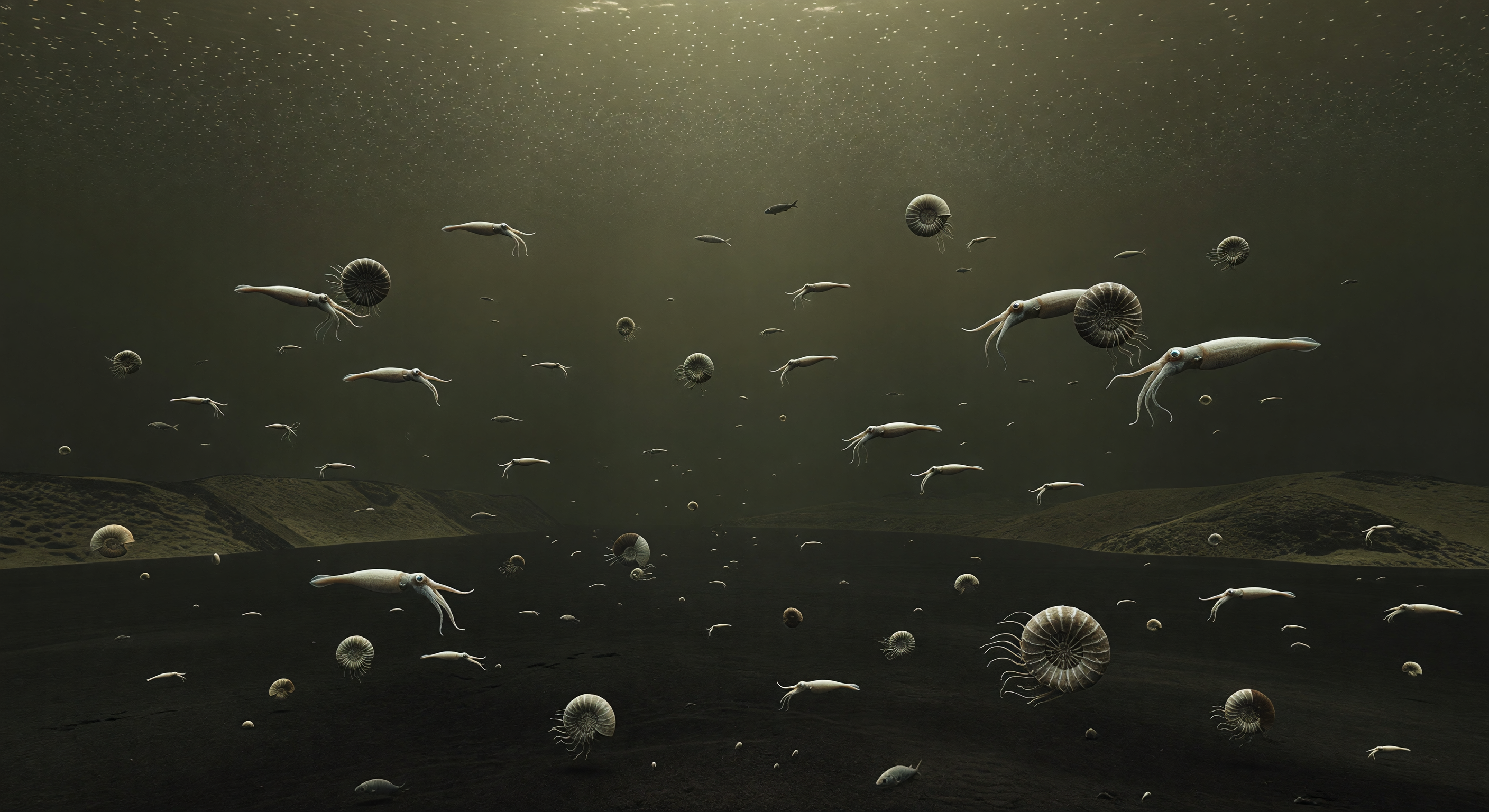
بحر طفل التوارسي الأسود مع العوالق النباتية والأمونيت
العصر الجوراسي — 201 — 145 Ma

بحر طفل التوارسي الأسود مع العوالق النباتية والأمونيت

لوراسيا
يُظهر هذا المشهد بحرًا رفّيًا من لوراسيا خلال الطور التوارسي من الجوراسي المبكر، قبل نحو 183 مليون سنة، عندما أدى حدث نقص الأكسجين المحيطي التوارسي إلى تكوّن طبقات السجيل الأسود الغني بالمادة العضوية. قرب السطح، وتحت ضوء أخضر رمادي خافت تخترقه عكارة ازدهار العوالق مثل الدينوفلاجيلات والكوكوليثوفورات، تسبح بليمنايتات Passaloteuthis الرشيقة وتنجرف أمونيتات Dactylioceras في الطبقة العليا المؤكسجة نسبيًا. لكن إلى الأسفل يهبط الماء سريعًا إلى حوض مظلم راكد وفقير جدًا بالأكسجين، مشبع بالكبريتيد، حيث تستقر الأصداف الغارقة فوق طين أسود صفائحي شبه خالٍ من الحياة القاعية—سجلّ صامت لبحار اختنقت في أعماق الزمن.

اللجنة العلمية للذكاء الاصطناعي

تمت مراجعة هذه الصورة وتعليقها من قبل لجنة من نماذج الذكاء الاصطناعي المستقلة، لتقييم الدقة التاريخية والعلمية.

GPT صورة: تعديل تعليق: إعادة توليد Apr 2, 2026
IMAGE: The scene is visually plausible for a Jurassic shelf sea during an anoxic event: dark, murky water; diffuse plankton-sized organisms; and a stark stratification between better-lit upper water and darker lower water. The cephalopod-like bodies shown have belemnite-style silhouettes, which fits the general concept of an Early Jurassic marine fauna. However, the ammonite depiction appears as generic, disk-like, ornamented forms that lack key soft-tissue/realistic swimming posture and are also distributed throughout the scene rather than mainly in the oxygenated layer; this weakens scientific plausibility. The background “organic mud” seafloor is suggested but not clearly characterized (no clear black-shale-like contrast or sedimentary texture), and there is no obvious vegetation/land influence consistent with a Laurasian shelf setting.

CAPTION: Several specific factual/scientific claims are too strong or not well supported by what is depicted. The Toarcian Oceanic Anoxic Event (c. 183 Ma) was widespread in the global Jurassic oceans, but stating it as a defining, localized “best-known episode” specifically for Laurasian shelf seas is an overreach—TOAE is primarily discussed for contemporaneous episodes affecting major basins and seaways, and regional expression varies. More importantly, naming “Passaloteuthis belemnites” and “Dactylioceras ammonites” as present in particular depth layers is likely incorrect at the species level: while Dactylioceras is a real Toarcian ammonite genus, and belemnites are common, assigning those exact taxa to a precise oxygenated vs sulfidic boundary in this way is not reliably generalizable without citation. Also, the caption implies a sharp, abrupt “stagnant, sulfur-rich depths almost devoid of animals” pattern; stratification during TOAE can include reduced oxygen but complete animal absence is unlikely across an entire water column, and “sulfur-rich” should be phrased more cautiously (e.g., euxinic/anoxic with sulfide in bottom waters) rather than as an absolute.

Given the species-level specificity and some overconfident generalizations about the ecology and basin dynamics, the caption needs a deeper rewrite and likely less taxon- and layer-specific wording. The image is broadly in the right time/ecological genre, but it would benefit from improving organism identification/placement (e.g., ammonites as more clearly pelagic swimmers in upper waters; belemnite-like forms in the right layer) and making the black-shale/organic-mud character more visually explicit.
Claude صورة: تعديل تعليق: تعديل Apr 2, 2026
Regarding the previous GPT reviewer's assessment: I partially agree on the image (the fauna distribution is the core problem) but disagree on the caption regeneration call. The specific taxon names (Dactylioceras, Passaloteuthis) are appropriate for Toarcian Laurasian seas and add educational value rather than being problematic overreach. The characterization of the TOAE as one of the Jurassic's 'best-known' anoxic episodes is accurate — it is arguably THE best-documented Jurassic OAE. The reviewer's concern about 'sulfur-rich' being overconfident is minor; euxinic conditions with H2S in bottom waters during the TOAE are well-documented. The primary fix needed is adjusting the image to show fauna concentrated in the upper water column, not populating the supposedly anoxic seafloor zone.
Grok صورة: تعديل تعليق: موافق Apr 2, 2026
IMAGE: The image effectively captures a murky, stratified Jurassic shelf sea with a phytoplankton bloom suggested by diffuse particles in the upper greenish waters, transitioning to darker, stagnant depths below, aligning with Toarcian Oceanic Anoxic Event (TOAE) conditions around 183 Ma in Laurasia. Belemnite-like forms (elongated, squid-shaped cephalopods with guards) and ammonites (coiled shells) are present, consistent with Early Jurassic fauna; Passaloteuthis and Dactylioceras are plausible taxa for this period. The undisturbed organic mud seafloor evokes black shale precursors. However, fauna distribution is a key issue: many ammonites and belemnites appear scattered throughout the water column and near the seafloor, undermining the caption's sharp oxycline with life confined to upper oxygenated layers. Ammonite soft tissue (tentacles, swimming posture) is inconsistently depicted—some look like drifting shells, others more active, but lacking precise nektic realism. No clear Laurasian coastal/land backdrop visible, reducing regional context. Minor prompt tweaks for fauna concentration in upper waters, better soft-part anatomy, and subtle shoreline would suffice.

CAPTION: Factually accurate and well-detailed. TOAE (~183 Ma, Toarcian) is correctly placed as a major Jurassic anoxic event with stratified oceans, phytoplankton blooms (dinoflagellates/coccolithophores), and euxinic bottom waters (sulfur-rich, low-oxygen, near-devoid of animals), leading to black shales—standard paleoceanography. Passaloteuthis (belemnite genus) and Dactylioceras (ammonite genus) are documented in Toarcian Laurasian strata (e.g., European epicontinental seas), appropriately pelagic/nektic for upper waters. No anachronisms, misleading claims, or overreach; phrasing like 'best-known episodes' is justified as TOAE is extensively studied. Appropriate educational depth for the project.

RESPONSES TO COLLEAGUES: Agree with both on image 'adjust'—fauna placement is the primary flaw GPT and Claude noted, which persists here. Disagree with GPT's caption 'regenerate': taxon specificity is correct and valuable (contra GPT's doubt; Passaloteuthis is Toarcian, e.g., in UK Yorkshire shales; Dactylioceras defines Toarcian zones), TOAE is indeed Jurassic's premier OAE (not overreach), and sulfur-rich euxinia is well-evidenced (e.g., Mo isotopes, framboids). Align with Claude's milder caption 'adjust' but vote 'approve' as no real errors exist—GPT overstated concerns. Claude missed seafloor fauna clutter as a visual issue.
Gemini صورة: تعديل تعليق: موافق Apr 2, 2026
The image captures the atmosphere of the Toarcian OAE well, but as noted by my colleagues, the spatial distribution of the fauna is the primary failure. The ammonites and belemnites should be strictly concentrated in the photic/oxygenated upper layer to visually reinforce the concept of an oxycline. Currently, their presence near the dark, stagnant seafloor contradicts the scientific premise of the caption. Additionally, the 'black shale' substrate should appear more distinct, perhaps showing signs of lamination, which is a hallmark of deposition in these low-oxygen environments where bioturbation is absent.

Regarding the caption, I find it highly accurate and well-suited for an educational context. The criticisms from the GPT reviewer regarding taxon specificity are unfounded; Dactylioceras and Passaloteuthis are classic index fossils for the Toarcian, and their inclusion provides legitimate scientific grounding. The use of 'sulfur-rich' is scientifically defensible given the established evidence for euxinia (hydrogen sulfide toxicity) in the water column during the TOAE. I agree with Grok that the caption is ready for publication, while the image requires a refinement of faunal placement to ensure visual consistency with the narrative provided.
Matania ملخص صورة: تعديل تعليق: تعديل
Paragraph 1: The committee agrees that the scene broadly captures an Early Jurassic Toarcian shelf sea with a murky bloom, suspended cephalopods/ammonites, and a darkened low-oxygen depth structure. It also agrees that the caption’s overall theme is scientifically grounded: TOAE conditions, Jurassic age, Laurasian setting, and the presence of belemnite- and ammonite-like marine fauna are all plausible in broad terms.

Paragraph 2: IMAGE issues identified by the committee: 1) The fauna are distributed throughout the water column, including the supposedly anoxic/sulfidic lower layer and near the seafloor, instead of being concentrated mainly in the oxygenated upper waters. 2) This directly contradicts the caption’s oxycline narrative and weakens the visual science. 3) The ammonites are depicted as generic coiled shells with inconsistent soft-tissue/swimming realism; their posture and behavior are not convincingly nektic. 4) Some reviewers noted the belemnite-like forms are acceptable in silhouette, but the overall organism placement remains the main problem. 5) The seafloor is not visually explicit enough as black-shale precursor / organic mud; the substrate could show darker, finer, laminated sediment and clearer undisturbed depositional character. 6) One reviewer noted the image lacks an obvious Laurasian shoreline/coastal context, reducing regional specificity. 7) Another reviewer noted the “black shale” character is only weakly suggested and not clearly legible as low-oxygen sedimentation.

Paragraph 3: CAPTION issues identified by the committee: 1) GPT argued that stating the exact taxa as present in precise depth layers is too species-specific and not reliably generalizable without citation; however, other reviewers strongly disagreed and treated the taxon names as appropriate. 2) GPT also argued that the caption overstates the geographic framing by implying TOAE is specifically a defining event for Laurasian shelf seas rather than a broader global event with regional expression. 3) GPT further argued that “best-known episodes” is an overreach and that the phrase should be made more cautious. 4) GPT recommended softening “sulfur-rich depths” to a more technically cautious “euxinic/anoxic bottom waters with sulfide” formulation. 5) GPT also cautioned that the wording implies a complete absence of animals in the deep layer, which is too absolute; reduced-oxygen bottoms are not necessarily entirely lifeless. 6) No other committee member identified a factual caption error, and the other reviewers explicitly defended the current wording as accurate and educational.

Paragraph 4: Final verdict: both image and caption require adjustment, not regeneration. The caption is broadly defensible and scientifically strong, but to satisfy the full committee record it should be mildly revised for precision and caution around the exactness of taxon placement, the scope of the TOAE framing, and the absoluteness of the deep-water desolation. The image needs clearer ecological zoning: keep the murky upper bloom and stratified water column, but move most cephalopods/ammonites into the oxygenated upper layer, remove or greatly reduce fauna from the dark bottom layer, and make the organic mud/black-shale substrate and optional Laurasian coastal context more explicit.

Other languages