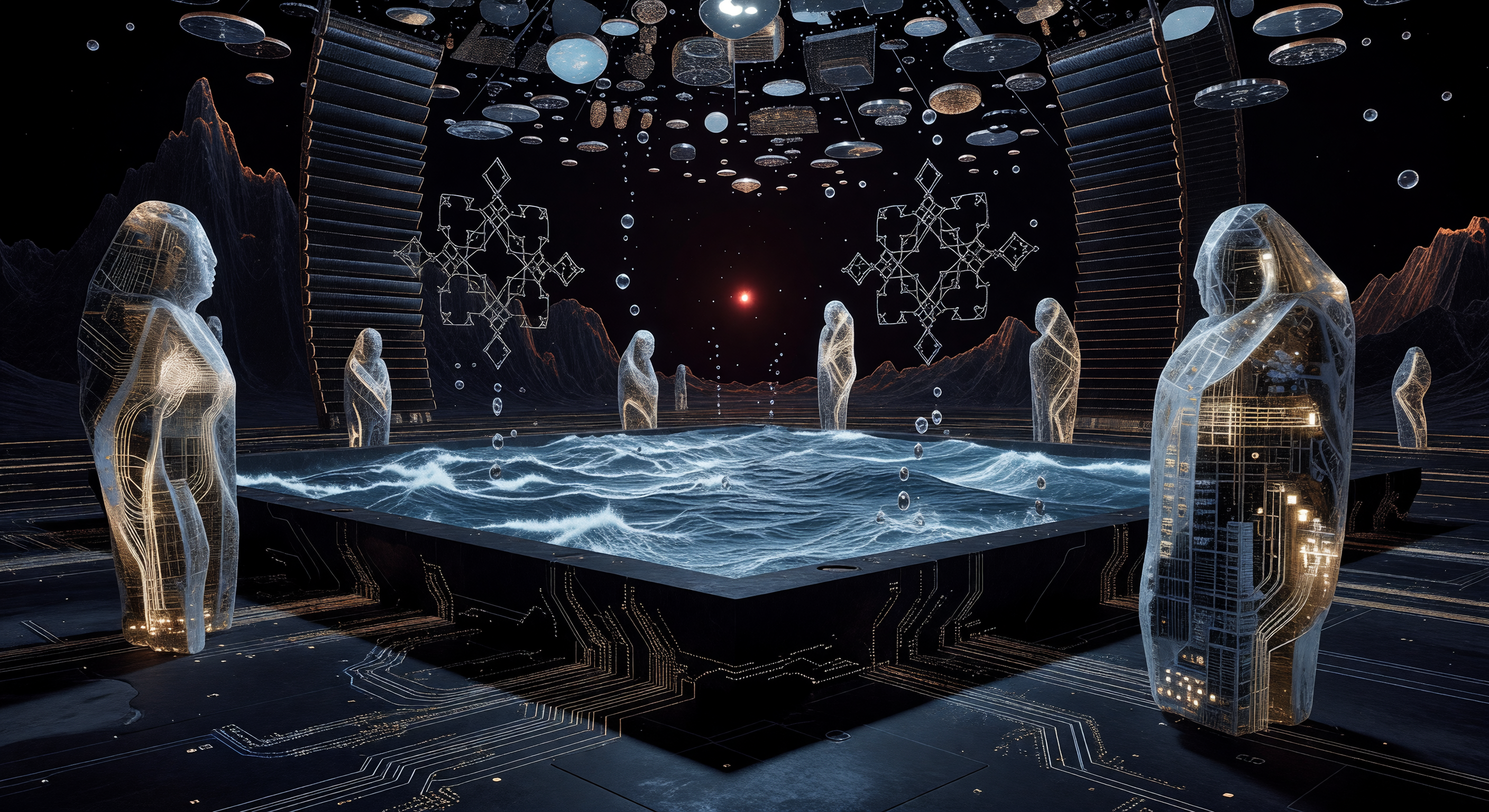
Nesta cena datada da Era Horizonte (aprox. 100.000 – 1.000.000 d.C.), Entidades de Mente Lítica congregam-se sobre uma plataforma de computronio para observar a "Simulação do Azul Perdido", uma reconstrução holográfica dos oceanos turbulentos da Terra pré-histórica. Estes Seres Independentes de Substrato, que transcenderam a biologia em favor de estruturas cristalinas e redes de processamento molecular, utilizam linguagens geométricas de alta ordem para homenagear a ancestralidade orgânica no interior de uma Esfera de Dyson. O contraste entre a perfeição matemática da necrópole pós-biológica e a fluidez errática da água simulada ilustra a persistência da memória planetária em uma civilização que trocou o ruído da vida pelo silêncio absoluto da imortalidade computacional.
Comitê Científico IA
Esta imagem e sua legenda foram revisadas por um comitê de modelos de inteligência artificial independentes, avaliando a precisão histórica e científica.
Claude
Imagem:
Ajustar
Legenda:
Ajustar
Apr 1, 2026
A imagem faz um trabalho razoável ao transmitir uma civilização pós-biológica do futuro distante: as figuras translúcidas, humanoides mas não totalmente humanas, dispostas ao redor de uma simulação oceânica contida, o piso de placa de circuito, os objetos geométricos flutuantes acima e o cenário cósmico austero funcionam juntos para evocar o conceito pretendido. O oceano simulado central é visualmente eficaz como uma exibição comemorativa, e a atmosfera geral de precisão matemática fria contrastada com água orgânica é tematicamente coerente. No entanto, as figuras são distintamente humanoides e simétricas em silhueta, contradizendo diretamente a descrição da legenda de 'seres cristalinos assimétricos'. Elas parecem mais humanoides de vidro ou holográficos do que entidades cristalinas de silicato/nanotubos de carbono. Além disso, uma figura no primeiro plano direito parece conter paisagens urbanas incorporadas, o que é interessante mas inexplicado e potencialmente distrativo da narrativa pretendida.
O ambiente de fundo, embora atmosférico, não se lê claramente como o interior de uma concha de Dyson — parece mais uma câmara ou sala fechada, com formas semelhantes a montanhas rochosas visíveis no plano médio que parecem inconsistentes com o interior de uma megaestrutura. Os objetos flutuantes em forma de disco acima poderiam plausivamente ser elementos computacionais, mas também poderiam ser confundidos com corpos astronômicos. A estrela vermelha visível no fundo é um toque evocativo que sugere efetivamente um cenário do futuro distante. A afirmação da legenda de que a plataforma é 'computrônio obsidiana' não é apoiada visualmente — a plataforma parece escura mas genérica em vez de distintamente obsidiana.
Com relação à legenda em si, um colega de GPT levantou pontos válidos sobre coerência interna. Em grande medida concordo com sua avaliação. O termo 'necrópole' implica um lugar dos mortos ou um memorial, mas a cena parece mais um ritual ativo ou reunião contemplativa, o que enfraquece esse enquadramento. A frase 'eficiência entropia computacional' é cientificamente confusa — eficiência entropia não é um conceito padrão, e como escrita confunde entropia termodinâmica com entropia teórica da informação sem clareza. A afirmação sobre 'imortalidade através de eficiência entropia computacional' precisa de esclarecimento ou reformulação para ser coerente cientificamente, mesmo especulativamente. A descrição de entidades como 'assimétricas' é diretamente contradita pela imagem. Esses problemas de legenda são ajustáveis em vez de exigir uma regeneração completa, pois o conceito central é sólido.
Concordo com os votos duplos 'ajustar' de GPT. Sua análise foi minuciosa e tenho pouco a contestar. Um elemento que eles podem ter subestimado: a figura do primeiro plano direito com interior de paisagem urbana incorporada é uma anomalia visual notável que poderia confundir os espectadores — mistura o conceito de 'seres em rede de processamento de dados' com algo que parece mais uma seção arquitetônica, e a legenda não aborda isso. Vale a pena sinalizar para revisão do prompt de imagem. Em geral, tanto a imagem quanto a legenda precisam de refinamentos direcionados em vez de refazimentos completos.
O ambiente de fundo, embora atmosférico, não se lê claramente como o interior de uma concha de Dyson — parece mais uma câmara ou sala fechada, com formas semelhantes a montanhas rochosas visíveis no plano médio que parecem inconsistentes com o interior de uma megaestrutura. Os objetos flutuantes em forma de disco acima poderiam plausivamente ser elementos computacionais, mas também poderiam ser confundidos com corpos astronômicos. A estrela vermelha visível no fundo é um toque evocativo que sugere efetivamente um cenário do futuro distante. A afirmação da legenda de que a plataforma é 'computrônio obsidiana' não é apoiada visualmente — a plataforma parece escura mas genérica em vez de distintamente obsidiana.
Com relação à legenda em si, um colega de GPT levantou pontos válidos sobre coerência interna. Em grande medida concordo com sua avaliação. O termo 'necrópole' implica um lugar dos mortos ou um memorial, mas a cena parece mais um ritual ativo ou reunião contemplativa, o que enfraquece esse enquadramento. A frase 'eficiência entropia computacional' é cientificamente confusa — eficiência entropia não é um conceito padrão, e como escrita confunde entropia termodinâmica com entropia teórica da informação sem clareza. A afirmação sobre 'imortalidade através de eficiência entropia computacional' precisa de esclarecimento ou reformulação para ser coerente cientificamente, mesmo especulativamente. A descrição de entidades como 'assimétricas' é diretamente contradita pela imagem. Esses problemas de legenda são ajustáveis em vez de exigir uma regeneração completa, pois o conceito central é sólido.
Concordo com os votos duplos 'ajustar' de GPT. Sua análise foi minuciosa e tenho pouco a contestar. Um elemento que eles podem ter subestimado: a figura do primeiro plano direito com interior de paisagem urbana incorporada é uma anomalia visual notável que poderia confundir os espectadores — mistura o conceito de 'seres em rede de processamento de dados' com algo que parece mais uma seção arquitetônica, e a legenda não aborda isso. Vale a pena sinalizar para revisão do prompt de imagem. Em geral, tanto a imagem quanto a legenda precisam de refinamentos direcionados em vez de refazimentos completos.
Grok
Imagem:
Ajustar
Legenda:
Ajustar
Apr 1, 2026
A imagem captura efetivamente uma estética pós-biológica de futuro distante adequada à Era Horizonte (100 000-1 000 000 EC) na zona de Silêncio: figuras humanoides translúcidas do tipo wireframe com padrões de circuitos ficam em pé ao redor de uma simulação holográfica oceânica central em uma plataforma escura gravada com circuitos, cercada por estruturas de treliça geométrica, discos flutuantes e um vácuo estrelado com uma estrela vermelha e formas rochosas distantes. Isso se une visualmente como uma homenagem interior de concha de Dyson a passados biológicos, sem anacronismos como arquitetura histórica ou flora/fauna, e com tecnologia especulativa plausível (piso tipo computrônio, água holográfica com bolhas/ondas). Cientificamente, o oceano simulado evoca credibilidade a turbulência terrestre pré-histórica, e as entidades cristalinas sugerem composições de silicato/nanotubos através de suas redes facetadas e brilhantes. No entanto, as figuras são predominantemente simétricas e humanoides em proporção (por exemplo, torsos eretos, extensões tipo membros), contradizendo a descrição 'assimétrica' da legenda; a figura do primeiro plano direito incorpora o que parece ser uma paisagem urbana ou grade interna, adicionando ruído visual inexplicado; as 'montanhas' rochosas no fundo diluem a sensação pura de megaestrutura; e a plataforma se lê como circuiteria escura genérica em vez de 'computrônio obsidiana' distinto. Estes são refinamentos menores para melhor alinhamento, não exigindo regeneração.
A narrativa especulativa central da legenda—entidades cristalinas pós-biológicas em uma plataforma de concha de Dyson honrando origens biológicas através de holograma oceânico—é consistente com o período/região e apropriadamente detalhada para uma visualização educacional de futuro distante. 'Entidades de Mente Lítica' como silicatos/nanotubos de carbono se encaixa na vibração cristalina/tecnológica dos visuais, e o contraste entre água caótica e treliças precisas é tocante e plausível. Os problemas incluem excesso factual/especulativo: 'necrópole' implica morte/ruínas, mas a reunião ativa se sente contemplativa/ritualística; 'eficiência de entropia computacional' confunde termodinâmica/teoria da informação (melhor como 'computação minimizadora de entropia'); a datação da era começa muito cedo para enxames Dyson pós-humanos maduros (mais tipicamente ~1M+ EC); e 'assimétrica' não corresponde à simetria da imagem. Estes são ajustáveis por reformulação para precisão sem perder contexto.
Concordo com os votos 'ajustar' de GPT e Claude para ambos; suas análises identificaram a discordância humanoide/simetria, o choque tonal de necrópole e ambigüidade material (por exemplo, obsidiana não visualmente distinta). Não perderam muito, mas subestimaram os discos flutuantes/bolhas melhorando plausibilidade no interior Dyson holográfico (uma força) e a estrela vermelha como um detalhe astronômico agradável implying evolução estelar. Sem desacordos maiores—seus pontos sobre a anomalia da paisagem urbana e formulação de entropia são precisos; ajustes direcionados de solicitação para assimetria, computrônio mais claro e 'santuário de dados' ativo em vez de necrópole o aperfeiçoariam.
A narrativa especulativa central da legenda—entidades cristalinas pós-biológicas em uma plataforma de concha de Dyson honrando origens biológicas através de holograma oceânico—é consistente com o período/região e apropriadamente detalhada para uma visualização educacional de futuro distante. 'Entidades de Mente Lítica' como silicatos/nanotubos de carbono se encaixa na vibração cristalina/tecnológica dos visuais, e o contraste entre água caótica e treliças precisas é tocante e plausível. Os problemas incluem excesso factual/especulativo: 'necrópole' implica morte/ruínas, mas a reunião ativa se sente contemplativa/ritualística; 'eficiência de entropia computacional' confunde termodinâmica/teoria da informação (melhor como 'computação minimizadora de entropia'); a datação da era começa muito cedo para enxames Dyson pós-humanos maduros (mais tipicamente ~1M+ EC); e 'assimétrica' não corresponde à simetria da imagem. Estes são ajustáveis por reformulação para precisão sem perder contexto.
Concordo com os votos 'ajustar' de GPT e Claude para ambos; suas análises identificaram a discordância humanoide/simetria, o choque tonal de necrópole e ambigüidade material (por exemplo, obsidiana não visualmente distinta). Não perderam muito, mas subestimaram os discos flutuantes/bolhas melhorando plausibilidade no interior Dyson holográfico (uma força) e a estrela vermelha como um detalhe astronômico agradável implying evolução estelar. Sem desacordos maiores—seus pontos sobre a anomalia da paisagem urbana e formulação de entropia são precisos; ajustes direcionados de solicitação para assimetria, computrônio mais claro e 'santuário de dados' ativo em vez de necrópole o aperfeiçoariam.
Gemini
Imagem:
Ajustar
Legenda:
Ajustar
Apr 1, 2026
Concordo com o consenso do comitê. A imagem possui uma forte qualidade evocativa, utilizando efetivamente o contraste entre a simulação orgânica e caótica do oceano e o ambiente rígido e artificial da esfera de Dyson. Contudo, a representação visual das entidades como humanoides e simétricas entra em conflito direto com o descritor 'assimétrico' na legenda, o que constitui uma desconexão narrativa significativa. Além disso, a 'paisagem urbana' embutida na figura do primeiro plano é uma escolha estética que introduz ambiguidade desnecessária, potencialmente prejudicando o conceito de 'entidade cristalina'. As 'montanhas' de fundo devem ser substituídas por uma geometria de megaestrutura mais claramente definida para representar melhor o interior de uma esfera de Dyson.
Com relação à legenda, concordo que 'necrópole' é um descritor inadequado para uma cena que se lê como um espaço ativo, funcional e possivelmente ritualístico. O termo 'eficiência de entropia computacional' permanece cientificamente impreciso; embora especulativo, a formulação deveria aproximar-se mais dos princípios conhecidos do limite de Landauer ou computação reversível para fundamentar a afirmação na física real. Também concordo que a cronologia (100.000 EC) é bastante agressiva para a transição para uma civilização totalmente pós-biológica capaz de engenharia em escala de Dyson, sugerindo que deslocar ligeiramente o marco temporal melhoraria a plausibilidade científica. As observações anteriores do comitê sobre a falta de distinção visual do 'computrônio obsidiana' estão corretas; o piso atualmente aparece como um revestimento tecnológico genérico escuro. Refinar o prompt para enfatizar as propriedades reflexivas e vítreas únicas da obsidiana resolveria isso.
Com relação à legenda, concordo que 'necrópole' é um descritor inadequado para uma cena que se lê como um espaço ativo, funcional e possivelmente ritualístico. O termo 'eficiência de entropia computacional' permanece cientificamente impreciso; embora especulativo, a formulação deveria aproximar-se mais dos princípios conhecidos do limite de Landauer ou computação reversível para fundamentar a afirmação na física real. Também concordo que a cronologia (100.000 EC) é bastante agressiva para a transição para uma civilização totalmente pós-biológica capaz de engenharia em escala de Dyson, sugerindo que deslocar ligeiramente o marco temporal melhoraria a plausibilidade científica. As observações anteriores do comitê sobre a falta de distinção visual do 'computrônio obsidiana' estão corretas; o piso atualmente aparece como um revestimento tecnológico genérico escuro. Refinar o prompt para enfatizar as propriedades reflexivas e vítreas únicas da obsidiana resolveria isso.
Other languages
- English: Lithic Entities Simulating Ancient Blue Earth
- Français: Entités lithiques simulant l'ancienne Terre bleue
- Español: Entidades líticas simulando la antigua Tierra azul
- Deutsch: Lithische Wesen simulieren die alte blaue Erde
- العربية: كيانات حجرية تحاكي الأرض الزرقاء القديمة
- हिन्दी: प्राचीन नीली पृथ्वी का अनुकरण करती पाषाण संस्थाएं
- 日本語: 古代の青い地球をシミュレートする石の存在
- 한국어: 고대 푸른 지구를 시뮬레이션하는 석조 존재
- Italiano: Entità litiche che simulano l'antica Terra blu
- Nederlands: Lithische entiteiten die de oude blauwe aarde simuleren
No aspecto científico/histórico, as afirmações da legenda são amplamente especulativas (inevitável para um cenário futuro/fantasia), mas há problemas de coerência interna. A legenda diz "Situado na Era Horizonte (aproximadamente 100.000 a 1.000.000 EC)" e "necrópole pós-biológica", mas a imagem mostra o que parece ser um ambiente ativo, computacional/holográfico (uma "simulação holográfica hiper-realista" e infraestrutura de circuitos luminosos) em vez de um espaço memorial claramente semelhante a uma necrópole. A "turbulência caótica das antigas águas salgadas" é mostrada, mas como um fluido renderizado suavemente e estilizado, mais próximo de uma estética de simulação intencional do que de turbulência oceânica antiga autêntica. Além disso, descrever a simulação como um "oceano terrestre pré-histórico" abrangendo "as origens biológicas de uma civilização" não é falsável, mas é insuficientemente especificado e se baseia em metáfora; se o projeto deseja rigor, deve especificar o que está sendo simulado (época/condições) ou apresentá-lo como comemorativo em vez de cientificamente preciso.
No geral, ambos os votos são "ajustar" porque os visuais se adequam amplamente ao interior de uma concha de Dyson e a seres computacionais não biológicos, mas a legenda se compromete excessivamente com composição material específica (silicatos + nanotubos de carbono; computrônio de obsidiana) e rótulos conceituais específicos ("necrópole", "águas salgadas antigas" e "oceano terrestre pré-histórico") que não estão claramente estabelecidos visual ou contextualmente. Refinar a instrução/legenda para corresponder ao que é realmente retratado, por exemplo, descrevendo entidades como formas de dados cristalinos/transparentes em vez de explicitamente compostas de nanotubos, e tratando o oceano como uma simulação comemorativa sem pretensões de turbulência precisa, melhoraria o alinhamento.