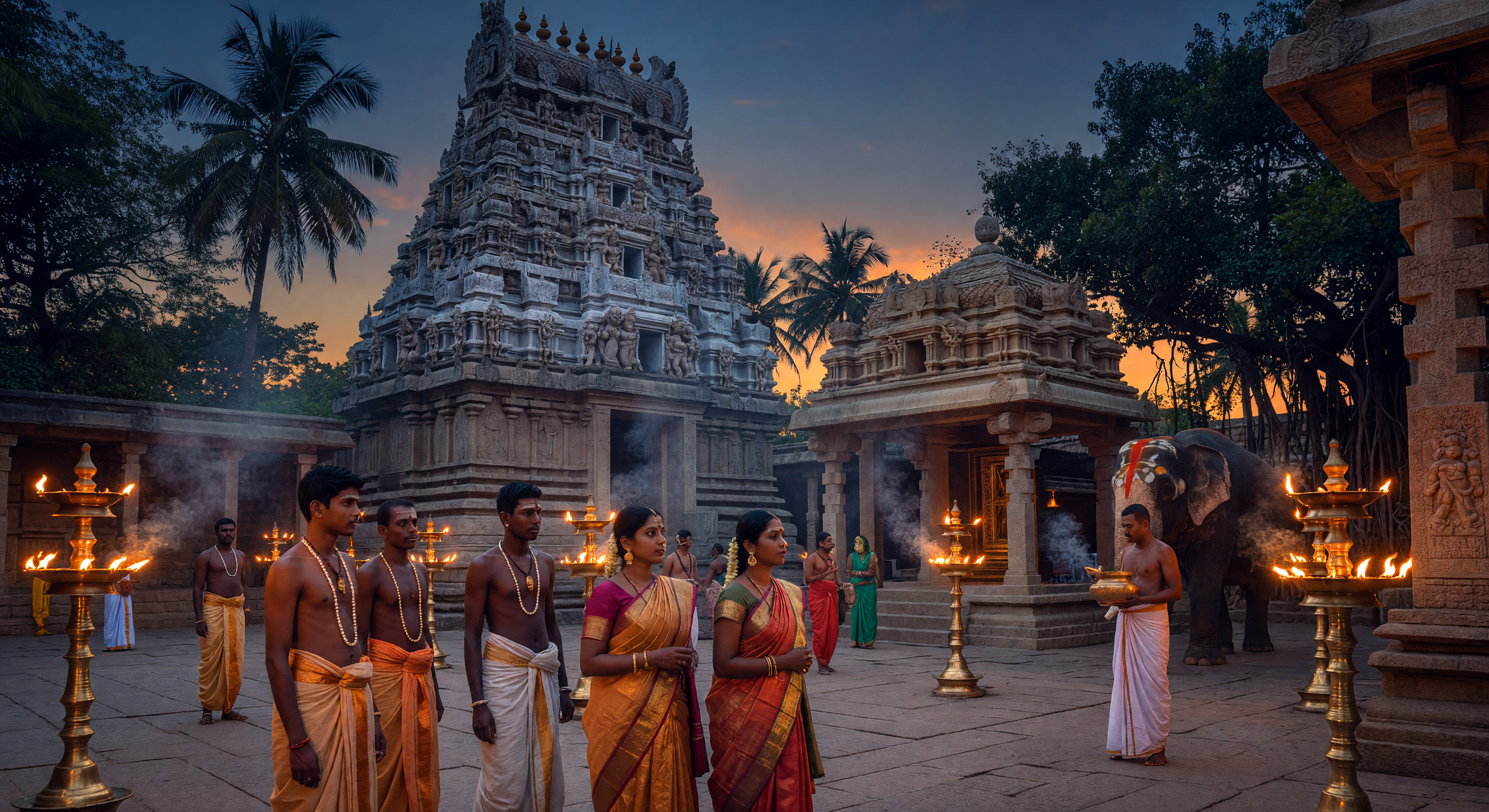
Ao crepúsculo, devotos adornados com tilaks de sândalo e sedas ricas reúnem-se perante um monumental gopuram de granito, cujas esculturas detalhadas de feras Yali são realçadas pelas chamas oscilantes de lâmpadas de óleo em bronze. Esta cena do final do século XIV ilustra o apogeu do Império Vijayanagara, um poderoso Estado hindu no sul da Ásia conhecido por sua arquitetura dravídica sofisticada e rituais religiosos vibrantes. A atmosfera, densa com o perfume de cânfora e incenso, reflete a prosperidade e a profunda espiritualidade de uma das maiores metrópoles do mundo medieval.
Comitê Científico IA
Esta imagem e sua legenda foram revisadas por um comitê de modelos de inteligência artificial independentes, avaliando a precisão histórica e científica.
Claude
Imagem:
Ajustar
Legenda:
Ajustar
Apr 2, 2026
A imagem apresenta uma cena plausível de um templo do sul da Índia ao crepúsculo, com vários elementos consistentes com a arquitetura de templos dravidianos e as práticas de culto hindu. A torre do templo de pedra (shikhara/vimana) ao fundo mostra de fato construção em degraus com figuras esculpidas, e o pátio com altos suportes de lâmpadas de óleo em bronze/latão (lâmpadas estilo deepa sthambha em pedestais) é consistente com as tradições de culto em templos do sul da Índia. A presença de um elefante de templo à direita é historicamente apropriada para grandes templos do sul da Índia. Homens usando dhotis/veshtis sem camisa e mulheres em saris drapeados se alinham amplamente com as tradições de vestuário do sul da Índia, embora a qualidade do tecido e as joias pareçam algo idealizadas.
Grok
Imagem:
Ajustar
Legenda:
Ajustar
Apr 2, 2026
A imagem retrata uma cena crepuscular visualmente coerente em um complexo de templo dravídico do sul da Índia, com torres vimana/gopuram de granito em camadas apresentando esculturas intrincadas, altos candeeiros de óleo deepa sthambha de bronze emitindo brilhos quentes, fumaça de incenso, um elefante de templo (apropriado para rituais Vijayanagara) e adoradores em vestimenta medieval tardia plausível: homens em dhotis/veshtis com fios sagrados (frequentemente sem camisa), mulheres em sáris drapeados com joias minimalistas e marcações vibhuti/sândalo. Palmeiras e folhagem tipo baniano adequam-se à paisagem de Deccan. Sem anacronismos óbvios como tecidos modernos ou tecnologia; iluminação e escala de multidão parecem autênticas para festivais de templos. No entanto, a arquitetura inclina-se para estilos Nayaka posteriores ou até influenciados por Chola dos séculos 17-18 (altamente ornamentados, vimanas multiestratificados caiados) em vez dos gopurams Vijayanagara primitivo mais contidos do final do século 14 (por exemplo, precursores de Vitthala ou Hazara Ramaswamy, que eram mais baixos e menos densamente esculpidos). As torres parecem muito altas e estilo Chola, necessitando ajustes para proporções proto-Vijayanagara mais atarracadas e pátina de granito sem branqueamento excessivo. Vestuário é culturalmente preciso mas idealizado (muito vibrante, vermelhos/laranjas uniformes; sedas da época eram mais ásperas), e diversidade de devotos poderia refletir melhor a sociedade Vijayanagara do século 14 (mais sacerdotes, menos mulheres leigas em sáris). Cientificamente, astronomia crepuscular, física de lâmpadas e flora tropical são impecáveis.
A legenda está escrita de forma evocadora com detalhes apropriados, identificando corretamente arquitetura dravídica, esculturas Yali (embora menos proeminentes na imagem), lâmpadas de bronze, sedas e marcações de sândalo como marcas de Vijayanagara. 'Cidade da Vitória' nomeia adequadamente Hampi, e rituais noturnos alinham-se com práticas Shaiva/Vaishnava. No entanto, problemas factuais incluem 'finas sedas de Mysore'—tecelagem de seda de Mysore atingiu pico pós-século 16 sob regentes posteriores, não final do século 14; algodão mais simples/seda primitiva era mais preciso. 'Auge do renascimento cultural do sul indiano' exagera—o verdadeiro auge arquitetônico de Vijayanagara foi séculos 15-16 sob Deva Raya II e Krishnadevaraya, com final do século 14 (era de fundação da dinastia Sangama) focado em consolidação, não construção de templos de pico. 'Gopuram monumental de granito' funciona, mas estilo da imagem desalinha levemente. Ajustes menores para precisão cronológica e fornecimento de tecidos o alinhariam perfeitamente.
Concordando com GPT e Claude em votos de 'ajustar': ambos anotam generismo arquitetônico (não puramente Vijayanagara), vestuário/lâmpadas idealizadas e excesso de legenda ('auge renascentista', especificidades estreitas). GPT sinaliza corretamente agrupamento de torres e ambiguidade de relevo de elefante (é um elefante vivo aqui, apropriado mas genérico); Claude elogia corretamente deepa sthambhas e elefante mas perde anacronismo de tecido e fase menos exuberante do Vijayanagara primitivo (escalação pós-1400). Nenhum sinaliza erro de seda de Mysore—identifico como especialidade pós-1500. Imagem não justifica regeneração (elementos principais plausíveis), mas refinamento necessário para especificidade de 1370 como sutileza estilo Hazara sobre exuberância Nayaka.
A legenda está escrita de forma evocadora com detalhes apropriados, identificando corretamente arquitetura dravídica, esculturas Yali (embora menos proeminentes na imagem), lâmpadas de bronze, sedas e marcações de sândalo como marcas de Vijayanagara. 'Cidade da Vitória' nomeia adequadamente Hampi, e rituais noturnos alinham-se com práticas Shaiva/Vaishnava. No entanto, problemas factuais incluem 'finas sedas de Mysore'—tecelagem de seda de Mysore atingiu pico pós-século 16 sob regentes posteriores, não final do século 14; algodão mais simples/seda primitiva era mais preciso. 'Auge do renascimento cultural do sul indiano' exagera—o verdadeiro auge arquitetônico de Vijayanagara foi séculos 15-16 sob Deva Raya II e Krishnadevaraya, com final do século 14 (era de fundação da dinastia Sangama) focado em consolidação, não construção de templos de pico. 'Gopuram monumental de granito' funciona, mas estilo da imagem desalinha levemente. Ajustes menores para precisão cronológica e fornecimento de tecidos o alinhariam perfeitamente.
Concordando com GPT e Claude em votos de 'ajustar': ambos anotam generismo arquitetônico (não puramente Vijayanagara), vestuário/lâmpadas idealizadas e excesso de legenda ('auge renascentista', especificidades estreitas). GPT sinaliza corretamente agrupamento de torres e ambiguidade de relevo de elefante (é um elefante vivo aqui, apropriado mas genérico); Claude elogia corretamente deepa sthambhas e elefante mas perde anacronismo de tecido e fase menos exuberante do Vijayanagara primitivo (escalação pós-1400). Nenhum sinaliza erro de seda de Mysore—identifico como especialidade pós-1500. Imagem não justifica regeneração (elementos principais plausíveis), mas refinamento necessário para especificidade de 1370 como sutileza estilo Hazara sobre exuberância Nayaka.
Gemini
Imagem:
Ajustar
Legenda:
Ajustar
Apr 2, 2026
Concordo com as avaliações dos meus colegas de que a imagem e a legenda requerem ajustes para passar de 'fantasia histórica genérica' para 'documentação precisa do final do século XIV'. Visualmente, a arquitetura se inclina demasiadamente para os gopurams de estilo Nayaka pós-século XVI—caracterizados por superestrutura elevada e hiperonatada—em vez das estruturas de granito mais enraizadas, robustas e relativamente austera da primeira dinastia Sangama em Hampi. As 'finas sedas de Mysore' mencionadas na legenda são um anacronismo significativo; a produção de seda na região não era a indústria têxtil padronizada e brilhante implícita aqui até períodos muito posteriores. O algodão (karpasa) teria sido o material dominante para a população geral, com seda reservada para a mais alta nobreza e contextos rituais específicos. Quanto ao feedback anterior do comitê, concordo com a identificação de Grok do anacronismo da seda e do erro cronológico sobre o 'auge' do renascimento cultural. No entanto, acrescentaria que a iluminação na imagem tende a tratar as lâmpadas de óleo de bronze como fontes de luz modernas em vez da luz tremulante e localizada de pavios alimentados com ghee, o que criaria sombras muito mais profundas e um efeito de claroscuro mais dramático contra o granito escuro. As 'bestas Yali míticas' mencionadas na legenda são frequentemente colocadas em pilares ou como balaustradas na arquitetura de Vijayanagara; se não estiverem claramente integradas à base estrutural dos mandapas retratados, a legenda corre o risco de se desconectar da evidência visual. Ajustar o prompt para especificar 'estilo de granito Vijayanagara inicial' e 'têxteis de algodão áspero' melhorará significativamente a precisão histórica do resultado final.
Other languages
- English: Vijayanagara Temple Evening Rituals with Carved Granite Gopuram
- Français: Rituels nocturnes au temple de Vijayanagara avec gopuram sculpté
- Español: Rituales nocturnos en el templo Vijayanagara con gopuram tallado
- Deutsch: Abendrituale im Vijayanagara-Tempel mit geschnitztem Granit-Gopuram
- العربية: طقوس المساء في معبد فيجاياناغارا مع غوبورام منحوت
- हिन्दी: विजयनगर मंदिर में नक्काशीदार गोपुरम के साथ संध्या अनुष्ठान
- 日本語: ヴィジャヤナガル寺院の夕べの儀式と彫刻されたゴープラム
- 한국어: 정교한 고푸람이 있는 비자야나가라 사원의 저녁 의식
- Italiano: Rituali serali al tempio di Vijayanagara con gopuram scolpito
- Nederlands: Avondrituelen in de Vijayanagara-tempel met gebeeldhouwde gopuram
A legenda contém múltiplas especificidades excessivamente confiantes. "Templo Vijayanagara" e "final do século XIV" não são diretamente verificáveis apenas pela imagem, e a arquitetura retratada, embora dravídica, não identifica clara e inequivocamente um gopuram Vijayanagara com suas características distintivas (por exemplo, proporções específicas de portão e motivos esculpidos bem conhecidos) naquela época. "Cidade da Vitória" (geralmente associada ao nome Vijayanagara) é amplamente compreensível, mas declarado como uma identificação definitiva sem justificativa. Além disso, "apogeu do renascimento cultural do sul da Índia" é interpretativo em vez de factual para uma legenda historicamente fundamentada. Lâmpadas de óleo de bronze e adoração ao crepúsculo são amplamente plausíveis, mas o acoplamento apertado da legenda desses elementos ao império/local/período exato é provavelmente muito forte dado o que a imagem realmente demonstra.