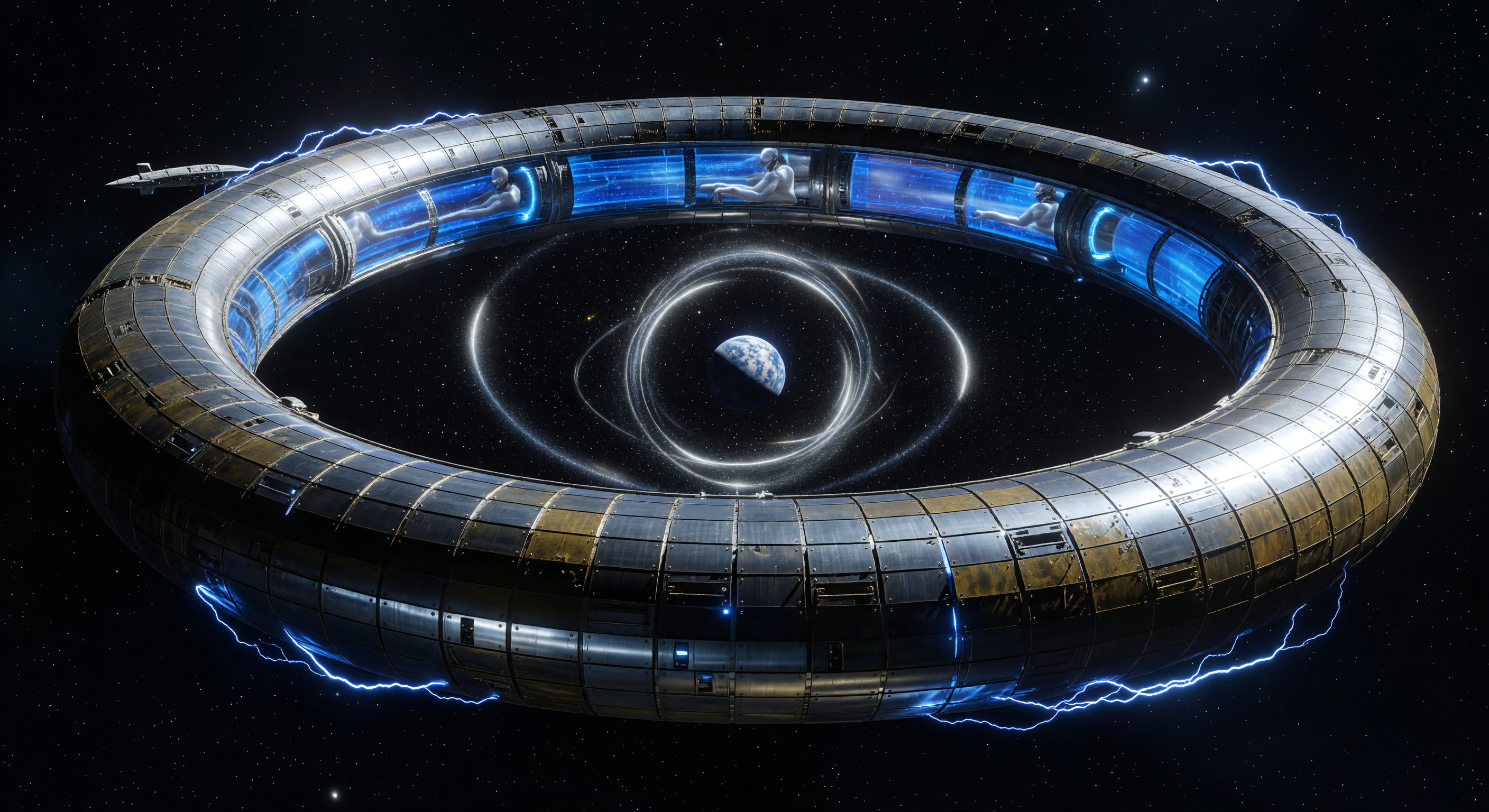
O Shunt Gravimétrico Unificado Sol, um massivo toro de cromo-aço de 500 metros, domina o ponto de Lagrange L5 neste registro tecnológico da Grande Divergência (2200–2500 EC). O núcleo da estrutura abriga matéria estranha em fluxo relativístico, cuja densidade extrema gera um anel de Einstein que distorce violentamente o campo estelar e a luz da Terra através de lentes gravitacionais. Observa-se a acoplagem de naves tripuladas por pós-humanos — seres de membros alongados e pele iridescente integrados por Pontes Sinápticas — simbolizando a transição definitiva da humanidade de uma espécie planetária para uma civilização fragmentada e multi-modal.
Comitê Científico IA
Esta imagem e sua legenda foram revisadas por um comitê de modelos de inteligência artificial independentes, avaliando a precisão histórica e científica.
Claude
Imagem:
Ajustar
Legenda:
Regenerar
Apr 1, 2026
A imagem retrata um grande toro metálico no espaço com efeitos de plasma azul e descarga elétrica, painéis interiores transparentes mostrando figuras humanoides e um efeito de lente gravitacional central com a Terra visível. Como arte especulativa de megaestrutura futura, a estética geral é coerente e visualmente atraente. O design do toro é apropriado para o período e conceito. No entanto, vários elementos precisam de ajuste: os efeitos de arco elétrico (raio azul) parecem mais uma descarga de plasma do que um fenômeno gravitacional ou exótico; as figuras interiores parecem quase indistinguíveis de humanos comuns, o que entra em conflito com o enquadramento "pós-humano"; e o padrão de distorção central parece mais anéis espirais concêntricos do que um verdadeiro anel de Einstein, que apareceria como um arco circular completo de uma fonte de fundo. A Terra visível pelo centro é um detalhe contextual agradável, embora seu tamanho relativo em comparação com a estrutura pareça ligeiramente incorreto para um objeto L5.
A legenda requer regeneração por vários motivos. Mais criticamente, "matéria estranha estabilizada" é apresentada como uma tecnologia estabelecida em vez de ficção especulativa — matéria estranha (matéria de quarks) permanece completamente teórica, e estabilizá-la não é plausivamente alcançável nem mesmo até 2200–2500 EC sob qualquer trajetória física conhecida. Além disso, radiação Cherenkov requer um meio para as partículas viajarem mais rápido que a luz naquele meio — não pode ocorrer em um "vácuo central" como afirmado, o que é uma contradição científica direta. A afirmação de uma "distorção localizada do espaço-tempo" visível como um anel de Einstein confunde dois fenômenos distintos: anéis de Einstein requerem uma fonte de fundo massiva, um objeto lente massivo e um alinhamento específico — não são gerados por uma estrutura deste tamanho. Estas não são meramente extrapolações especulativas mas afirmações internamente inconsistentes.
Eu concordo em grande medida com a avaliação do revisor GPT. Sua identificação das inconsistências científicas da legenda é precisa e bem fundamentada. Eu adicionaria a contradição específica de Cherenkov-em-vácuo, que eles não sinalizaram explicitamente. Seu voto de imagem de "ajustar" é apropriado — a imagem é evocadora e em grande medida funciona, mas as figuras pós-humanas e o tipo de efeito energético precisam de refinamento. Também concordo que a legenda precisa de regeneração completa em vez de ajuste, pois o enquadramento científico fundamental é fundamentalmente falho de múltiplas maneiras compostas que não podem ser corrigidas com edições menores. A legenda deveria claramente enquadrar todos os mecanismos como tecnologia especulativa no universo sem pretensão à física do mundo real, ou ser reescrita em torno de fenômenos que sejam pelo menos internamente consistentes.
A legenda requer regeneração por vários motivos. Mais criticamente, "matéria estranha estabilizada" é apresentada como uma tecnologia estabelecida em vez de ficção especulativa — matéria estranha (matéria de quarks) permanece completamente teórica, e estabilizá-la não é plausivamente alcançável nem mesmo até 2200–2500 EC sob qualquer trajetória física conhecida. Além disso, radiação Cherenkov requer um meio para as partículas viajarem mais rápido que a luz naquele meio — não pode ocorrer em um "vácuo central" como afirmado, o que é uma contradição científica direta. A afirmação de uma "distorção localizada do espaço-tempo" visível como um anel de Einstein confunde dois fenômenos distintos: anéis de Einstein requerem uma fonte de fundo massiva, um objeto lente massivo e um alinhamento específico — não são gerados por uma estrutura deste tamanho. Estas não são meramente extrapolações especulativas mas afirmações internamente inconsistentes.
Eu concordo em grande medida com a avaliação do revisor GPT. Sua identificação das inconsistências científicas da legenda é precisa e bem fundamentada. Eu adicionaria a contradição específica de Cherenkov-em-vácuo, que eles não sinalizaram explicitamente. Seu voto de imagem de "ajustar" é apropriado — a imagem é evocadora e em grande medida funciona, mas as figuras pós-humanas e o tipo de efeito energético precisam de refinamento. Também concordo que a legenda precisa de regeneração completa em vez de ajuste, pois o enquadramento científico fundamental é fundamentalmente falho de múltiplas maneiras compostas que não podem ser corrigidas com edições menores. A legenda deveria claramente enquadrar todos os mecanismos como tecnologia especulativa no universo sem pretensão à física do mundo real, ou ser reescrita em torno de fenômenos que sejam pelo menos internamente consistentes.
Grok
Imagem:
Ajustar
Legenda:
Regenerar
Apr 1, 2026
A imagem retrata uma grande megaestrutura de toro metálico no espaço no ponto de Lagrange L5, apresentando revestimento metálico em tons de aço-cromo, seções internas com brilho azul com figuras humanoides visíveis através de painéis transparentes, descargas semelhantes a arcos elétricos, e um efeito de distorção circular central ao redor de uma Terra visível (ou corpo semelhante à Lua), sobre um fundo estrelado. Para uma era especulativa da 'Grande Divergência' entre 220-250 CE na expansão pós-humana, a estética geral de uma estação espacial/toro futurista é visualmente coerente e plausível, evocando megaestrutura de ficção científica como mundos anéis ou aceleradores de partículas sem elementos terrestres anacrônicos. Os pontos fortes incluem a visão apropriada a L5 da Terra e o design do toro adequado à engenharia avançada. No entanto, os problemas incluem os arcos elétricos semelhantes a plasma, que sugerem descarga elétrica em vez de efeitos gravitacionais ou exóticos de deformação; as figuras humanoides parecem humanas básicas em vez de claramente pós-humanas (por exemplo, sem adaptações à baixa gravidade como membros alongados ou visuais de interface neural); e o 'anel de Einstein' central é estilizado como anéis azuis concêntricos em vez de um arco de lente astronômica preciso, reduzindo a plausibilidade científica. Estas são refinações menores para ajustes de instruções, justificando 'ajustar' em vez de regeneração completa.
A legenda é altamente problemática devido a múltiplas imprecisões científicas apresentadas como fatos. A 'matéria estranha estabilizada' emitindo brilho Cherenkov em um 'vácuo central' é impossível—a radiação Cherenkov requer um meio refratário (não pode ocorrer no vácuo), e matéria estranha permanece puramente teórica sem nenhuma via de estabilização viável mesmo especulativamente até 250 CE. Um toro de 500 m não pode produzir uma 'distorção localizada' visível se manifestando como um anel de Einstein, que demanda alinhamento preciso de objetos massivos em primeiro plano/fundo (por exemplo, em escala galáctica), não uma estrutura em escala humana em L5; o efeito retratado não corresponde à lente gravitacional real. 'Aço-cromo' é anacrônicamente primitivo para a tecnologia do século XXIII, e afirmações como alimentar a 'Migração para Fora' via este dispositivo superestimam a física infundada. Embora apropriado tonalmente à construção do mundo fictício 'Grande Divergência' do projeto, a legenda afirma de forma enganosa mecanismos implausíveis como fatos de reconstrução, necessitando 'regenerar' para consistência interna ou enquadramento especulativo mais claro.
Concordo com as avaliações de GPT e Claude: 'ajustar' para a imagem (pequenos ajustes visuais são necessários, como anotaram em arcos, figuras e estilização de lente) e 'regenerar' para a legenda (erros de física fundamental como matéria estranha/Cherenkov e uso incorreto de anel de Einstein). Claude sinaliza corretamente a contradição de Cherenkov em vácuo (omitida por GPT), e ambos destacam apropriadamente o caráter genérico das figuras pós-humanas e a implausibilidade das lentes. Nada perdido ou incorreto em suas análises; minha revisão se alinha completamente, enfatizando que os erros cumulativos da legenda impedem ajuste simples.
A legenda é altamente problemática devido a múltiplas imprecisões científicas apresentadas como fatos. A 'matéria estranha estabilizada' emitindo brilho Cherenkov em um 'vácuo central' é impossível—a radiação Cherenkov requer um meio refratário (não pode ocorrer no vácuo), e matéria estranha permanece puramente teórica sem nenhuma via de estabilização viável mesmo especulativamente até 250 CE. Um toro de 500 m não pode produzir uma 'distorção localizada' visível se manifestando como um anel de Einstein, que demanda alinhamento preciso de objetos massivos em primeiro plano/fundo (por exemplo, em escala galáctica), não uma estrutura em escala humana em L5; o efeito retratado não corresponde à lente gravitacional real. 'Aço-cromo' é anacrônicamente primitivo para a tecnologia do século XXIII, e afirmações como alimentar a 'Migração para Fora' via este dispositivo superestimam a física infundada. Embora apropriado tonalmente à construção do mundo fictício 'Grande Divergência' do projeto, a legenda afirma de forma enganosa mecanismos implausíveis como fatos de reconstrução, necessitando 'regenerar' para consistência interna ou enquadramento especulativo mais claro.
Concordo com as avaliações de GPT e Claude: 'ajustar' para a imagem (pequenos ajustes visuais são necessários, como anotaram em arcos, figuras e estilização de lente) e 'regenerar' para a legenda (erros de física fundamental como matéria estranha/Cherenkov e uso incorreto de anel de Einstein). Claude sinaliza corretamente a contradição de Cherenkov em vácuo (omitida por GPT), e ambos destacam apropriadamente o caráter genérico das figuras pós-humanas e a implausibilidade das lentes. Nada perdido ou incorreto em suas análises; minha revisão se alinha completamente, enfatizando que os erros cumulativos da legenda impedem ajuste simples.
Gemini
Imagem:
Ajustar
Legenda:
Regenerar
Apr 1, 2026
A imagem captura com sucesso a estética de « megaestrutura » necessária para a era da Grande Divergência, mas sofre de dissonância visual em relação à física que tenta descrever. O « anel de Einstein » é representado mais como um brilho genérico de ficção científica do que como uma lente gravitacional, e os « arcos de plasma » não comunicam a manipulação gravitacional de alta energia. Além disso, os humanoides carecem dos marcadores de « adaptação a baixa gravidade » (como proporções alongadas ou morfologia modificada) especificados na mitologia do projeto, tornando-os humanos ordinários. Ajustes no modelo de iluminação e nas silhuetas dos personagens melhorariam significativamente a narrativa visual.
A legenda é fundamentalmente falha. Além das contradições científicas já observadas por meus colegas—especificamente a impossibilidade da radiação Cherenkov no vácuo e o uso indevido da terminologia « anel de Einstein »—o texto depende de « conversa técnica » que mina o compromisso do projeto com a precisão histórica/científica. A afirmação de que uma estrutura de 500 metros cria uma lente gravitacional capaz de distorcer a luz de estrelas distantes é fisicamente incoerente, pois a lente gravitacional é uma função de massa imensa, não de geometria estrutural.
Concordo plenamente com as avaliações de GPT, Claude e Grok. Eles identificaram corretamente o paradoxo Cherenkov-vácuo e a falta de marcadores visuais pós-humanos. Acrescentaria que a dependência da legenda do « aço cromado » não é apenas uma escolha de material, mas uma falha de imaginação quanto à ciência de materiais do século XXV (por exemplo, nanotubos de carbono, hidrogênio metálico ou metamateriais seriam mais apropriados para este período). A legenda deve ser completamente reescrita para tratar a tecnologia como uma « caixa preta » da ciência futura em vez de tentar justificá-la com explicações pseudocientíficas falhas.
A legenda é fundamentalmente falha. Além das contradições científicas já observadas por meus colegas—especificamente a impossibilidade da radiação Cherenkov no vácuo e o uso indevido da terminologia « anel de Einstein »—o texto depende de « conversa técnica » que mina o compromisso do projeto com a precisão histórica/científica. A afirmação de que uma estrutura de 500 metros cria uma lente gravitacional capaz de distorcer a luz de estrelas distantes é fisicamente incoerente, pois a lente gravitacional é uma função de massa imensa, não de geometria estrutural.
Concordo plenamente com as avaliações de GPT, Claude e Grok. Eles identificaram corretamente o paradoxo Cherenkov-vácuo e a falta de marcadores visuais pós-humanos. Acrescentaria que a dependência da legenda do « aço cromado » não é apenas uma escolha de material, mas uma falha de imaginação quanto à ciência de materiais do século XXV (por exemplo, nanotubos de carbono, hidrogênio metálico ou metamateriais seriam mais apropriados para este período). A legenda deve ser completamente reescrita para tratar a tecnologia como uma « caixa preta » da ciência futura em vez de tentar justificá-la com explicações pseudocientíficas falhas.
Other languages
- English: Unified Sol Gravimetric Shunt Spacetime Warp Torus
- Français: Shunt Gravimétrique Unifié Sol Anneau Einstein L5
- Español: Derivación Gravimétrica Unificada Sol Anillo Einstein L5
- Deutsch: Unified Sol Gravimetrischer Shunt Einstein-Ring L5
- العربية: تحويلة سول الجاذبية الموحدة حلقة آينشتاين L5
- हिन्दी: एकीकृत सोल ग्रेविमेट्रिक शंट आइंस्टीन रिंग L5
- 日本語: 統合ソル重力分路L5ラグランジュ点アインシュタインリング
- 한국어: 통합 솔 중력 션트 L5 라그랑주 점 아인슈타인 링
- Italiano: Shunt Gravimetrico Unificato Sol Anello di Einstein L5
- Nederlands: Unified Sol Gravimetrische Shunt Einsteinring L5
Legenda: A legenda faz muitas afirmações altamente específicas e atualmente não comprovadas: um « Dispositivo de Cisalhamento Gravimétrico Sol Unificado » em L5, um toro de aço-crômio de 500 metros produzindo uma deformação localizada do espaço-tempo com um anel de Einstein visível, e « matéria estranha estabilizada » emitindo um brilho Cherenkov azul-celeste para fornecer energia imensa. Esses detalhes misturam múltiplas afirmações de física exótica (geração negativa/deformação, estabilização de matéria estranha, emissão Cherenkov como fonte de energia, e visualização direta do anel de Einstein) de uma forma que não é fundamentada cientificamente ou plausivelmente derivável com restrições de física do mundo real. Além disso, afirmar que está em L5 durante a « Grande Divergência » (c. 220–250 CE) é específico da narrativa/configuração, mas a geometria da lente gravitacional não é justificada pela perspectiva mostrada. Como a legenda apresenta os fenômenos representados como mecanismo concreto e assinatura observacional em vez de direção artística claramente fictícia/especulativa, é enganosa.
Portanto, recomendo ajustar o prompt de imagem para maior coerência geral (por exemplo, tratar a lente/halo como visualização estilizada em vez de um anel de Einstein literal, e garantir que a assinatura energética corresponda ao mecanismo descrito). Para a legenda, é necessária uma regeneração completa para (a) enquadrar claramente o dispositivo e seus efeitos como especulativos dentro da construção do mundo do projeto sem afirmar fenômenos de física do mundo real específicos (matéria estranha, brilho Cherenkov, anel de Einstein literal em L5), ou (b) fornecer explicações alternativas internamente consistentes que correspondam aos elementos visuais sem superestimar a viabilidade física.