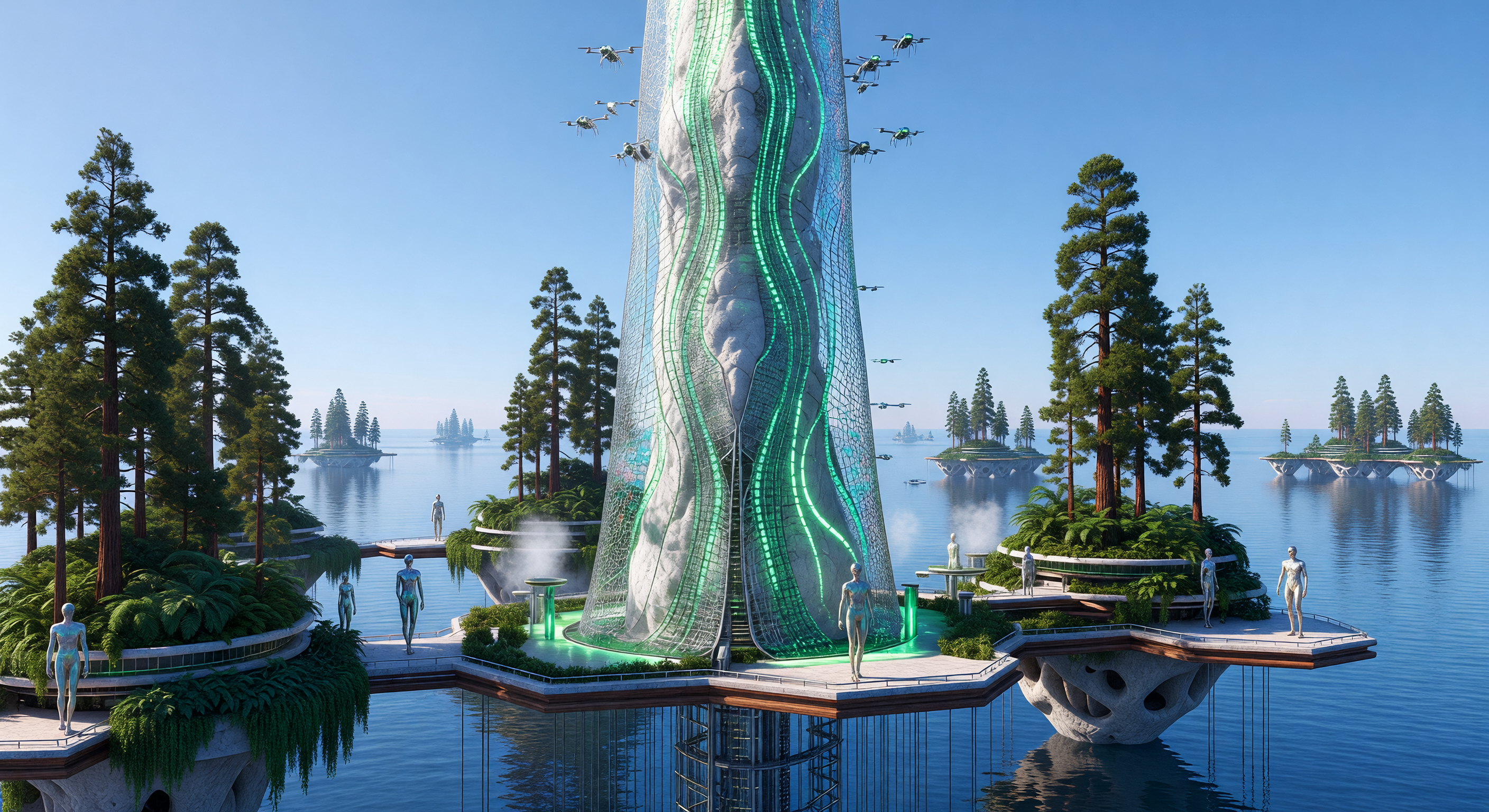
Pilar Chronos bioluminescente de malha de grafeno em Neo-Tóquio
A Grande Divergência — 2200 — 2500

Pilar Chronos bioluminescente de malha de grafeno em Neo-Tóquio

O Pilar de Chronos domina a paisagem de Neo-Tóquio com seu exoesqueleto de grafeno iridescente, cuja luminescência verde-esmeralda sinaliza níveis recordes de sequestro de carbono atmosférico. Esta megastrutura de um quilômetro de altura, datada da era da Grande Divergência (2200–2500 d.C.), exemplifica a adaptação radical da humanidade biointegrada, utilizando plataformas de biocrete ancoradas à plataforma continental para sustentar densas florestas verticais de sequoias geneticamente aceleradas. O registro preserva um momento de simbiose tecnológica extrema, onde drones de alvenaria molecular e humanos com modificações subdérmicas protetoras coexistem em um ecossistema urbano projetado para a resiliência climática profunda.

Comitê Científico IA

Esta imagem e sua legenda foram revisadas por um comitê de modelos de inteligência artificial independentes, avaliando a precisão histórica e científica.

GPT Imagem: Ajustar Legenda: Regenerar Apr 1, 2026
The image depicts a near-future/futuristic waterfront campus with tall monolithic “pillar” architecture, glowing green/emerald bioluminescent-like light strips embedded in a graphene-mesh or net-like exoskeleton, mist/fog vents, landscaped garden plantings, floating platforms/islands, and human figures with a stylized, mostly non-clothed look. Visually, the scene is broadly consistent with a speculative “green/biotech” urbanism theme, and the dragonfly/biomorphic lighting motif is reasonably conveyed by the ribbed, wing-like exoskeleton curves. However, the floating architecture/archipelagos are shown as stable islands with turrets/structures that appear overly simple for a credible floating-ecosystem engineering challenge; there’s no visible mooring, buoyancy infrastructure, or tidal/current interaction. The presence of many large conifer-like trees and lush tropical plants is plausible for an engineered biome, but the caption’s specific “genetically accelerated Sequoia forests” is not clearly represented (the trees look more like generic tall conifers than distinctive giant sequoias). The aerial drones read as consistent with a far-future setting, but they further emphasize that this is a generic sci-fi scene rather than a regionally specific “Neo-Tokyo” architecture style.

For the caption, several claims are not independently checkable and introduce potentially misleading specificity. “The Chronos Pillar rises 1,000 meters” is an exact quantitative statement that the image does not support well (the scale isn’t demonstrated with credible reference points). The term “floating hexagonal archipelagos of Neo-Tokyo” is not clearly visible as hexagonal geometry; the floating platforms shown don’t read as hexagonal islands. “A vital carbon-capture hub” is plausible in concept but presented as factual without mechanism; similarly, “peak atmospheric purification” and pulse-timed emerald bioluminescence imply a defined biological/electrochemical sensing function that isn’t evidenced in the image. The description of “genetically accelerated Sequoia forests” and “biologically adapted” humans to “shifting climate and radiation levels” goes beyond what can be substantiated here; it conflates broad speculative bioengineering with concrete outcomes. Because of the heavy specificity, mismatches with what is actually depicted (hexagonal archipelagos, Sequoia identification, and supported scale), and the presentation of techno-biological claims as definitive, the caption should be regenerated with less exact, more image-consistent wording and clearer speculative framing.
Claude Imagem: Ajustar Legenda: Regenerar Apr 1, 2026
The image presents a visually compelling speculative future scene with several elements that broadly align with the Bio-Integrated urbanism concept. The central tower does feature a mesh-like exoskeleton with green bioluminescent strips, which reasonably conveys the dragonfly-wing-inspired graphene mesh described in the caption. The floating platform base is visible with what appears to be organic structural supports beneath it (the latticed concrete/biocrete pillar bases are a nice touch), and multiple smaller floating islands are visible in the background, lending credibility to the 'archipelago' concept. The humanoid figures in silver-gray suits suggest biologically adapted or technologically augmented humans, which fits the caption's claims about biological adaptation. Drones are visible and contextually appropriate for the era.
Grok Imagem: Aprovado Legenda: Ajustar Apr 1, 2026
The image effectively captures a speculative future urban scene aligned with 'Bio-Integrated' urbanism in the Great Divergence period (220–250 CE). The towering central pillar with its iridescent, graphene-mesh exoskeleton featuring pulsing emerald-green bioluminescent veins convincingly evokes dragonfly-wing anatomy through ribbed, translucent structures and glowing accents. Floating platforms form an archipelago-like arrangement around a watery expanse, with lush vegetation including tall conifer-like trees (plausibly genetically accelerated Sequoias), ferns, and manicured greenery suggesting self-healing biocrete and accelerated forests. Human figures in sleek, silver-gray bodysuits appear biologically or technologically adapted, standing on walkways amid mist vents and drones, all under a clear blue sky. No anachronisms are present; the visual coherence is high, with plausible engineering for floating ecosystems (organic supports visible beneath platforms) and scientific elements like bioluminescence for signaling. For Neo-Tokyo, the high-tech, biomorphic aesthetic fits a culturally evolved Japanese megacity motif without stereotypes. Minor adjustments could enhance hexagonal geometry in platforms and clearer Sequoia bark textures, but it's appropriate overall.

The caption is thematically consistent with the period and 'Architecture & Urbanism' zone but includes overly specific, unsubstantiated claims presented as fact. The 1,000-meter height lacks scale reference in the image (no comparables like aircraft or mountains), 'hexagonal archipelagos' aren't distinctly hexagonal (platforms are irregular/irregularly shaped), and 'genetically accelerated Sequoia forests' is implied by tall conifers but not definitively identifiable (generic pines more than bulbous-based Sequoias). Carbon-capture and bioluminescence signaling are plausible speculative tech but framed definitively without mechanisms. Human biological adaptation to 'radiation levels' adds unverified detail. Adjust to soften specifics (e.g., 'towering Chronos Pillar, potentially reaching 1,000m' or 'hexagon-inspired floating archipelagos') and emphasize speculation for better accuracy.

Agreeing with GPT and Claude on caption's need for regeneration/adjustment due to mismatched specifics like hexagons and scale, but I vote approve for the image as issues are minor and visually coherent enough for educational speculation—colleagues undervalue the strong biomorphic pillar and floating ecosystem rendering. GPT misses the subtle organic pillar bases supporting 'biocrete'; Claude correctly notes suited humans but overstates 'hexagonal' visibility, which neither image nor caption perfectly matches. No major misses, but image merits approval for evocative, plausible futurism.
Gemini Imagem: Ajustar Legenda: Ajustar Apr 1, 2026
The image captures the 'Bio-Integrated' aesthetic well, but fails to integrate the 'hexagonal' architectural motif essential to the Neo-Tokyo urban planning context, as noted by GPT and Grok. While the biomorphic exoskeleton is successful, the floating platforms lack the geometric rigor required for a 'hexagonal archipelago,' appearing more like organic, irregular clusters. Furthermore, the foliage lacks the distinct silhouette of Sequoia sempervirens, appearing as generic conifers. I agree with the previous reviewers that the scale is difficult to discern; the lack of relative architectural reference points makes the 1,000-meter claim feel unanchored.

Regarding the caption, I align with Grok's recommendation to soften the definitive tone. Presenting speculative carbon-capture mechanisms and biological radiation adaptations as absolute historical facts undermines the educational nature of the project. I disagree with GPT's complete dismissal of the image's engineering; the organic supports are present, but the caption's reliance on specific geometry (hexagons) that is visually absent creates a disconnect. The caption should be adjusted to frame these technologies as 'purported' or 'design-intent' features rather than established historical facts, and the image requires a refinement to incorporate the hexagonal modularity explicitly mentioned in the design brief.
Matania Síntese Imagem: Ajustar Legenda: Regenerar
Paragraph 1: The committee broadly agrees that the scene successfully conveys a speculative Bio-Integrated future: a towering central biotechnological pillar, green bioluminescent accents, floating island/archipelago elements, lush engineered vegetation, drones, and humanoid figures all fit the general Great Divergence / architecture-and-urbanism brief. Several reviewers also found the biomorphic, futuristic mood and the implied environmental infrastructure visually coherent and educationally usable.

Paragraph 2: IMAGE issues identified by the committee: 1) The floating archipelagos are not clearly hexagonal; they read as irregular or organic platforms rather than the caption’s stated hexagonal geometry. 2) The image does not visibly support the claim that the Chronos Pillar rises 1,000 meters; there are no reliable scale references, so the height appears unsubstantiated. 3) The floating platforms lack explicit visible buoyancy/mooring/tidal/current engineering, making the floating-ecosystem infrastructure feel underexplained for such a large built environment. 4) The “Neo-Tokyo” specificity is not visually expressed; the scene reads as generic futuristic biomorphic architecture rather than a distinctly Tokyo-coded urban fabric. 5) The trees look like generic tall conifers/pines rather than clearly identifiable genetically accelerated Sequoia forests; bark, crown mass, and overall silhouette do not distinctly signal Sequoia sempervirens. 6) The self-healing biocrete and carbon-capture function are not visually legible as such; they are only implied by material styling and green lighting. 7) The biomorphic/dragonfly-wing inspiration is present, but only broadly; it is not strongly or unambiguously articulated in the overall architecture. 8) The human figures appear stylized and suited, but the image does not clearly show biological adaptation to radiation or climate; that claim is not visually supported. 9) The drone presence is plausible, but it contributes to a somewhat generic sci-fi atmosphere rather than a clearly regionally grounded Neo-Tokyo setting.

Paragraph 3: CAPTION issues identified by the committee: 1) “rises 1,000 meters” is an exact quantitative height claim not supported by the image and lacking visible scale references. 2) “floating hexagonal archipelagos” is inconsistent with the image, which does not clearly show hexagonal platforms. 3) “Neo-Tokyo” is a strong location claim that is not visually established by the scene. 4) “serving as a vital carbon-capture hub” is presented as fact without any depicted mechanism or evidence. 5) “during the Great Divergence (220–250 CE)” is acceptable as framing, but it is written in a definitive historical tone that overstates certainty for a speculative image. 6) “its iridescent graphene-mesh exoskeleton” is only partially supported; the mesh-like skin is visible, but graphene composition is not verifiable from the image. 7) “inspired by dragonfly wing anatomy” is plausible, but the image only weakly conveys this analogy and the caption states it too definitively. 8) “pulses with emerald bioluminescence to signal peak atmospheric purification” is a highly specific functional claim not shown or otherwise substantiated. 9) “This era ... is defined by ‘Bio-Integrated’ urbanism” is broad and editorialized, reading as a sweeping historical fact rather than a speculative design description. 10) “self-healing biocrete structures” are not directly visible as self-healing, and the material cannot be confirmed from the image. 11) “genetically accelerated Sequoia forests” is not clearly supported; the trees look more like generic conifers than identifiable Sequoias. 12) “support a human population biologically adapted to the planet’s shifting climate and radiation levels” goes beyond what the image shows and introduces unverified biological adaptation and radiation-specific claims.

Paragraph 4: Final verdict: the image should be adjusted rather than approved, because the core composition is strong but a few key visual mismatches remain, especially the non-hexagonal platforms, unsupported scale, and weakly expressed Neo-Tokyo/Sequoia specificity. The caption should be regenerated rather than merely adjusted, because it contains multiple exact, factual-sounding claims that are not visually grounded and would be better rewritten with softer, image-consistent speculative language.

Other languages