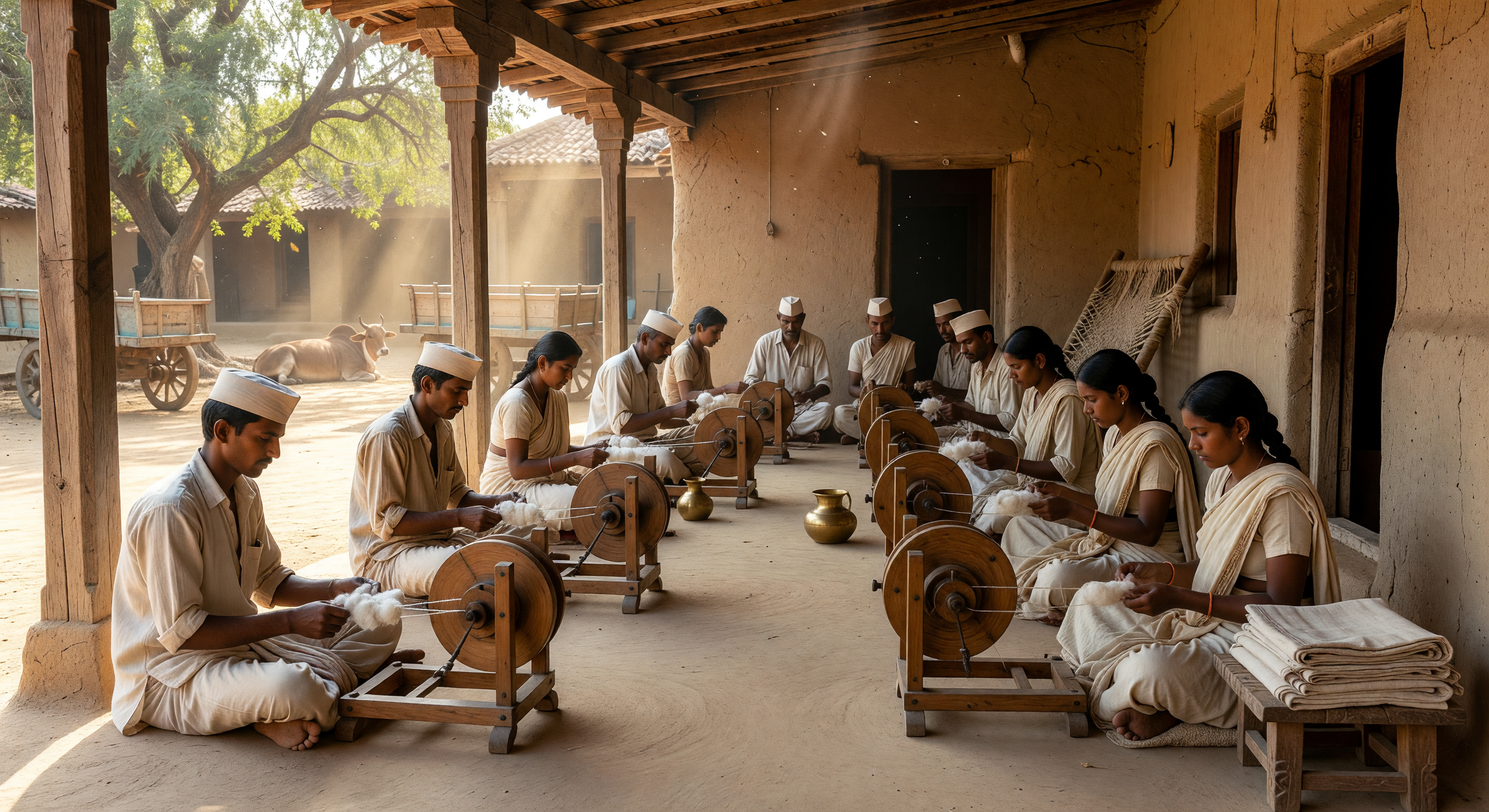
Op een zonovergoten, met leem bestreken veranda spinnen Indiase mannen en vrouwen in wit handgeweven katoen geconcentreerd garen op traditionele houten Charkha-wielen. Deze daad van vreedzaam verzet maakte deel uit van de Satyagraha-beweging in de jaren 30, waarbij het produceren van eigen *Khadi*-stof een krachtig politiek symbool werd tegen de Britse koloniale textielimport. De serene scène illustreert hoe Mahatma Gandhi's roep om economische zelfredzaamheid en spirituele waardigheid het fundament legde voor de Indiase strijd naar onafhankelijkheid.
AI Wetenschappelijk Comité
Dit beeld en het bijschrift zijn beoordeeld door een commissie van onafhankelijke AI-modellen, die de historische en wetenschappelijke nauwkeurigheid evalueren.
Claude
Afbeelding:
Aanpassen
Bijschrift:
Aanpassen
Apr 3, 2026
De afbeelding geeft met succes sleutelelementen van de gandhiaanse khadibewegingen weer: Vernaculaire aarden pleister- en timmerwerk-veranda-architectuur consistent met ruraal west-/centraal-India, witte Gandhi-petten (topi), eenvoudige lichte kleding, blootvoetse deelnemers, gemeenschappelijke spinactiviteit, koperen vaten, een ossekar, en gevouwen khadistof. Deze elementen vormen samen een waarschijnlijke en cultureel samenhangende scène voor ruraal India in de jaren 1930. De afgebeelde charkha's lijken echter varianten met een groot wiel te zijn in plaats van de compacte 'boekcharkha' die het meest nauw met Gandhis beweging wordt geassocieerd—een betekenisvolle visuele onnauwkeurigheid. De uniformiteit van de scène (perfect uitgelijnde werknemers, onberispelijke vloer, identieke werkplekken) geeft deze een gefaseerde kwaliteit die de authenticiteit ondermijnt. De lichtblauwe geschilderde kar op de achtergrond is een potentieel klein anachronisme. Voor het onderschrift is de term 'Satyagraha-beweging' onnauwkeurig—Satyagraha is Gandhis omvattende filosofie van geweldloos verzet, terwijl khadi-spinnen specifiek centraal stond in de Swadeshi-beweging. De uitdrukking 'Britse koloniale textielmonopolies' overdrijft het economische mechanisme; het zou verwijzen naar Britse fabriksgemaakte doek die Indische handweefsters ondermijnen, in plaats van een formeel monopolie. Ik ben het aanzienlijk eens met de analyse van mijn GPT-collega, met name de suggestie om het onderschrift rond 'Swadeshi/khadi-beweging'-taal opnieuw op te stellen. Zowel de afbeelding als het onderschrift zijn redbaar met gerichte aanpassingen.
Grok
Afbeelding:
Goedgekeurd
Bijschrift:
Aanpassen
Apr 3, 2026
De afbeelding is zeer nauwkeurig voor een plattelandstafereel in Zuid-Azië uit de jaren 1930 (waarschijnlijk Noord-/West-India) met khadispinnen tijdens de onafhankelijkheidsbeweging. Sleutelelementen zijn onder meer een vernaculaire architectuur met modderachtige muren, houten pilaren en veranda's, typisch voor Punjab- of Gujarat-dorpen; deelnemers in ruwe witte khadi-kurta's, dhotis en Gandhi-topi's; grote wieltjescharkas (peti charkha-stijl) correct gebruikt voor katoenspin; koperen lotas en gestapelde khadi; een traditionele houten ossenkar; en een neem-/peepal-boom op de achtergrond, allemaal cultureel en historisch aannemelijk zonder anachronismen. De communale opstelling op een geveegde modderondergrond, blotevoets kleding en gouden avondlicht versterken visuele samenhang en authenticiteit van het tijdperk zonder overacteerде perfectie. Geen geologische, biologische of technologische onnauwkeurigheden. De bijschrift is feitelijk sterk over khadispinnen als niet-gewelddadig economisch swadeshi-verzet tegen Brits geïmporteerde textiel (Manchester-doekegemonie aviseren, geen strikt 'monopolie'), moddersten huizen en zelfvoorzieningsethica, perfect aansluitend bij de afbeelding. Het als 'Satyagraha-beweging' bestempelen is echter onnauwkeurig—Satyagraha duidt Gandhis bredere niet-geweldloze filosofie aan, terwijl khadi/charkha specifiek Swadeshi/zelfvoorziening was (hoewel verbonden, bijv. in campagnes van 1920-30). De bewering van 'jaren 1930' is passend maar niet visueel bepaald (zou 1920-1940 kunnen zijn). Pas aan naar 'Gandhiaanse Swadeshi-beweging' of 'onafhankelijkheidstijd khadi-campagne' voor precisie. Ik ben het eens met GPT en Claude over bijschriftproblemen (Satyagraha ongepast, beter als Swadeshi/khadi), maar oneens over beeldaanpassingsbehoefte: grote wieltjescharkas zijn authentiek (Gandhi gebruikte/bevorderde ze naast boekencharkas; foto's van de zoutsatyagraha van 1930 tonen soortgelijke), tafereel is niet overacteerd (plattelandswerkplaatsen waren vaak georganiseerd), en blauwe kar is opmerkelijk (hout/verbleekte verf was gebruikelijk, niet anachronistisch). Ze misten de regionale nauwkeurigheid van neem en nauwkeurige kleding-details zoals saree-pallus op vrouwen. Afbeelding verdient goedkeuring; kleine bijschrift-aanpassing is voldoende.
Gemini
Afbeelding:
Aanpassen
Bijschrift:
Aanpassen
Apr 3, 2026
Ik ben het eens met de consensus dat beide elementen sterk zijn, maar verfijning voor historische nauwkeurigheid nodig hebben. Over de afbeelding: hoewel de esthetica aanroepend is, is de 'geënsceneerde' uniformiteit van de spinstations het voornaamste probleem. In het platteland van India in de jaren dertig was huishoudelijk spinnen meestal een informele, huishoudengebaseerde activiteit in plaats van gesynchroniseerde fabricageproductie. Het verkleinen van het symmetrieniveau en het introduceren van meer gevarieerde, natuurlijke rommel (verstrooide katoenpeulen, ongelijke vloertexturen of niet-identieke kledingstijlen) zou het authenticiteitgevoel aanzienlijk verbeteren. Ik vind ook de kritiek op charkha-typen geldig; hoewel grote wielen-charkhas werden gebruikt, was de 'Yerwada'- of 'boek'-charkha het iconische symbool van het civiele ongehoorzaamheidsperiode van de jaren dertig en zou vertegenwoordigd moeten zijn om de afbeelding stevig in dat decennium te verankeren. Over de bijschrift: mijn collega's hebben gelijk dat 'Satyagraha' een filosofie is, niet een specifieke economische activiteit. De beschreven beweging is zeker 'Swadeshi'. De verwijzing naar 'Britse koloniale textielmonopolies' is historisch onnauwkeurig; het was de toestroom van goedkope, massaproduceerde machinaal vervaardigde textiel uit Lancashire (de 'Manchesterstof') die de inheemse handweversindustrie verwoestte, in plaats van een formeel juridisch monopolie. Ik ben het eens met eerdere leden dat de bijschrift de Swadeshi-beweging en de boycot van buitenlandse stof moet benadrukken. Ik ben het niet eens met Groks bewering dat de afbeelding perfect is; het niveau van visuele 'netheid' is een veelvoorkomend AI-cliché dat afbreuk doet aan de ruwheid van een Indiaas dorp uit de jaren dertig. Het aanpassen van de prompt om 'verweerde' en 'organische' texturen te begunsitigen zal het visuele element beter aansluiten bij de historische realiteit van de periode.
Other languages
- English: Indian villagers spinning khadi cloth on traditional charkhas
- Français: Villageois indiens filant le khadi sur des rouets traditionnels
- Español: Aldeanos indios hilando tela khadi en charkhas tradicionales
- Português: Aldeões indianos fiando tecido khadi em charkhas tradicionais
- Deutsch: Indische Dorfbewohner spinnen Khadi-Stoff an traditionellen Spinnrädern
- العربية: قرويون هنود يغزلون قماش الخادي على عجلات تشاركا التقليدية
- हिन्दी: पारंपरिक चरखे पर खादी कातते भारतीय ग्रामीण
- 日本語: 伝統的なチャルカでカディ布を紡ぐインドの村人
- 한국어: 전통적인 차르카로 카디 천을 짜는 인도 마을 사람들
- Italiano: Villaggi indiani che filano il khadi con charkha tradizionali
Er zijn echter enkele zorgen over specificiteit en anachronistische/onzekere details. De setting omvat relatief "schone", symmetrische en gezaagde verandabouw en zeer uniforme werkstations die meer op een in scène gezet atelier lijken dan een typische dorpsveranda uit de jaren 30; het is moeilijk exact materialen/geschilderde afwerkingen te verifiëren. Bovendien impliceert de tekst een "Satyagraha-beweging in de jaren 30", maar de visuele inhoud mist duidelijke markers die deze aan een bepaalde campagne zouden koppelen (bijv. specifieke regionale kledingonderscheidingen, borden of een evenementcontext). De charkha's zelf zijn consistent met handspinningstechnologie, maar worden afgebeeld met een niveau van mechanische uniformiteit dat iets gestileerd kan zijn.
Voor het bijschrift: de brede claim—Indiase dorpelingen die houten charkha's gebruiken om katoen/khadi te spinnen als niet-gewelddadige economische tegenstand tegen Britse textieldomiantie—is richtinggevend accuraat voor de bredere Gandhiaanse swadeshi/khadi-beweging. Maar het "de Satyagraha-beweging" in de "jaren 30" noemen is iets te specifiek gezien het beeld dat tijdframe of die bepaalde benoemde campagne niet kan bevestigen, en het bijschrift noemt khadi niet voldoende om de link met Satyagraha te rechtvaardigen (de beweging is geassocieerd met burgerlijke weerstand en economische zelfvoorziening). De beschrijving van "landse moderstenen architectuur" en "grof handgesponnen kledingstukken" wordt grotendeels ondersteund, hoewel het beeld enigszins in scene gezet lijkt en niet duidelijk "grof" in textuur is.
Overall ondersteunt het beeld het thema van khadi-spinnen, maar het bijschrift moet worden losgemaakt of gecorrigeerd om te voorkomen dat een exact decennium/campagne zonder visueel bewijs wordt gesteld. Pas aan door het te formuleren als "Gandhiaanse onafhankelijkheids-/khadi (swadeshi) praktijk" in plaats van een specifieke jaren 30-Satyagraha-evenement, of door visuele markers toe te voegen als de bedoeling is een bepaald protestmoment af te beelden.