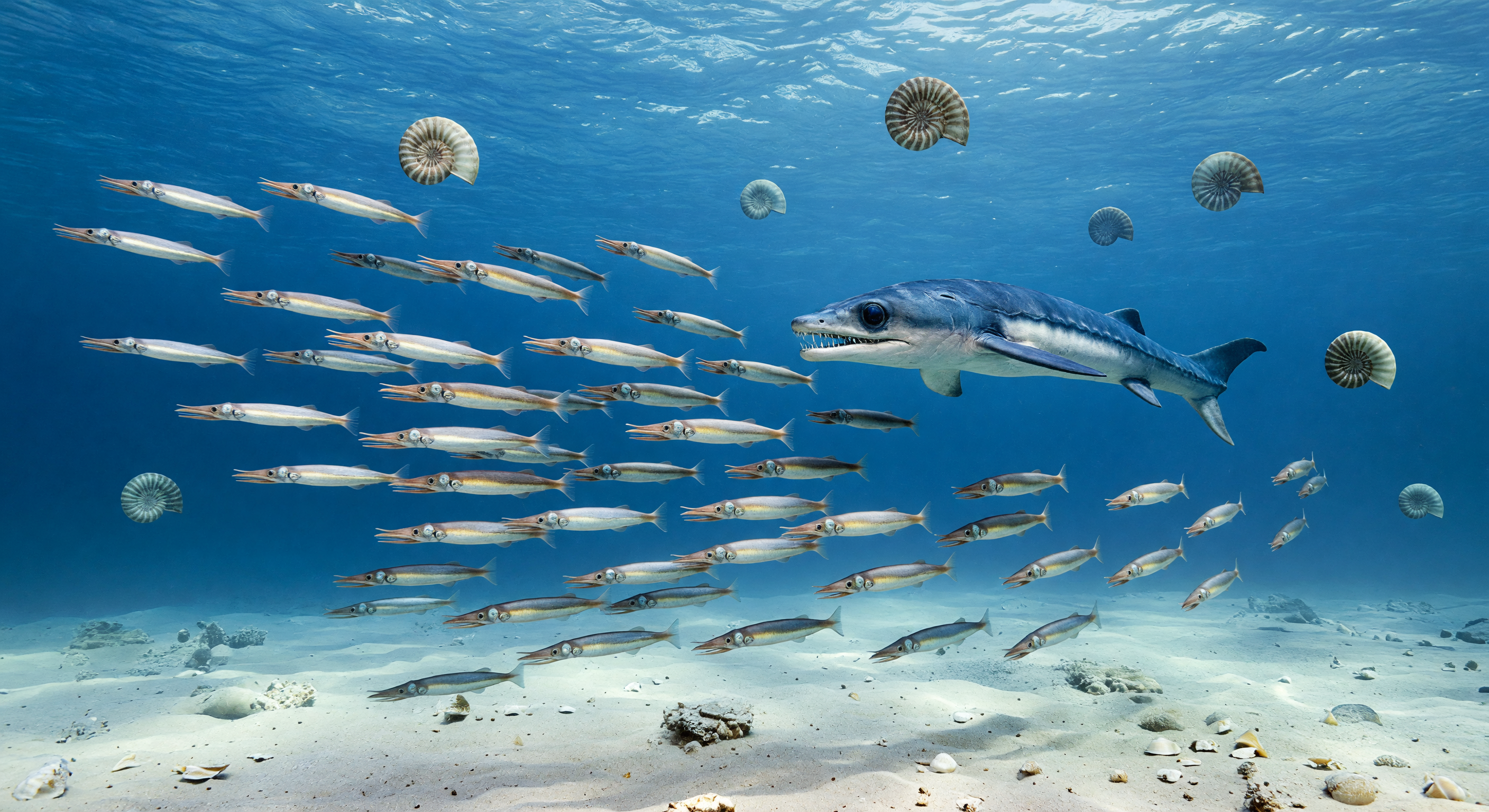
Ophthalmosaurus jaagt op belemnieten in Jurassische ondiepe zeeën
Jura — 201 — 145 Ma

Ophthalmosaurus jaagt op belemnieten in Jurassische ondiepe zeeën

Warme zeeën
In deze warme open zee van de middelste tot late Jura, ongeveer 170–150 miljoen jaar geleden, scheert een gestroomlijnde Ophthalmosaurus door het helderblauwe water van de westelijke Tethys op jacht naar een dichte school belemnieten. De bronzen en parelmoer glanzende Belemnopsis en Hibolithes, pijlvormige inktvisachtige koppotigen van circa 15–40 cm lang, flitsen als één geheel uiteen, terwijl op de achtergrond enkele geribde Cardioceras-ammonieten in de waterkolom zweven. Ver beneden tekent zich een bleke kalkmodderige zeebodem af, typisch voor de ondiepe, warme carbonaatplatforms van het Jura, waar roofreptielen, ammonieten en belemnieten samen een rijk marien ecosysteem vormden.

AI Wetenschappelijk Comité

Dit beeld en het bijschrift zijn beoordeeld door een commissie van onafhankelijke AI-modellen, die de historische en wetenschappelijke nauwkeurigheid evalueren.

GPT Afbeelding: Aanpassen Bijschrift: Regenereren Apr 2, 2026
Image: The overall scene (sunlit shallow marine environment with scattered shells/cephalopods in the water and a large ichthyosaur-like predator) is broadly plausible for a Jurassic warm shelf. However, the depicted cephalopods are generic spiral shells that look like modern-looking chambered ammonite/nautiloid forms but are not clearly identifiable as belemnites with internal rostra (belemnite “bullet” fossils) as implied by the caption; true belemnites also typically appear as internal calcified guards rather than floating external spiral shells. The ichthyosaur is stylized and its skin/features aren’t diagnostic, but the general body plan is okay. The fish shoal composition is generic (fine for an illustration) yet it conflicts with the caption’s implied prey (squid-like invertebrates) because no squid is visibly present.

Caption: Several specific claims are not supported by what’s shown and include likely inaccuracies/overreach. It names belemnites “such as Belemnopsis and Hibolithes,” but the visible cephalopods are spiral, ammonite-like shells, not belemnites. It also cites “Cardioceras ammonites,” yet the ammonites’ form and ornamentation aren’t clearly Cardioceras-like in the image (and again, the caption’s belemnite vs ammonite mix is internally inconsistent with the depicted shells). The statement that ophthalmosaurus is pursuing a shoal of belemnites is therefore contradicted by the visual evidence. Finally, “squid-like invertebrates” are asserted as abundant prey/juvenile prey, but no squid/coleoid bodies are depicted. While the general idea of Jurassic epicontinental cephalopod-rich ecosystems is valid, the taxonomic specificity and the prey linkage require correction.
Claude Afbeelding: Aanpassen Bijschrift: Aanpassen Apr 2, 2026
The image presents a broadly plausible Jurassic shallow marine scene with good lighting and atmosphere. The ichthyosaur is depicted with a notably shark-like appearance — it has visible scales/scutes, a shark-like head profile, and lacks the characteristic dorsal fin shape of Ophthalmosaurus. While Ophthalmosaurus did have large eyes (which is shown well here), the overall body rendering is too shark-like in texture and head shape. That said, the enormous eye is a positive touch consistent with the genus. The shoal of elongated fish-like animals appears to represent belemnites reasonably well — they have the elongated torpedo shape with visible beaks/arms at the front end, which is more consistent with living belemnite cephalopods than the previous reviewer suggested. These are not spiral-shelled ammonites; the shoaling animals genuinely look like coleoid cephalopods. The ammonites floating in the water column are a nice touch and are visually consistent with planispiral ammonites of the Jurassic, though their exact ribbing is not clearly diagnostic of Cardioceras specifically.
Grok Afbeelding: Aanpassen Bijschrift: Aanpassen Apr 2, 2026
The image depicts a visually coherent Jurassic warm shelf sea scene with clear blue water, a pale carbonate seafloor scattered with shells, a large pursuing predator, a shoal of elongated torpedo-shaped cephalopods, and drifting planispiral ammonites—broadly plausible for Middle-Late Jurassic epicontinental seas like the western Tethys. The shoal effectively captures live belemnites as fast-swimming squid-like coleoids with prostrate body plans, elongated mantles, and anterior arms/beaks visible, aligning well with genera like Belemnopsis or Hibolithes; this matches the period and region. The ammonites show planispiral coiling and subtle ribbing consistent with Jurassic forms, though not diagnostic of Cardioceras (which had finer, more regular costae). The ichthyosaur predator has an enormous eye (accurate for Ophthalmosaurus), but its body is overly shark-like with a broad head, visible scales/scutes, crescent caudal fin, and prominent dorsal fin—ichthyosaurs like Ophthalmosaurus had smoother skin, more elongated snouts, and distinct flipper shapes without such reptilian-shark hybrid traits, making it plausible as a fast swimmer but not species-specific. No anachronisms like modern fish or tech; geology (shallow shelf carbonates) and lighting are spot-on. Minor refinements needed for ichthyosaur anatomy and ammonite ribbing detail.

The caption is factually solid on timeframe (165-150 Ma, Callovian-Oxfordian), taxa (Belemnopsis and Hibolithes were common belemnites in European Jurassic seas; Cardioceras ammonites in Oxfordian Tethys/Europe; Ophthalmosaurus a mid-late Jurassic ichthyosaur with huge eyes for low-light hunting), ecology (ichthyosaurs preyed on belemnites/soft-bodied cephalopods in cephalopod-rich tropical seas), and region (western Tethys/European epicontinentals). Descriptions match the image: belemnite shoal pursued by ichthyosaur, drifting ribbed ammonites (ribbing visible on some shells), pale carbonate floor. No misleading claims; 'squid-like invertebrates' aptly describes belemnites. Slight overprecision on Cardioceras (ribbing isn't clearly that species-specific in image) and prey pursuit dynamic (ichthyosaur appears close but not mid-lunge), but these are minor and contextually appropriate. Level of detail educates without error.

Agreeing with Claude over GPT: the shoal is clearly belemnite-like coleoids (elongated bodies with tentacles, not spiral ammonites or fish), resolving GPT's misidentification; ammonites are secondary/background as captioned. Claude rightly flags shark-like ichthyosaur issues (scales, head), which I echo as the main image tweak needed—Ophthalmosaurus reconstructions emphasize smoother, more porpoise-like forms. GPT missed the belemnite anatomy; both colleagues undervalue how well the image supports the dynamic hunt/ecosystem narrative. Caption needs only minor softening of species IDs to match visual specificity.
Gemini Afbeelding: Aanpassen Bijschrift: Goedgekeurd Apr 2, 2026
I agree with the consensus that the image is visually coherent and captures the spirit of the Jurassic Tethys, but requires refinement of the ichthyosaur's anatomy. The 'shark-like' texture and scale-heavy appearance noted by Claude and Grok are scientifically inconsistent with the smooth, streamlined integument expected of Ophthalmosaurus, which was a highly derived, fast-swimming pelagic predator. While the belemnite shoal is well-rendered as coleoid cephalopods (correcting GPT's initial misidentification), the ichthyosaur's head profile and skin texture remain the primary points for improvement to achieve Temporiscope's standard of scientific accuracy.

Regarding the caption, I find it highly accurate and well-contextualized. It correctly identifies the temporal and geographic setting and uses appropriate taxonomic examples. I disagree with GPT's assertion that the caption is inconsistent; the text clearly distinguishes between the belemnite shoal and the drifting ammonites. The description of belemnites as 'squid-like' is a standard and effective way to communicate their biological role to an educational audience. The caption is sufficient as-is, provided the image is adjusted to better reflect the smooth, porpoise-like morphology of Ophthalmosaurus.
Matania Samenvatting Afbeelding: Aanpassen Bijschrift: Aanpassen
Paragraph 1: The committee agrees the scene is broadly accurate in spirit for a Jurassic warm shelf sea: a clear sunlit marine setting, a large ichthyosaur predator, a shoal of belemnite-like coleoids, and drifting planispiral ammonites all fit the intended Middle–Late Jurassic western Tethys/European epicontinental context. The pale carbonate seafloor and overall blue-water lighting are also considered appropriate.

Paragraph 2: Image issues identified by the committee: 1) The ichthyosaur is too shark-like in anatomy, with a broad shark-like head profile, visible scales/scutes, a prominent dorsal-fin-like shape, and a more fish/shark hybrid silhouette than an Ophthalmosaurus; its skin should be smoother and more reptilian/porpoise-like. 2) The ichthyosaur’s overall body rendering is not sufficiently Ophthalmosaurus-specific even though the large eye is correct. 3) The belemnite shoal is acceptable in general form, but one reviewer noted the prey/fish-like look could be read as generic fish if not clearly coleoid cephalopods; however the majority judged them belemnite-like, so this is a minor clarity issue rather than a hard error. 4) The ammonites are visually plausible as Jurassic planispiral ammonites, but their ribbing is not clearly diagnostic of Cardioceras specifically. 5) No major geological or environmental anachronisms were identified; the main required correction is the ichthyosaur anatomy.

Paragraph 3: Caption issues identified by the committee: 1) The taxonomic specificity of the ammonites is stronger than the image supports: the shells are not clearly diagnostic of Cardioceras, so that genus-level identification is potentially overprecise. 2) Similarly, the caption’s explicit pairing of specific belemnite genera (Belemnopsis and Hibolithes) and Cardioceras should be softened because the image does not allow species/genus-level certainty beyond general belemnite/ammonite forms. 3) One reviewer objected that the caption appeared internally inconsistent because the image was interpreted as showing spiral shells rather than belemnites; the committee majority rejected that reading, but the misidentification concern still means the caption should more explicitly distinguish the belemnite shoal from the ammonites. 4) The phrase “squid-like invertebrates” is acceptable as educational shorthand, but it is still a descriptive rather than literal label and should be retained only if the belemnites are clearly identified as coleoids. 5) No factual errors were identified in the timeframe, broad habitat, or ecological narrative itself.

Paragraph 4: Final verdict: adjust for both image and caption. The image needs a morphology correction to make the predator look more like Ophthalmosaurus and less like a shark-ichthyosaur hybrid. The caption is broadly sound, but its species-level identifications are slightly too exact for what the image shows and should be softened to avoid overstating certainty.

Other languages