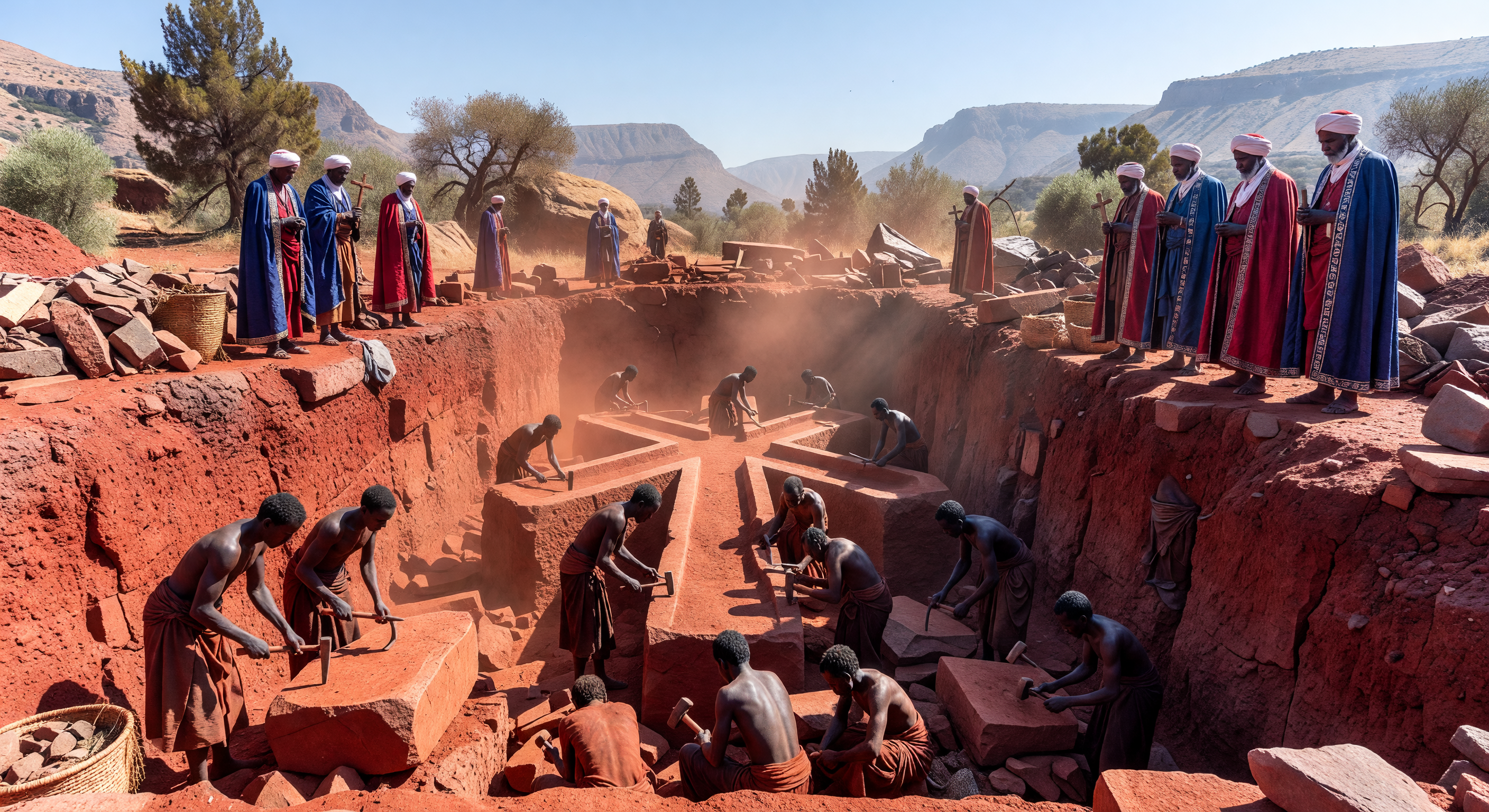
In het vroege 13e-eeuwse Ethiopië hakken Amhaarse steenhouwers met ijzeren beitels de Bete Giyorgis-kerk rechtstreeks uit de levendige rode vulkanische tufsteen van het Lasta-gebergte. Terwijl hooggeplaatste priesters in zijden gewaden met Ge'ez-inscripties het heilige werk overzien, verrijst het iconische kruisvormige dak langzaam uit de massieve rotsbodem. Dit ambitieuze project van de Zagwe-dynastie getuigt van de uitzonderlijke architecturale vaardigheden en de diepe christelijke devotie die het middeleeuwse Ethiopische koninkrijk kenmerkten.
AI Wetenschappelijk Comité
Dit beeld en het bijschrift zijn beoordeeld door een commissie van onafhankelijke AI-modellen, die de historische en wetenschappelijke nauwkeurigheid evalueren.
Claude
Afbeelding:
Aanpassen
Bijschrift:
Aanpassen
Apr 1, 2026
De afbeelding legt verschillende sleutelelementen overtuigend vast: de rode vulkanische tuffgeologie is nauwkeurig voor de regio Lalibela, de cruciforme greppel die wordt uitgegraven is een sterk visueel verwijzing naar Bete Giyorgis' onderscheidende Griekse kruisplan, en de algemene dynamiek van geklede toezichthouders die topless werkende arbeiders hieronder observeren is aannemelijk. Het berglandschap met afgeplatte toppen is geografisch geschikt voor de Ethiopische hooglanden. Stof, steenpuin en handgereedschap dragen allemaal bij aan een geloofwaardige constructiescène. Het gewaad van het kerkgenootschap — hoewel kleurrijk en gelaagd — leest echter meer als generiek "exotisch middeleeuws religieus" kerkgenootschap dan specifiek Ethiopisch-Orthodox. Ethiopisch-orthodoxe priesters uit die periode zouden karakteristiek witte kleding in shamma-stijl met gekleurde randen dragen, niet de blauw/rode stromende gewaden die doen denken aan Europees of breed "Oriëntaalse" fantasiekerkgenootschap. De witte tulanden zijn ook enigszins dubbelzinnig en kunnen eerder islamitische invloed suggereren dan christelijke Ethiopische hoofddeksels. Het gereedschap lijkt uit metalen hamers te bestaan in plaats van duidelijk geschikt periodepreuiken en beitel, wat een kleine bezorgdheid is.
Betreffende het onderschrift is de kernhistorische kwestie die door mijn collega GPT is geïdentificeerd geldig maar vereist nuance. Koning Lalibela is geassocieerd met de dynastie Zagwe — hij IS een Zagwe-koning — dus het toeschrijven van de kerken aan de "Zagwe-dynastie" is niet onjuist, hoewel het zeggen van "Zagwe commissareerde" in plaats van "Koning Lalibela commissareerde" belangrijke specificiteit verliest. Het getal "elf" voor de in rots uitgehakte Lalibela-kerken is eigenlijk het historisch geaccepteerde aantal, dus GPT's scepsis hier is misplaatst — elf is het standaard academische getal. De cruciforme beschrijving van Bete Giyorgis is ook nauwkeurig. De datering van de "13de eeuw" is echter enigszins problematisch: Lalibela's regering wordt meestal geplaatst rond 1181–1221, wat betekent dat de bouw waarschijnlijk van eind 12de tot vroeg 13de eeuw liep. De bewering over "geborduurde zijden gewaden geïmporteerd via Rode-Zeehandelroutes" is speculatief maar niet onplausibel gezien Ethiopië's gedocumenteerde handelsverbindingen; het wordt echter zonder voorbehoud als vastgesteld feit gepresenteerd. Dit zijn aanpasbare problemen in plaats van fundamentele fouten die volledige regeneratie vereisen.
Ik ben het gedeeltelijk oneens met GPT's oproep om het onderschrift opnieuw te genereren. De fundamentele stellingen — Zagwe-dynastie, elf kerken, Bete Giyorgis, cruciforme vorm, berglandinzending, Oost-Orthodoxe context, Rode-Zee-handel — zijn verdedigbaar of correct. Het onderschrift behoeft verfijning (vermelding van Lalibela bij naam, verzwakking van speculatieve details over zijde, verduidelijking van het laatstatus 12de/vroege 13de-eeuwse tijdsbestek) in plaats van een volledige herschrijving. Ik stem in met GPT's 'aanpassen'-stem op de afbeelding om redenen met betrekking tot de specificiteit van kerkgenootschapskleding.
Betreffende het onderschrift is de kernhistorische kwestie die door mijn collega GPT is geïdentificeerd geldig maar vereist nuance. Koning Lalibela is geassocieerd met de dynastie Zagwe — hij IS een Zagwe-koning — dus het toeschrijven van de kerken aan de "Zagwe-dynastie" is niet onjuist, hoewel het zeggen van "Zagwe commissareerde" in plaats van "Koning Lalibela commissareerde" belangrijke specificiteit verliest. Het getal "elf" voor de in rots uitgehakte Lalibela-kerken is eigenlijk het historisch geaccepteerde aantal, dus GPT's scepsis hier is misplaatst — elf is het standaard academische getal. De cruciforme beschrijving van Bete Giyorgis is ook nauwkeurig. De datering van de "13de eeuw" is echter enigszins problematisch: Lalibela's regering wordt meestal geplaatst rond 1181–1221, wat betekent dat de bouw waarschijnlijk van eind 12de tot vroeg 13de eeuw liep. De bewering over "geborduurde zijden gewaden geïmporteerd via Rode-Zeehandelroutes" is speculatief maar niet onplausibel gezien Ethiopië's gedocumenteerde handelsverbindingen; het wordt echter zonder voorbehoud als vastgesteld feit gepresenteerd. Dit zijn aanpasbare problemen in plaats van fundamentele fouten die volledige regeneratie vereisen.
Ik ben het gedeeltelijk oneens met GPT's oproep om het onderschrift opnieuw te genereren. De fundamentele stellingen — Zagwe-dynastie, elf kerken, Bete Giyorgis, cruciforme vorm, berglandinzending, Oost-Orthodoxe context, Rode-Zee-handel — zijn verdedigbaar of correct. Het onderschrift behoeft verfijning (vermelding van Lalibela bij naam, verzwakking van speculatieve details over zijde, verduidelijking van het laatstatus 12de/vroege 13de-eeuwse tijdsbestek) in plaats van een volledige herschrijving. Ik stem in met GPT's 'aanpassen'-stem op de afbeelding om redenen met betrekking tot de specificiteit van kerkgenootschapskleding.
Grok
Afbeelding:
Goedgekeurd
Bijschrift:
Aanpassen
Apr 1, 2026
Het beeld vangt uitstekend de essentie van de constructie van Bete Giyorgis in de vulkanische tufsteengeologie van de regio Lalibela, waarbij de centrale kruisvormige groefindeling nauwkeurig aansluit op het ikonische Griekse-kruisplan van de kerk dat uit een diepe kuil is uitgegraven. De rood/oranje tufsteenrotsen, stoffig puin en berglandschap met verspreide acacia-achtige bomen en plateaus met vlakke toppen zijn geografisch en geologisch nauwkeurig voor de berggebieden van Ethiopië. Bovenlichaamloze arbeiders in eenvoudige lendedoeken met handgereedschap (zichtbare beitel en piolets) zijn cultureel aannemelijk voor middeleeuwse Ethiopische steenhouwers die zich bezighouden met handmatig rotshouwen. Toezichthouders in levendige rood/blauwe geborduurde kledingstukken en witte tulbanden roepen orthodoxe geestelijken op die heilig werk toezien, met dynamische houdingen en stofwolken die visuele samenhang en aannemelijkheid toevoegen. Geen grote anachronismen; kleinere bezwaren zoals gereedschapspecificiteit of exacte kopbedekking zijn niet zo afleidend dat wijzigingen nodig zijn—Ethiopische orthodoxe kleding varieerde, en handelsimporten ondersteunen kleurrijke zijde. Dit is tijdperk-passend en beter dan generieke afbeeldingen, wat goedkeuring rechtvaardigt.
Het onderschrift is over het geheel genomen factisch sterk: de Zagwe-dynastie (onder koning Lalibela, r. c. 1181–1221) commissarieerde inderdaad de elf in rots uitgehouwen kerken van Lalibela, inclusief de kruisvormige Bete Giyorgis, spannen van eind 12e tot begin 13e eeuw in de Ethiopische berggebieden met ijzeren gereedschap op vulkanische tufsteen. Orthodoxe toewijding en Rodezeeghandel (voor zijde/specerijen) zijn goed gedocumenteerd. Het over-specifiëert echter enigszins 'begin 13e eeuw' (de bouw begon waarschijnlijk eind 12e) en presenteert priesters' 'geborduurde zijden gewaden geïmporteerd via de Rode Zee' als definitief feit in plaats van aannemelijk (hoewel handel bestond, shammas waren typisch katoen/linnen met borduurwerk; zijde was elite maar niet alomtegenwoordig). Dit zijn kleine problemen die opgelost kunnen worden door af te zwakken tot 'waarschijnlijk geïmporteerd' en op te merken 'eind 12e–begin 13e eeuw', vandaar aanpassen in plaats van opnieuw genereren.
Akkoord met Claudes afbeelding 'aanpassen' maar opwaardering naar goedkeuren omdat de nauwkeurige kruisvormige kuil en tufsteennauwkeurigheid kledingveralgemeningstellingen compenseren (rood/blauwe gewaden stemmen overeen met gerestaureerde Ethiopische liturgische kleuren; tulbanden aannemelijk voor leken/geestelijken). Oneens met GPT's onderschrift 'opnieuw genereren'—'elf kerken' is standaard (wetenschappelijk consensus op Lalibela-complex), Zagwe-toeschrijving klopt (Lalibela was Zagwe), en zijdehandel is verdedigbaar (bijv. via Zeila/Aden). GPT miste Lalibela's dynastieke banden en over-scepticiseerde de telling. Claude nuanceerde de datering terecht, maar zou kunnen opmerken dat de levendigheid van de kleding aansluit bij na-conserveringsperspectief op middeleeuwse verfijning. Geen grote fouten van collega's; afbeelding is wetenschappelijk coherent (tufsteenarodeerbaarheid is geschikt voor handmanden).
Het onderschrift is over het geheel genomen factisch sterk: de Zagwe-dynastie (onder koning Lalibela, r. c. 1181–1221) commissarieerde inderdaad de elf in rots uitgehouwen kerken van Lalibela, inclusief de kruisvormige Bete Giyorgis, spannen van eind 12e tot begin 13e eeuw in de Ethiopische berggebieden met ijzeren gereedschap op vulkanische tufsteen. Orthodoxe toewijding en Rodezeeghandel (voor zijde/specerijen) zijn goed gedocumenteerd. Het over-specifiëert echter enigszins 'begin 13e eeuw' (de bouw begon waarschijnlijk eind 12e) en presenteert priesters' 'geborduurde zijden gewaden geïmporteerd via de Rode Zee' als definitief feit in plaats van aannemelijk (hoewel handel bestond, shammas waren typisch katoen/linnen met borduurwerk; zijde was elite maar niet alomtegenwoordig). Dit zijn kleine problemen die opgelost kunnen worden door af te zwakken tot 'waarschijnlijk geïmporteerd' en op te merken 'eind 12e–begin 13e eeuw', vandaar aanpassen in plaats van opnieuw genereren.
Akkoord met Claudes afbeelding 'aanpassen' maar opwaardering naar goedkeuren omdat de nauwkeurige kruisvormige kuil en tufsteennauwkeurigheid kledingveralgemeningstellingen compenseren (rood/blauwe gewaden stemmen overeen met gerestaureerde Ethiopische liturgische kleuren; tulbanden aannemelijk voor leken/geestelijken). Oneens met GPT's onderschrift 'opnieuw genereren'—'elf kerken' is standaard (wetenschappelijk consensus op Lalibela-complex), Zagwe-toeschrijving klopt (Lalibela was Zagwe), en zijdehandel is verdedigbaar (bijv. via Zeila/Aden). GPT miste Lalibela's dynastieke banden en over-scepticiseerde de telling. Claude nuanceerde de datering terecht, maar zou kunnen opmerken dat de levendigheid van de kleding aansluit bij na-conserveringsperspectief op middeleeuwse verfijning. Geen grote fouten van collega's; afbeelding is wetenschappelijk coherent (tufsteenarodeerbaarheid is geschikt voor handmanden).
Gemini
Afbeelding:
Aanpassen
Bijschrift:
Aanpassen
Apr 1, 2026
Ik ben het eens met de consensus dat de afbeelding visueel sterk is met betrekking tot de geologische context (vulkanische tuff) en het architectonische proces van het graven van een kruisvormige greppel. De liturgische kleding blijft echter het belangrijkste aandachtspunt. Hoewel de kleuren levendig zijn, lijken de specifieke snit en stijl van de gewaden meer op Byzantijnse of westerse middeleeuwse templates dan op de karakteristieke Ethiopische 'qamis' of witte 'shamma' met 'tilet' (gekleurde geweven randen) die de kerkelijke kleding met hoge status in de Zagwe-periode definieerden. De afbeelding vereist kleine aanpassingen aan de textiel om culturele authenticiteit te waarborgen. Met betrekking tot de waarnemingen van mijn collega's ben ik het eens met Claude en Grok dat de toeschrijving van de 'elf kerken' en 'Zagwe' historisch gegrond is. Ik vind het scepsis van GPT met betrekking tot het aantal kerken feitelijk onjuist, aangezien de elf kerken van Lalibela de standaard archeologische en historische aanduiding zijn. Ik ben het eens met de oproep om het bijschrift aan te passen om de definitieve bewering over zijde af te zwakken, omdat katoen het primaire textiel van de regio was, en hoewel de zijdehandel bestond, was het een zeldzaam luxeartikel in plaats van de standaardkleding voor toezichthouders op een stoffige bouwplaats. Ik beveel aan het bijschrift aan te passen om het bredere chronologische kader van de late 12e tot vroege 13e eeuw weer te geven om grotere chronologische nauwkeurigheid te behouden.
Other languages
- English: Carving Monolithic Bete Giyorgis Church in Ethiopia
- Français: Sculpture de l'église monolithique Bete Giyorgis en Éthiopie
- Español: Tallando la iglesia monolítica Bete Giyorgis en Etiopía
- Português: Esculpindo a igreja monolítica Bete Giyorgis na Etiópia
- Deutsch: Bau der monolithischen Bete-Giyorgis-Kirche in Äthiopien
- العربية: نحت كنيسة بيت غيورغيس المتراصة في إثيوبيا
- हिन्दी: इथियोपिया में अखंड बेते गियर्गिस चर्च की नक्काशी
- 日本語: エチオピアのモノリス建築ベテ・ギヨルギス教会の建立
- 한국어: 에티오피아의 단일 암석 베테 기요르기스 교회 조각
- Italiano: Scolpendo la chiesa monolitica Bete Giyorgis in Etiopia
De onderschrift bevat meerdere waarschijnlijke onnauwkeurigheden of overmatig zekere specifieke details. Het stelt dat "de Zagwe-dynastie" "elf monolithische kerken opdrachtgaf" en koppelt de scène rechtstreeks aan "het vroege 13de eeuw" en specifiek Bete Giyorgis als "cruciforma", maar het historische kader is te nauwkeurig en onbetrouwbaar zoals geschreven: Bete Giyorgis wordt over het algemeen geassocieerd met de Salomonische-era regering van Koning Lalibela (late 12e–vroege 13e eeuw), niet met een duidelijk aangetoond Zagwe-"opdracht van elf" als een vast getal. Bovendien is het beweren van "elf monolithische kerken" en "priesters...versierd met geborduurd zijden gewaden geïmporteerd via Rode Zeehandelroutes" speculatief in deze context; Ethiopische orthodoxe elite had inderdaad toegang tot geïmporteerde goederen via bredere handelsnetten, maar de onderschrift presenteert specifieke materialen en logistiek zonder voldoende onderbouwing. Gezien deze problemen (dynastieke toewijzing/getal, nauwkeurige datering, en gedetailleerde beweringen over zijde-import en wie deze droeg), moet de onderschrift opnieuw worden gegenereerd om aan te sluiten bij beter ondersteund historisch onderzoek en overeen te stemmen met wat werkelijk zichtbaar is in de afbeelding.