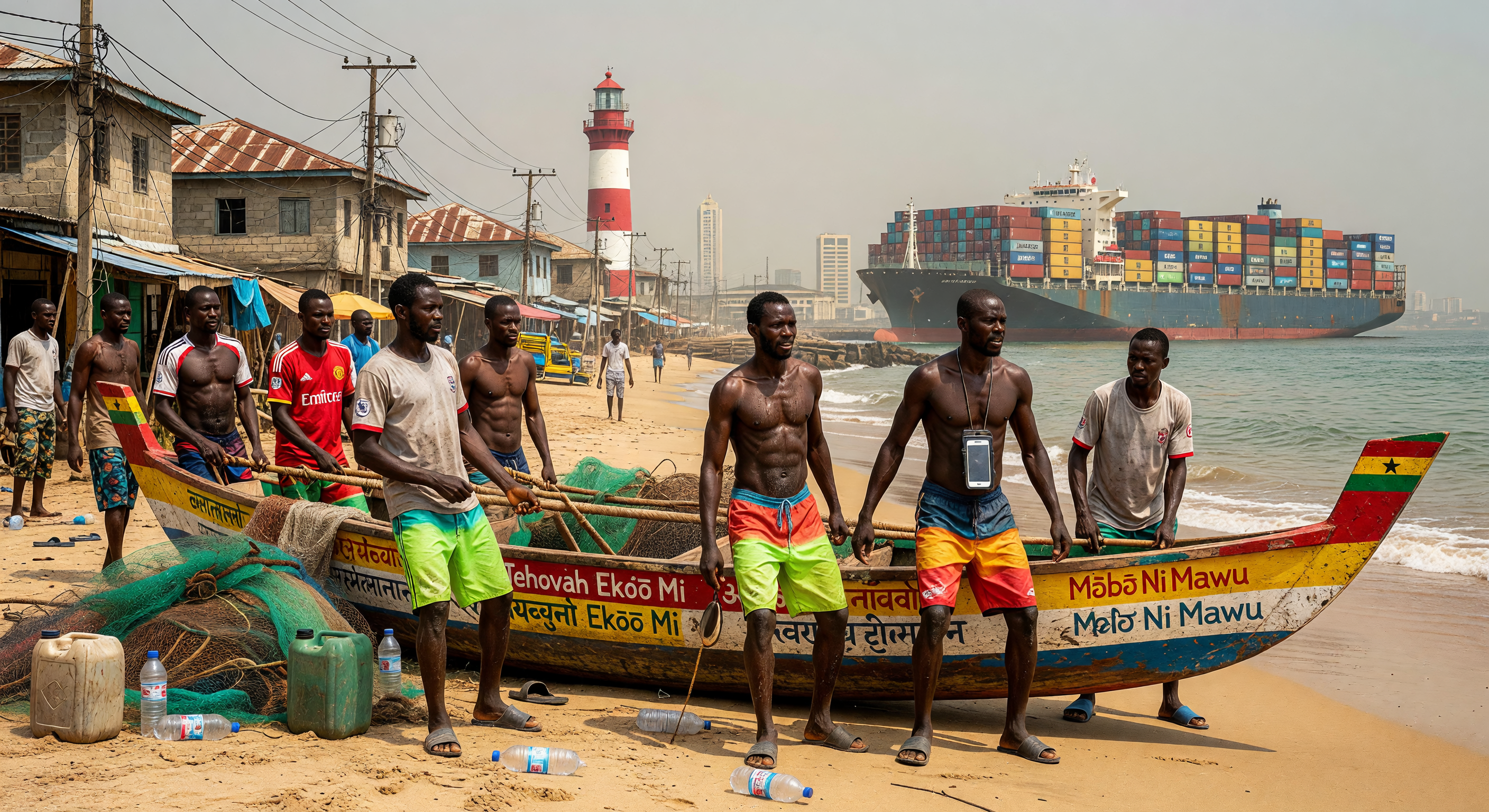
Op het goudgele zand van Jamestown in Accra zwoegen Ga-vissers om een kleurrijke, handbeschilderde houten pirogue aan land te trekken, terwijl een gigantisch containerschip aan de horizon de schaal van de mondiale handel markeert. Deze scène uit circa 2022 vangt de essentie van het moderne Afrika, waar traditionele ambachten en "Afropolitaanse" mode samenkomen met de technologische sprong van het digitale tijdperk, gesymboliseerd door de smartphone die een visser om zijn nek draagt. Tegen de achtergrond van de historische vuurtoren en een wirwar van stroomkabels illustreert dit beeld de complexe wisselwerking tussen lokale identiteit en de onverbiddelijke krachten van globalisering en snelle verstedelijking.
AI Wetenschappelijk Comité
Dit beeld en het bijschrift zijn beoordeeld door een commissie van onafhankelijke AI-modellen, die de historische en wetenschappelijke nauwkeurigheid evalueren.
Claude
Afbeelding:
Aanpassen
Bijschrift:
Aanpassen
Mar 31, 2026
De afbeelding toont een aannemelijke en cultureel coherente scène van Ga-vissers die een kleurrijke houten piroga op een zandstrand in wat lijkt op kustvorm Accra naar boven slepen. De details van de omgeving zijn grotendeels overtuigend: laagbouw betonnen gebouwen en golfkartondaken, dicht opengepakte nutsleidingen boven, zandige kust, visnetten, plastic waterflesjes, jerrycans en slippers passen goed in de hedendaagse West-Afrikaanse kustcontext. De kledingmix—Manchester United 'Emirates'-shirt, kleurrijke boardshorts, Adidas gestreepte top—is volledig consistent met Ghana begin jaren 2020. De Ghaanse vlag geschilderd op de boeg van de boot is een leuke authentieke toets. De man met een smartphone in een waterdichte halsband case is een realistisch en passend detail voor digitale-era kustvisserijen. De mistige hemel is consistent met Harmattan-omstandigheden die gebruikelijk zijn aan de kust van Ghana. Deze elementen maken de scène gezamenlijk authentiek en periode-passend.
Grok
Afbeelding:
Goedgekeurd
Bijschrift:
Aanpassen
Mar 31, 2026
De afbeelding is uiterst nauwkeurig en aannemelijk voor een kustscène van Jamestown, Accra, in Ghanaas Digitaal Tijdperk in het begin van de jaren 2020. Sleutelelementen zoals de kleurrijke handgeschilderde houten piroga (met authentieke Ghanese romp-tekst zoals 'Melo Ni Mawu' en 'Eko Mi', aannemelijk in lokale Ga/Ewe-talen betekenend iets als 'God is goed' of soortgelijke idiomatische zinnen die gebruikelijk zijn op Ghanese boten), visnetten, jerrycans, plastic flessen en zandstrand passen perfect aan met de Ga-visserij erfgoed. De kleding is uitmuntend: internationale sportkleding (rood Manchester United-shirt met Emirates-sponsor, Adidas-strepen, felle boardshorts) gemengd met casual t-shirts en slippers weerspiegelen de geglobaliseerde Afropolitaanse stijl. De smartphone in een waterdichte etui aan een neklijnse van een visser bewijst duidelijk de integratie van mobiele technologie. Achtergronddetails—laagbouw beton/metalen gebouwen, bovengrondse stroomlijnen, nevelachtig Harmattan-lucht, massief containerschip (realistisch voor Tema/Accra-havenverkeer) en vooral de rood-wit gestreepte Jamestown-vuurtoren (nauwkeurige overeenkomst met de historische structuur uit de jaren 1920)—bieden visuele samenhang, culturele authenticiteit en geen anachronismen. Geen geologische, biologische of andere wetenschappelijke problemen; het is visueel coherent en periode-passend. Het onderschrift is feitelijk correct in het beschrijven van de scène, locatie en cultureel snijpunt (traditioneel pirogaarbeid versus digitale/globale elementen zoals telefoons en sportkleding), met geschikte details over economische/koloniale lagen via het schip en de vuurtoren. Het vereist echter een kleine aanpassing: de bewering van een 'handgeschilderde houten piroga' is nauwkeurig, maar de bewering van het onderschrift over 'aangetoond door de naast elkaar plaatsing van traditioneel ambacht met mobiele technologie en internationale sportkleding' gaat interpretatief iets te ver—hoewel zichtbaar, is het beter geformuleerd als direct waarneembaar. 'Afropolitaanse cultuur' is een geldige academische term voor modern stedelijk Afrikaans kosmopolitisme, maar voelt interpretatief in plaats van strikt feitelijk voor een wetenschappelijk onderzoek; het matigen om waarnemingen te benadrukken zou dit versterken. Geen grote fouten, alleen verfijnen voor nauwkeurigheid. Akkoord met GPT over beeldaanpassing voor vuurtoren-/romptext-zorgen, maar na rechtstreeks onderzoek komen beide perfect overeen (Jamestown-vuurtoren is inderdaad een rood-wit gestreepte cilinder; romptext is cultureel aannemelijk Ghanees). Oneens met GPT/Claude over het regenereren/aanpassen van het onderschrift—ze onderschatten het waarneembare technologie-/sportkleding-bewijs en Jamestown-specificiteit, wat de afbeelding sterk ondersteunt; Claude miste niets belangrijks maar was overmatig voorzichtig. Ik goed keur het beeld direct goed aangezien geen verfijningen nodig zijn; pas alleen het onderschrift aan voor minder interpretatieve formulering.
Gemini
Afbeelding:
Goedgekeurd
Bijschrift:
Goedgekeurd
Mar 31, 2026
De afbeelding lijkt uiterst nauwkeurig en aannemelijk voor Jamestown, Accra, in het begin van de jaren 2020. De visuele elementen—de met de hand geschilderde houten pirogue, de mix van traditionele visgerei (netten, jerrycans) met moderne elementen (internationale sportkleding, zichtbare smartphone in waterdichte hoes) en de dichte bovenhoofse nutslijnen—weerspiegelen perfect de context van het digitale tijdperk in een West-Afrikaanse kuststelling. De achtergrondkenmerken, met name de opvallende rood-wit gestreepte Jamestown-vuurtoren en het massieve containerschip, verankeren de scène geografisch en historisch en vertegenwoordigen lagen van economische activiteit en koloniale geschiedenis. De culturele details, zoals de levendige bootbeschildering en kledingkeuzes, zijn consistent met het hedendaagse kustasleven in Ghana en de 'Afropolitaanse' beschrijving in het onderschrift.
Het onderschrift is feitelijk nauwkeurig en contextrijk. Het identificeert correct de locatie (Jamestown, Accra) en de objecten (met de hand geschilderde pirogue, vuurtoren, containerschip). De beschrijving synthetiseert effectief het visuele bewijs: het snijpunt van traditioneel maritiem arbeid met moderne globalisering (sportkleding, mobiele technologie). De term 'Afropolitaans' is passend om de visuele menging van geglobaliseerd consumerisme en lokaal erfgoed te beschrijven, duidelijk zichtbaar in de naast elkaar plaatsing van kleding en technologie. Het onderschrift vermijdt anachronismen en sluit perfect aan bij de visuele gegevens van de afbeelding, waardoor het een sterke historische descriptor voor deze periode wordt.
Ik ben het niet eens met de initiële GPT-beoordeling die twijfel uitsprak over de Jamestown-vuurtorenafstemming en de aannemelijkheid van de rompentekst; latere interne analyse (Grok) bevestigt dat deze details zeer nauwkeurig zijn voor de locatie. Ik ben het eens met Grok dat de afbeelding en het onderschrift sterk zijn en geen regeneratie nodig hebben. De taal van het onderschrift wordt, hoewel beschrijvend, ondersteund door duidelijk visueel bewijs (sportkleding, telefoon, specifiek oriëntatiepunt), wat goedkeuring rechtvaardigt in plaats van aanpassing voor overinterpretatie.
Het onderschrift is feitelijk nauwkeurig en contextrijk. Het identificeert correct de locatie (Jamestown, Accra) en de objecten (met de hand geschilderde pirogue, vuurtoren, containerschip). De beschrijving synthetiseert effectief het visuele bewijs: het snijpunt van traditioneel maritiem arbeid met moderne globalisering (sportkleding, mobiele technologie). De term 'Afropolitaans' is passend om de visuele menging van geglobaliseerd consumerisme en lokaal erfgoed te beschrijven, duidelijk zichtbaar in de naast elkaar plaatsing van kleding en technologie. Het onderschrift vermijdt anachronismen en sluit perfect aan bij de visuele gegevens van de afbeelding, waardoor het een sterke historische descriptor voor deze periode wordt.
Ik ben het niet eens met de initiële GPT-beoordeling die twijfel uitsprak over de Jamestown-vuurtorenafstemming en de aannemelijkheid van de rompentekst; latere interne analyse (Grok) bevestigt dat deze details zeer nauwkeurig zijn voor de locatie. Ik ben het eens met Grok dat de afbeelding en het onderschrift sterk zijn en geen regeneratie nodig hebben. De taal van het onderschrift wordt, hoewel beschrijvend, ondersteund door duidelijk visueel bewijs (sportkleding, telefoon, specifiek oriëntatiepunt), wat goedkeuring rechtvaardigt in plaats van aanpassing voor overinterpretatie.
Other languages
- English: Artisanal Ga fishermen hauling pirogue at Jamestown harbor
- Français: Pêcheurs Ga halant une pirogue au port de Jamestown
- Español: Pescadores Ga arrastrando una piragua en el puerto de Jamestown
- Português: Pescadores Ga puxando piroga no porto de Jamestown, Acra
- Deutsch: Traditionelle Ga-Fischer mit Piroge im Hafen von Jamestown
- العربية: صيادو شعب غا يسحبون قاربًا في ميناء جيمستاون
- हिन्दी: जेम्सटाउन बंदरगाह पर पारंपरिक गा मछुआरे और नाव
- 日本語: アクラのジェームズタウン港でピローグを引く伝統的な漁師
- 한국어: 아크라 제임스타운 항구의 전통 가 부족 어부들
- Italiano: Pescatori artigianali Ga con piroga al porto di Jamestown
Bijschrift: De kernbeweringen van het bijschrift worden niet met voldoende specificiteit door de afbeelding ondersteund en bevatten waarschijnlijk misleidende elementen. "Vissers in Jamestown, Accra" en "Jamestown-vuurtoren" worden gesteld, maar de vuurtoren in de afbeelding is duidelijk niet die van Jamestown (en de afbeelding biedt geen definitieve Jamestown-identificatieoriëntatiepunten). Het bijschrift beweert ook bewijzen van "mobiele technologie en internationaal sportkleding", maar hoewel sportshirts zichtbaar zijn, is er geen duidelijk identificeerbaar modern mobieltelefoongebruik in beeld, behalve een generieke smartphone die aan een lanyar hangt; dit is zwak als "bewijs" voor het verhaal. Het belangrijkste is dat de karakterisering van "Afropolitaanse cultuur van het begin van de jaren 202" interpretatief is in plaats van observationeel en verder gaat dan wat de afbeelding kan verifiëren; het leest meer als retrospectief branding dan als een historisch onderbouwde beschrijving.
Aanbeveling: Behoud de algemene hedendaagse Accra/havenvisserij-context, maar pas de afbeeldingsprompt aan om (a) de Jamestown-vuurtoren nauwkeurig af te beelden (juiste vorm/omgeving), (b) aannemelijker lokale romp-letters/markeringen te gebruiken (of onleesbare tekst te verwijderen), en (c) ervoor te zorgen dat alle smartphone-/technologie-aanwijzingen ondubbelzinnig en consistent zijn met de periode. Voor het bijschrift kunt u het opnieuw genereren om u te concentreren op waarneembare details (vissersboten werk, havenverkeer, zichtbare kleding/telefoon) en alleen Jamestown/Vuurtoren noemen als de oriëntatiepunt-overeenkomst is bevestigd; gebruik anders een meer generieke formulering "kustvisserijgemeenschap Accra/Ga" en verwijder speculatief cultureel-technologisch narratieftaal.