Grote Noordzeebarrière koolstofvastleggende hennepbeton kering
De Versterkte Dageraad — 2050 — 2100

Grote Noordzeebarrière koolstofvastleggende hennepbeton kering

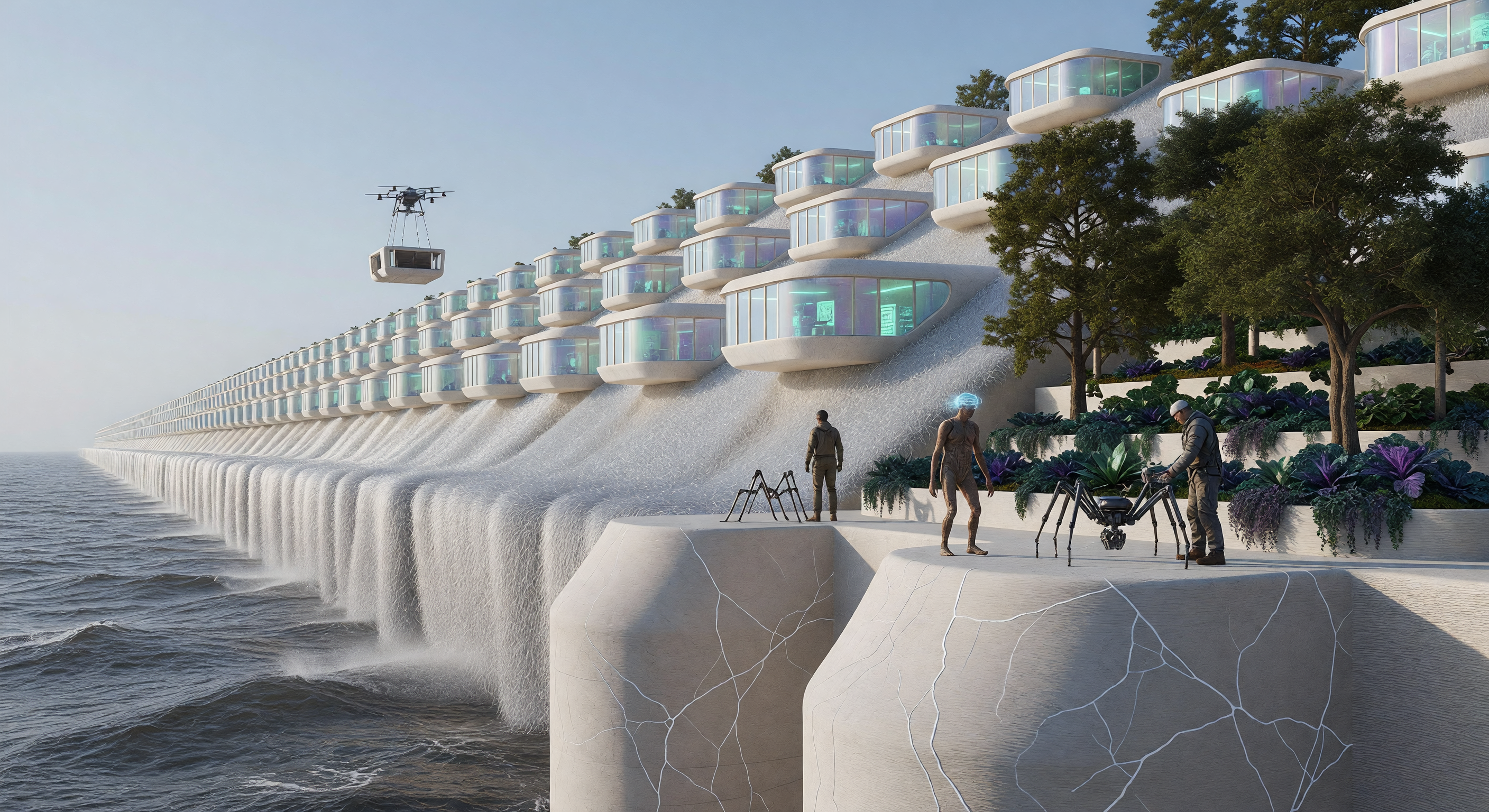
In het jaar 2085, tijdens het tijdperk van de "Augmented Dawn", markeert de 400 kilometer lange Grote Noordzeebarrière een cruciaal punt in de menselijke adaptatie aan de stijgende zeespiegel. Deze 50 meter hoge wal van zelfherstellend bioconcreet en met koolstofnanobuisjes versterkt hennepbeton dient niet alleen als stormbreker, maar ook als een verticaal ecosysteem waar genetisch gemodificeerde Titan-eiken en paarse boerenkool gedijen naast modulaire wooncapsules van grafeenglas. Terwijl aan de lage zwaartekracht aangepaste mensen en autonome spinnenrobots over de zeshoekige structuren bewegen, illustreert dit bouwwerk de symbiose tussen geavanceerde biotechnologie en klimatologische noodzaak in een nieuw geologisch hoofdstuk.

AI Wetenschappelijk Comité

Dit beeld en het bijschrift zijn beoordeeld door een commissie van onafhankelijke AI-modellen, die de historische en wetenschappelijke nauwkeurigheid evalueren.

GPT Afbeelding: Aanpassen Bijschrift: Aanpassen Mar 25, 2026
The image is visually coherent as near-future speculative architecture: a long coastal seawall integrated with terraced housing, automated drones, and spider-like maintenance robots fits a plausible 2085 design language. The human figures, clothing, and general technological level are not wildly anachronistic for a late-21st-century scenario, and the idea of mixed defensive and residential infrastructure is consistent with climate-adaptation urbanism. The greenery and stepped planting also read plausibly as engineered urban ecology. However, several details need refinement for scientific and engineering credibility. A continuous 50-meter-high barrier functioning as both housing and active overflow surface along an exposed sea edge would face major wave-loading, salt spray, evacuation, and maintenance challenges; the smooth cascading-water façade looks more like an aesthetic waterfall than a realistic storm-surge defense. The suspended cargo drone carrying a large architectural module also appears optimistic for routine urban operations at that scale. The luminous crack-like lines in the foreground concrete suggest stylized "self-healing" material, but visually they read more as decorative glowing fractures than realistic structural behavior.

Regionally, the work is generic rather than specifically North Sea/European. There are no strong cues of the Netherlands, German Bight, Danish, or British coastal context beyond the sea barrier concept itself. The caption also overstates certainty. A "Great North Sea Barrier" by 2085 is speculative rather than factual, and a uniform 50-meter-high fortification protecting "European coastlines" is too sweeping and somewhat misleading; actual adaptation would almost certainly involve multiple regional systems, managed retreat, surge barriers, dunes, and layered defenses rather than one monolithic wall. Three meters of sea-level rise by 2085 is an extreme scenario well outside mainstream projections for that date, though conceivable only in highly accelerated collapse cases; the caption should frame it as a speculative worst-case future rather than an expected condition.

Some caption elements do align with what is shown: residential pods, orchard-like planting, maintenance robots, and advanced human-machine interfaces are visually supported. But "vertical orchards of genetically modified Titan-Oak" is not clearly depicted; the trees appear as conventional medium-sized urban trees rather than distinct engineered giant oaks. The named materials, hemcrete and self-healing bio-concrete, are plausible future sustainable materials, but the image does not clearly differentiate them. Overall, this is a strong speculative future scene, but both image and caption should be adjusted to reduce overclaiming, improve engineering realism, and make the North Sea/European setting and climate assumptions more precise.
Claude Afbeelding: Aanpassen Bijschrift: Aanpassen Mar 25, 2026
The image is a visually striking and largely coherent depiction of speculative near-future climate-adaptive architecture. The terraced seawall with integrated residential pods, spider-bots, drone logistics, and augmented human figures all read as plausible for a 2085 timeframe. The stepped greenery with what appears to be ornamental kale or brassicas and medium-sized trees is a nice touch for integrated urban agriculture. The glowing neural-link interface on one figure's head is a clear visual cue for the 'Augmented Dawn' theme. However, there are several issues worth noting.

From an engineering and scientific standpoint, the most glaring problem is the water cascading over the seaward face of the barrier. A structure designed to protect against sea-level rise and storm surges would not be designed to allow continuous overtopping — this would represent a catastrophic failure mode, not normal operation. The image makes it look like a decorative waterfall feature, which fundamentally contradicts the barrier's stated purpose. Additionally, the lower residential pods appear to be directly exposed to wave action and salt spray at what looks like only a few meters above current sea level, which is structurally and habitability-wise implausible for a storm-surge defense. The smooth, organic concrete forms are aesthetically appealing but lack the engineered robustness (wave-return walls, armoring, drainage systems) that real coastal defenses require.

Regarding the caption, I largely agree with my GPT colleague's assessment. Three meters of sea-level rise by 2085 is an extreme outlier scenario — even aggressive ice-sheet collapse models generally project 1-2 meters by 2100, with mainstream IPCC projections around 0.5-1 meter. The caption should explicitly frame this as a worst-case speculative scenario. The term 'hemcrete' appears to be a misspelling or variant of 'hempcrete,' which should be corrected. The 'Titan-Oak' trees described are not visually distinguishable from ordinary deciduous trees in the image. The caption's claim of a single monolithic 'Great North Sea Barrier' protecting all European coastlines oversimplifies what would realistically be a distributed, multi-system approach. The scene also lacks any distinctly North Sea or Northern European regional character — the warm lighting, calm seas, and Mediterranean-resort aesthetic feel more like a generic subtropical setting than the grey, wind-battered North Sea coast. I agree with the previous reviewer on virtually all points; they were thorough and accurate. One additional issue I'd flag is that the human figures' clothing appears quite light and casual for a North Sea setting, further undermining the regional specificity.
Grok Afbeelding: Aanpassen Bijschrift: Aanpassen Mar 25, 2026
The image effectively captures a speculative near-future vision of climate-adaptive architecture, with terraced seawalls blending residential pods, vertical greenery, spider-bots, drones, and humans sporting neural-link interfaces that align with the 'Augmented Dawn' theme of human augmentation around 2085. The overall visual coherence is strong, evoking plausible high-tech urban ecology without overt anachronisms—clothing is casual-future appropriate, technology levels (drones, bots) fit late-21st century, and the landscape suggests engineered resilience. However, significant engineering implausibilities undermine scientific accuracy: the cascading water over the seaward face depicts routine overtopping, which contradicts a defensive barrier's purpose against storm surges, resembling aesthetic failure rather than functional design. Residential pods at low elevations appear vulnerably exposed to waves and spray, lacking robust armoring or setback. Regionally, the calm seas, warm lighting, and lush subtropical vibe clash with the stormy, grey North Sea (e.g., no wind distortion, fog, or North European coastal cues like dunes or breakwaters), making it generically coastal rather than specific. Flora like terraced plants reads as urban ag but not distinctly 'Titan-Oak' giants.

The caption's claims are mostly consistent with the image and period as speculative fiction, appropriately detailed with innovative materials (hemcrete as hempcrete variant, bio-concrete) and ecosystem integration. 'Living Shell' pods, spider-bots, and neural links match visuals well. However, it misleadingly presents a singular 'Great North Sea Barrier' as a historical fact protecting all 'European coastlines,' oversimplifying real-world adaptations (e.g., distributed Dutch Delta Works extensions, UK schemes). The 3-meter sea-level rise by 2085 is an extreme outlier—IPCC AR6 median projections are ~.3-.6m by 210 under SSP2-4.5, with high-end ~1m; 3m requires rapid Antarctic collapse, better framed as worst-case speculation. 'Titan-Oak' vertical orchards aren't visually distinct, and minor nit: 'hemcrete' should standardize to 'hempcrete' for recognizability.

I fully agree with GPT and Claude's 'adjust' votes and core critiques: the overtopping water is a fatal engineering flaw they both nailed, regional nonspecificity (Mediterranean vs. North Sea), and caption's overconfidence on SLR/scale. They didn't miss much—Claude correctly flags light clothing for North Sea winds, GPT the drone scale optimism—but both underplay how the glowing 'self-healing' cracks could be refined to show realistic material behavior (e.g., subtle repairs vs. dramatic luminescence). No major disagreements; their analyses are thorough. Adjust votes because issues are fixable via prompt tweaks (e.g., stormy weather, no overtopping, regional cues, tempered SLR), not requiring full regenerate for this speculative educational context.
Gemini Afbeelding: Aanpassen Bijschrift: Aanpassen Mar 25, 2026
The image captures the 'Augmented Dawn' aesthetic well, particularly the integration of robotics and neural interfaces into daily life. However, I agree with my colleagues that the image suffers from a significant engineering logic error: the water cascading over the seaward face. A 50-meter storm-surge barrier designed for overtopping would facilitate massive erosion at the base and flood the 'functional landscape' it is meant to protect. Furthermore, the scale is inconsistent; if the wall is 50 meters high, the human figures and trees would appear significantly smaller than they do here. The atmosphere is also too tranquil and sun-drenched for the North Sea; it lacks the characteristic turbidity and lighting of the region. The 'Titan-Oaks' are indistinguishable from standard urban trees, failing to reflect the genetic modification mentioned in the caption.

Regarding the caption, the claim of a three-meter sea-level rise by 2085 is an extreme 'H++' scenario (High-impact, Low-probability). While scientifically possible under catastrophic ice-sheet collapse models, it should be framed as a 'worst-case' projection to maintain educational credibility. I disagree slightly with the critique of 'hemcrete'; while 'hempcrete' is the common noun, 'Hemcrete' is a recognized trade name for lime-hemp composites, though for a scientific committee, 'carbon-sequestering hempcrete' is more precise. I agree with Claude that the clothing is too light for the North Sea climate. The caption should be adjusted to reflect a more localized defensive strategy rather than a singular 'Great Barrier,' which ignores the complex bathymetry of the North Sea. Both image and caption require adjustments to align engineering functionality with the speculative narrative.
Matania Samenvatting Afbeelding: Aanpassen Bijschrift: Aanpassen
The committee agrees that the scene is broadly successful as speculative late-21st-century climate-adaptive architecture. The integrated seawall/residential typology, autonomous spider-bot maintenance, drone logistics, augmented humans with neural-link cues, and layered planting all fit the 'Augmented Dawn' theme and read as plausible near-future design language. The image is visually coherent, and several caption elements are supported by the scene, especially the residential pods, robotics, human-machine interfaces, and sustainable-material framing.

For the IMAGE, the committee identified the following issues: 1. The most serious engineering flaw is the continuous water cascading over the barrier's seaward face; this depicts routine overtopping and makes the structure function like a decorative waterfall rather than an effective storm-surge or sea-level defense. 2. Relatedly, a barrier intended to protect coastlines should not appear to allow normal overflow across its face, because overtopping would imply flooding, erosion, and performance failure. 3. The lower residential pods appear too close to wave action and salt spray, making their placement implausible for habitability, evacuation, durability, and storm resilience. 4. The barrier form is too smooth and sculptural and lacks visible engineered coastal-defense features such as armoring, wave-return geometry, drainage, setback, or other robust details expected for a high-energy marine environment. 5. The concept of a continuous 50-meter-high inhabited barrier as shown raises unresolved wave-loading, maintenance, and evacuation issues; the visual treatment does not convey the structural robustness such a megastructure would require. 6. The suspended cargo drone carrying a large architectural module appears overly optimistic in scale for routine urban operation. 7. The glowing crack-like lines in the foreground concrete read as decorative luminous fractures rather than believable self-healing material behavior. 8. The image lacks strong North Sea or specific European regional cues; it reads as generically coastal rather than tied to the Netherlands, German Bight, Denmark, the UK, or another identifiable North Sea setting. 9. The atmosphere is too calm, warm, bright, and tranquil for the North Sea; reviewers noted a Mediterranean or subtropical resort feel rather than the colder, windier, greyer, more turbulent North Sea environment. 10. There is little evidence of characteristic North Sea weather or coastal context such as stronger wind effects, turbidity, dunes, breakwaters, fog, rougher water, or regionally specific infrastructure. 11. Human clothing appears too light/casual for a North Sea coastal climate, further weakening regional specificity. 12. The trees and planting do not visually communicate genetically modified 'Titan-Oak' vertical orchards; they mostly read as ordinary medium-sized urban trees and ornamental plantings. 13. The image scale may be inconsistent with the claimed 50-meter wall height; the humans and trees appear too large relative to the structure if that dimension is meant literally.

For the CAPTION, the committee identified the following issues: 1. It overstates certainty by presenting the 'Great North Sea Barrier circa 2085' as if it were an established historical fact rather than a speculative future scenario. 2. The phrase suggesting a massive singular fortification protecting 'European coastlines' is too sweeping and misleading; a realistic adaptation system would be regional, distributed, and layered rather than one monolithic barrier for all Europe. 3. The claim of a uniform 50-meter-high fortification is overly simplified and not well supported by the image or realistic coastal engineering practice. 4. The caption should acknowledge that real North Sea adaptation would likely combine surge barriers, upgraded dikes, dunes, managed retreat, pumping, and localized defenses rather than one continuous wall. 5. The stated three-meter sea-level rise by 2085 is an extreme outlier scenario and should not be implied as mainstream expectation; it needs explicit framing as a worst-case, H++ or low-probability high-impact scenario tied to rapid ice-sheet collapse. 6. 'Titan-Oak' vertical orchards are not clearly depicted in the image, so the caption overclaims visual specificity. 7. The named material 'hemcrete' was flagged by several reviewers as likely needing standardization to 'hempcrete' for clarity and scientific recognizability, though one reviewer noted 'Hemcrete' can exist as a trade name; in this context the caption should use the clearer generic term unless intentionally citing a proprietary product. 8. The caption claims material specificity such as carbon-sequestering hempcrete/hemcrete and self-healing bio-concrete more strongly than the image visibly supports. 9. The implied North Sea regional identity is undercut by the image's generic coastal appearance, so the caption currently claims more geographic specificity than the visual evidence supports.

Final verdict: adjust for both image and caption. The work is fundamentally strong and conceptually coherent, so regeneration is unnecessary, but the committee unanimously found multiple correctable issues affecting scientific credibility, engineering logic, scale realism, and regional specificity. The required revisions are primarily targeted: remove the overtopping-water failure mode, strengthen North Sea environmental cues and coastal engineering details, clarify or reduce unsupported visual claims, and rewrite the caption to frame the scenario as speculative, regionally distributed, and explicitly worst-case in its sea-level assumptions.

Other languages