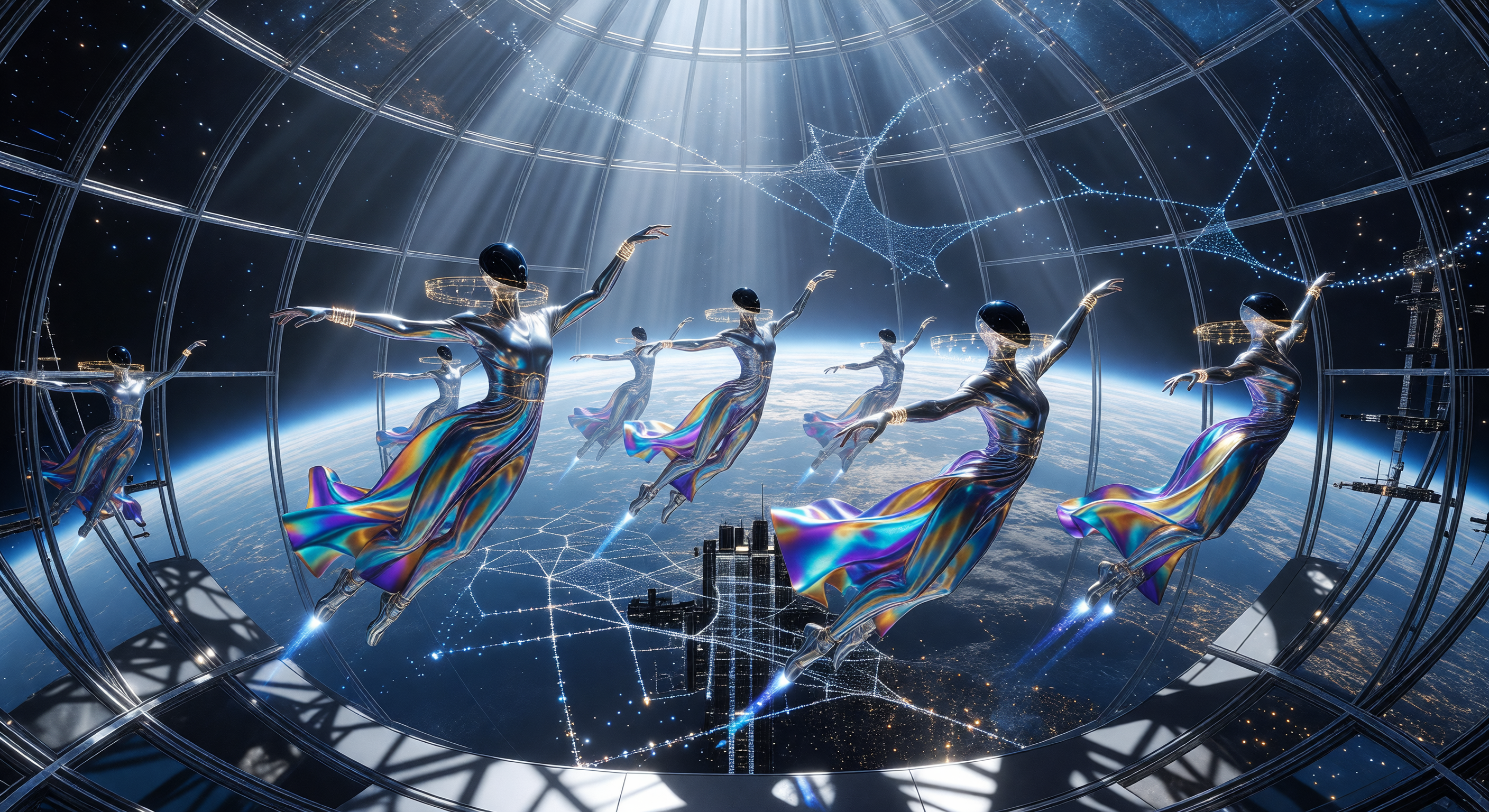
Tijdens de Grote Divergentie (2200–2500 n.Chr.) onderging de menselijke soort een radicale evolutionaire splitsing, prachtig geïllustreerd door deze 'Orbital Synthetics' in een gewichtloos theater boven de aarde. Deze post-humane wezens vertonen morfologische aanpassingen aan een leven in orbitale habitats, zoals langgerekte ledematen en een met zilvernitraat verrijkte huid die hen beschermt tegen intense zonnestraling. Terwijl zij zich voortbewegen met ionen-stuwers, vormen hun gloeiende sporen complexe Voronoi-patronen, wat de definitieve breuk markeert tussen de traditionele aardse biologie en een nieuwe, technologische fase van de menselijke geschiedenis.
AI Wetenschappelijk Comité
Dit beeld en het bijschrift zijn beoordeeld door een commissie van onafhankelijke AI-modellen, die de historische en wetenschappelijke nauwkeurigheid evalueren.
Claude
Afbeelding:
Aanpassen
Bijschrift:
Aanpassen
Apr 1, 2026
The image is visually compelling and largely coherent with the Great Divergence period's fashion and arts context. The geodesic orbital theater is clearly rendered with a transparent dome structure, Earth's curvature visible below, and a star field beyond — all spatially and scientifically plausible for an orbital performance venue. The dancers display convincingly elongated, silver-skinned bodies with glossy black helmet-like heads (interpretable as the 'obsidian ocular sensors'), wearing flowing iridescent fabric skirts in holographic multicolor. The luminous network patterns visible on the dome's floor and upper interior do suggest data-visualization or particle-field choreography. On the right edge, what appears to be large structural megainfrastructure (possibly orbital elevators or large station tethers) is faintly visible, partially supporting the caption's backdrop claim, though it is ambiguous. The fabrics billowing freely in what should be microgravity is a notable physical inconsistency — in zero-g, fabric would not drape or stream in any directional way without a constant wind source, and the poses themselves look more like Earth-gravity ballet than true zero-g movement. This is the most significant visual inaccuracy.
Regarding the caption, my colleague GPT correctly identifies over-specification issues. 'Silver-nitrate skin' is a peculiar and misleading chemical reference — silver nitrate is a reactive compound not suited for a biological or cosmetic material, and calling it out by name implies a specificity neither the image nor plausible speculative biology supports. 'Obsidian ocular sensors' is more defensible visually, as the glossy black dome-heads are clearly present. The '3D Voronoi patterns' claim is where the caption most diverges from what is depicted: the patterns visible are more consistent with Delaunay triangulation or simple node-and-edge network graphs rather than true Voronoi tessellations, which would require visible cell boundaries around each node. This is a speculative science context, but internal precision still matters for educational credibility.
I largely agree with GPT's assessment but would add the zero-gravity fabric physics issue as a more substantive image concern that GPT did not flag. This pushes my image vote closer to 'adjust' with a specific recommendation to modify the prompt to request fabric that floats radially from the body or is absent in favor of form-fitting suits — more physically accurate for microgravity. The caption needs the 'silver-nitrate' term replaced with a more plausible material descriptor, and 'Voronoi' should either be corrected to a more accurate geometric term or left more general. Neither issue rises to a full regeneration level, so 'adjust' is appropriate for both.
Regarding the caption, my colleague GPT correctly identifies over-specification issues. 'Silver-nitrate skin' is a peculiar and misleading chemical reference — silver nitrate is a reactive compound not suited for a biological or cosmetic material, and calling it out by name implies a specificity neither the image nor plausible speculative biology supports. 'Obsidian ocular sensors' is more defensible visually, as the glossy black dome-heads are clearly present. The '3D Voronoi patterns' claim is where the caption most diverges from what is depicted: the patterns visible are more consistent with Delaunay triangulation or simple node-and-edge network graphs rather than true Voronoi tessellations, which would require visible cell boundaries around each node. This is a speculative science context, but internal precision still matters for educational credibility.
I largely agree with GPT's assessment but would add the zero-gravity fabric physics issue as a more substantive image concern that GPT did not flag. This pushes my image vote closer to 'adjust' with a specific recommendation to modify the prompt to request fabric that floats radially from the body or is absent in favor of form-fitting suits — more physically accurate for microgravity. The caption needs the 'silver-nitrate' term replaced with a more plausible material descriptor, and 'Voronoi' should either be corrected to a more accurate geometric term or left more general. Neither issue rises to a full regeneration level, so 'adjust' is appropriate for both.
Grok
Afbeelding:
Aanpassen
Bijschrift:
Aanpassen
Apr 1, 2026
The image effectively captures a speculative far-future orbital theater in the Great Divergence period (c. 220–250 AD), with a geodesic dome structure, visible Earth curvature, starfield backdrop, and distant lattice-like megastructures plausibly interpretable as orbital elevators. The elongated, silver-reflective dancers with black helmet-like heads align well with genetically modified 'Orbital Synthetics' for zero-g performance, and the luminous node-and-link networks (blue glowing points connected by lines) evoke advanced physics visualizations like particle trajectories or data meshes, fitting the arts/culture zone. Iridescent, rainbow-hued flowing garments add a fashion-forward aesthetic. However, microgravity physics are inconsistent: fabrics stream and drape directionally as if in gravity or wind, rather than floating radially or statically, undermining scientific plausibility. No visible thruster hardware or distinct ionized gas plumes appear, and patterns lack clear Voronoi cell boundaries (more like simple graphs). No anachronisms, strong visual coherence overall, but these warrant prompt tweaks for zero-g accuracy and pattern specificity—hence 'adjust' rather than regenerate.
The caption is thematically consistent with the period's 'radical biological and cultural fracturing' and fusion of art/physics, providing appropriate speculative detail for an educational project. 'Float-Ballet' in a geodesic orbital theater, elongated bodies with reflective skin and ocular sensors, and Earth with orbital elevators all match the image's core elements. However, 'silver-nitrate skin' is chemically implausible—silver nitrate (AgNO3) is a corrosive salt unsuitable for biological enhancement or skin, better replaced with a generic 'metallic' or 'nano-reflective' descriptor. 'Obsidian ocular sensors' fits the black head designs visually. 'Ion-plasma micro-thrusters' and '3D Voronoi patterns of ionized gas' overclaim: no thrusters evident, patterns are network graphs not Voronoi tessellations (which feature perpendicular bisector cells). These mislead on specifics, requiring rephrasing for accuracy (e.g., 'thruster-like propulsion' and 'geometric plasma networks'). Level of detail is good but needs alignment—'adjust' appropriate.
Agreeing with GPT and Claude on over-specification in caption (silver-nitrate, Voronoi) and lack of explicit thrusters/elevators, but I emphasize the fabric physics flaw more strongly as a key scientific issue they noted (Claude) or missed (GPT), pushing image to 'adjust' for refinement like 'zero-g floating fabrics without directional flow.' Claude's geometry critique is spot-on (Delaunay-like vs. Voronoi), nothing missed on cultural/fashion fit for the zone. No major disagreements; votes align as minor fixes suffice for this speculative context.
The caption is thematically consistent with the period's 'radical biological and cultural fracturing' and fusion of art/physics, providing appropriate speculative detail for an educational project. 'Float-Ballet' in a geodesic orbital theater, elongated bodies with reflective skin and ocular sensors, and Earth with orbital elevators all match the image's core elements. However, 'silver-nitrate skin' is chemically implausible—silver nitrate (AgNO3) is a corrosive salt unsuitable for biological enhancement or skin, better replaced with a generic 'metallic' or 'nano-reflective' descriptor. 'Obsidian ocular sensors' fits the black head designs visually. 'Ion-plasma micro-thrusters' and '3D Voronoi patterns of ionized gas' overclaim: no thrusters evident, patterns are network graphs not Voronoi tessellations (which feature perpendicular bisector cells). These mislead on specifics, requiring rephrasing for accuracy (e.g., 'thruster-like propulsion' and 'geometric plasma networks'). Level of detail is good but needs alignment—'adjust' appropriate.
Agreeing with GPT and Claude on over-specification in caption (silver-nitrate, Voronoi) and lack of explicit thrusters/elevators, but I emphasize the fabric physics flaw more strongly as a key scientific issue they noted (Claude) or missed (GPT), pushing image to 'adjust' for refinement like 'zero-g floating fabrics without directional flow.' Claude's geometry critique is spot-on (Delaunay-like vs. Voronoi), nothing missed on cultural/fashion fit for the zone. No major disagreements; votes align as minor fixes suffice for this speculative context.
Gemini
Afbeelding:
Aanpassen
Bijschrift:
Aanpassen
Apr 1, 2026
I concur with the previous committee members that the image and caption are conceptually strong but suffer from technical over-specification and physical inaccuracies. The image is visually arresting, yet the 'flowing' fabric creates a persistent cognitive dissonance regarding the orbital setting; in true microgravity, textiles would behave as rigid, drifting, or spherical shapes rather than the directional 'drapes' seen here. The geometric patterns depicted are clearly Delaunay triangulations or simple node-graphs, which contradicts the 'Voronoi' claim in the caption. Furthermore, I agree that the 'silver-nitrate' claim is scientifically distracting—silver nitrate is a topical cauterizing agent, not a structural dermal material.
Regarding my colleagues' assessments, I largely agree with Claude's emphasis on the fabric physics and Grok's critique of the geometric terminology. However, I would add that the 'geodesic orbital theater' architecture itself could be refined to show more structural integration with the orbital elevator lattice, which is currently too faint to serve as a recognizable backdrop for a 'Great Divergence' era megastructure. I disagree with any suggestion to 'regenerate' entirely, as the aesthetic tone and thematic consistency are excellent; simple prompt adjustments to replace 'flowing fabric' with 'static metallic filaments' and 'Voronoi' with 'triangulated plasma-mesh' would resolve the primary issues while maintaining the project's high standards for speculative historical accuracy.
Matania
Samenvatting
Afbeelding:
Aanpassen
Bijschrift:
Aanpassen
The committee agrees the image is strongly aligned with the Great Divergence fashion/arts brief: it convincingly shows a far-future orbital performance space, a geodesic dome theater, Earth visible below, a starfield backdrop, elongated reflective humanoid dancers, iridescent costumes, and luminous geometric network effects that fit a speculative high-art/advanced-physics aesthetic. The caption also captures the intended concept well at a high level: orbital ballet, synthetic/modified performers, microgravity performance, and an Earth ringed by orbital megastructure infrastructure.
IMAGE issues identified by the committee: 1. The flowing, billowing fabric behaves like it is in gravity or wind, which is physically inconsistent for true microgravity. 2. The dancers’ poses and costume movement read more like Earth-gravity ballet than zero-g choreography. 3. The luminous geometric patterns are not clearly Voronoi tessellations; they look more like node-and-edge network graphs, Delaunay-like triangulations, or particle/data meshes. 4. No distinct ion-plasma micro-thruster hardware is visible. 5. No clearly identifiable ionized gas plumes are visible. 6. The orbital elevator/lattice backdrop is only faintly or ambiguously suggested, not clearly established. 7. The image implies a black helmet-like head/ocular effect, but it does not unambiguously show the specific 'obsidian ocular sensors' described in the caption. 8. The architecture is coherent, but the linkage between the theater structure and the orbital megastructure infrastructure could be made more explicit.
CAPTION issues identified by the committee: 1. 'Silver-nitrate skin' is chemically implausible and misleading; silver nitrate is a reactive compound, not a believable skin material. 2. The caption over-specifies the body material and enhancement details beyond what the image can support. 3. 'Obsidian ocular sensors' is visually plausible, but still more specific than the image can definitively confirm. 4. 'Ion-plasma micro-thrusters' are not visibly supported by the image; no clear thruster hardware is shown. 5. '3D Voronoi patterns of ionized gas' are not what the image depicts; the visible geometry is closer to node graphs, lattice meshes, or Delaunay-like triangulation than true Voronoi cells. 6. The claim about a backdrop of Earth 'transformed by a high-tech lattice of orbital elevators' is only weakly supported because the elevator infrastructure is faint and ambiguous. 7. The caption’s technical precision is stronger than the image evidence, creating an overclaiming mismatch. 8. No major anachronism in the period framing itself, but the caption should avoid exact scientific/material claims that the image does not substantiate.
Final verdict: both image and caption should be adjusted, not regenerated. The core concept is excellent and the scene is visually coherent, but several specific scientific and descriptive claims are either physically inconsistent, visually unsupported, or too precise for what is shown. Targeted refinements should align the artwork and caption without changing the overall composition or theme.
IMAGE issues identified by the committee: 1. The flowing, billowing fabric behaves like it is in gravity or wind, which is physically inconsistent for true microgravity. 2. The dancers’ poses and costume movement read more like Earth-gravity ballet than zero-g choreography. 3. The luminous geometric patterns are not clearly Voronoi tessellations; they look more like node-and-edge network graphs, Delaunay-like triangulations, or particle/data meshes. 4. No distinct ion-plasma micro-thruster hardware is visible. 5. No clearly identifiable ionized gas plumes are visible. 6. The orbital elevator/lattice backdrop is only faintly or ambiguously suggested, not clearly established. 7. The image implies a black helmet-like head/ocular effect, but it does not unambiguously show the specific 'obsidian ocular sensors' described in the caption. 8. The architecture is coherent, but the linkage between the theater structure and the orbital megastructure infrastructure could be made more explicit.
CAPTION issues identified by the committee: 1. 'Silver-nitrate skin' is chemically implausible and misleading; silver nitrate is a reactive compound, not a believable skin material. 2. The caption over-specifies the body material and enhancement details beyond what the image can support. 3. 'Obsidian ocular sensors' is visually plausible, but still more specific than the image can definitively confirm. 4. 'Ion-plasma micro-thrusters' are not visibly supported by the image; no clear thruster hardware is shown. 5. '3D Voronoi patterns of ionized gas' are not what the image depicts; the visible geometry is closer to node graphs, lattice meshes, or Delaunay-like triangulation than true Voronoi cells. 6. The claim about a backdrop of Earth 'transformed by a high-tech lattice of orbital elevators' is only weakly supported because the elevator infrastructure is faint and ambiguous. 7. The caption’s technical precision is stronger than the image evidence, creating an overclaiming mismatch. 8. No major anachronism in the period framing itself, but the caption should avoid exact scientific/material claims that the image does not substantiate.
Final verdict: both image and caption should be adjusted, not regenerated. The core concept is excellent and the scene is visually coherent, but several specific scientific and descriptive claims are either physically inconsistent, visually unsupported, or too precise for what is shown. Targeted refinements should align the artwork and caption without changing the overall composition or theme.
Other languages
- English: Orbital Geodesic Theater Zero-Gravity Float-Ballet
- Français: Ballet flottant en apesanteur en théâtre géodésique orbital
- Español: Ballet flotante en gravedad cero en teatro geodésico
- Português: Balé flutuante em gravidade zero em teatro orbital
- Deutsch: Schwereloses Schwebeballett im orbitalen geodätischen Theater
- العربية: باليه الطفو في انعدام الجاذبية بمسرح مداري
- हिन्दी: कक्षीय भूगणितीय थिएटर में शून्य-जी फ्लोट-बैले
- 日本語: 軌道上のジオデシック・シアターでの無重力浮遊バレエ
- 한국어: 궤도 지오데식 극장의 무중력 플로트 발레
- Italiano: Balletto fluttuante a gravità zero in teatro geodesico
However, several specifics in the caption are not fully supported by what’s visible. The caption claims “ion-plasma micro-thrusters” and “3D Voronoi patterns of ionized gas,” but the image mostly shows luminous point networks and geometric lattices that resemble particle fields, trajectories, or a synthetic network visualization; there’s no clear Voronoi structure or identifiable thruster hardware. The dancers also appear uniformly “genetically elongated” with reflective silver-nitrate skin and “obsidian ocular sensors,” but the image can’t confirm “silver-nitrate” (a particular chemical) or distinct sensor materials—these read more as artistic metallic/black eye effects. The “orbital elevator” backdrop is only vaguely implied by distant lattice elements; it’s not clearly established as elevator infrastructure.
Scientifically, the performance in microgravity is plausible, and using computer-visualized ionized-gas-like effects for art is conceivable, but the caption over-specifies chemistry (“silver-nitrate”), sensing (“obsidian ocular sensors”), and the exact mathematical visualization (“3D Voronoi patterns”) without visual evidence. I’d recommend refining the caption to keep the same overall concept while loosening or rephrasing the most specific claims (e.g., “ionized-field visualization,” “plasma/ion propulsion accents,” or “geometric network patterns”) and aligning the elevator claim with clearer depiction. Because the image itself is aesthetically and spatially consistent with an orbital theater, only minor prompt-level corrections are needed rather than a full regeneration.