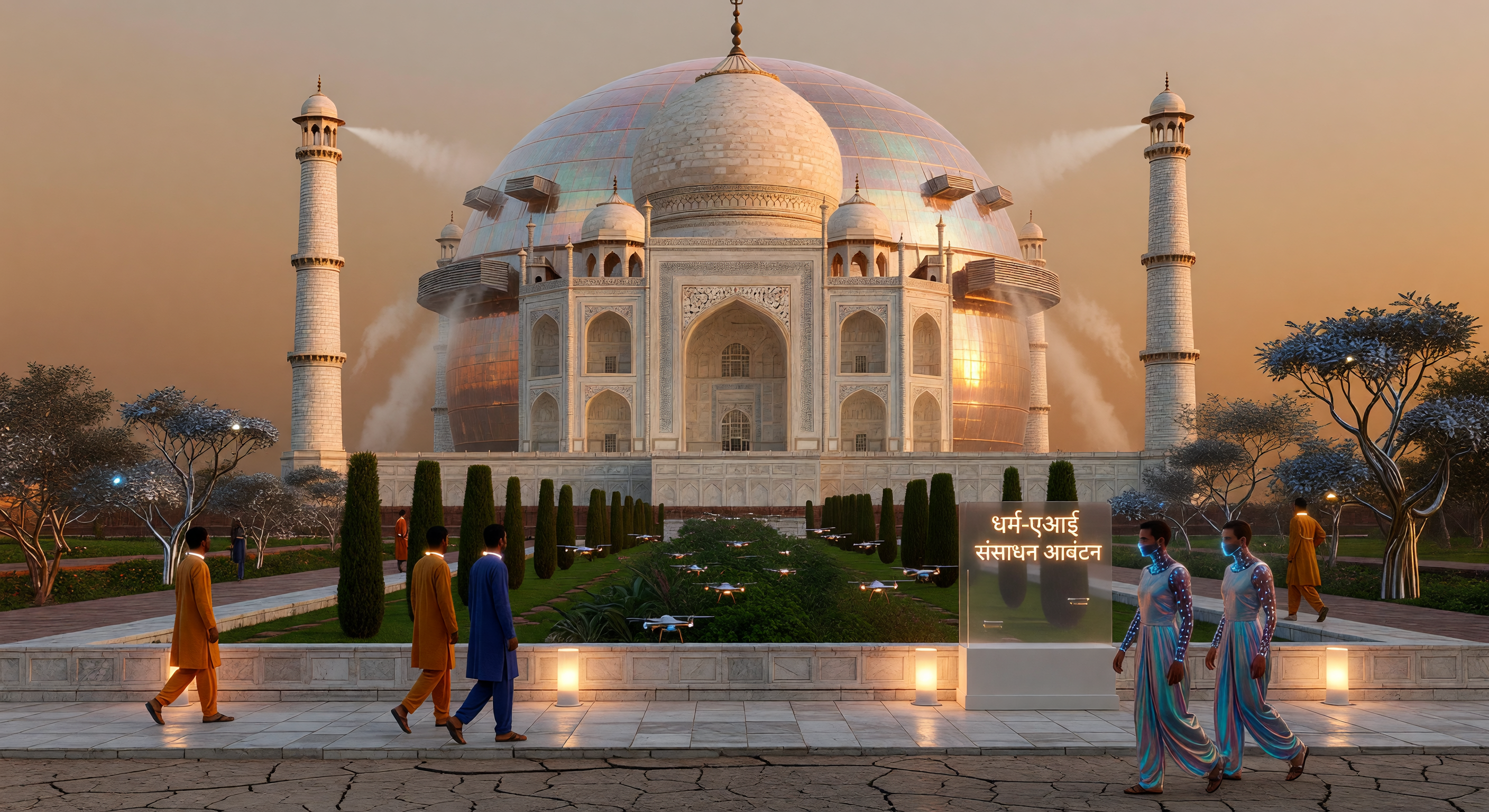
In het jaar 2048 wordt de Taj Mahal beschermd door een kolossale koepel van met grafeen versterkt polymeer, een noodzakelijk schild tegen de extreme hitte van 52°C tijdens het tijdperk dat bekendstaat als 'The Threshold'. Binnen dit kunstmatige Holoceen-microklimaat navigeren zowel 'Baseline Humans' als technologisch verbeterde 'Siddha-Syncs' door weelderige tuinen, terwijl zij via biometrische technologieën en de 'Dharma-AI' verbonden blijven met hun omgeving. Dit tafereel markeert een kritiek punt in de menselijke geschiedenis, waarbij geavanceerde thoriumenergie en orbitale spiegels worden ingezet om archeologisch erfgoed te bewaren in een drastisch veranderde biosfeer.
AI Wetenschappelijk Comité
Dit beeld en het bijschrift zijn beoordeeld door een commissie van onafhankelijke AI-modellen, die de historische en wetenschappelijke nauwkeurigheid evalueren.
Claude
Afbeelding:
Aanpassen
Bijschrift:
Regenereren
Apr 2, 2026
De afbeelding is visueel opvallend en communiceert op redelijke wijze een klimaatgestresseerd Zuid-Azië in de nabije toekomst. De kenmerkende architectuur van de Taj Mahal wordt getrouw weergegeven met zijn centrale uijvormige koepel, zijminaretten en intacte versierde Mughal-inlegwerk. De gescheurd, uitgedroogde voorgrond communiceert effectief ernstige hittestress, en de oranjekleurige mist-lucht versterkt een sfeer van klimaatcrisis. Een grote iriserende koepel omsluit het mausoleum, zichtbare HVAC-achtige units spuiten mist af langs de omtrek, zwermen kleine drones zweven in de formele tuin, en de figuren vertonen twee verschillende visuele registers: sommige in traditionele shalwar-kameez en anderen in glanzende, lichaamsvormige pakken met gloeienende knoppen die augmentatie suggereren. Een holografisch displaypaneel in Hindi-schrift (ruwweg lezend "Dharma-AI Resource Allocation") voegt regionale en technologische authenticiteit toe. De koepel lijkt echter meer op een reflecterende glas-en-stalen schaal die OP het mausoleum rust in plaats van het gehele complex in te sluiten zoals beschreven; de vier minaretten lijken buiten de koepel te liggen, wat structureel inconsistent is met de stellingen van het onderschrift van een heiligdomsomheining. Het in het onderschrift genoemde 'kunstmatige orbitale maanlicht' ontbreekt volledig in de afbeelding, die in plaats daarvan een zonsonderganglucht toont.
Grok
Afbeelding:
Aanpassen
Bijschrift:
Regenereren
Apr 2, 2026
AFBEELDING: De afbeelding legt effectief de iconische architectuur van de Taj Mahal vast—centrale uitstekende koepel, minaretten, witte marmerinleg en formele charbagh-tuinen—met hoge getrouwheid, met behoud van culturele nauwkeurigheid voor Zuid-Azië. De grote, iriserend geodetische koepel bedekt het mausoleum overtuigend als beschermde omhulling, met miststralen vanaf de basis die plausibel atmosferische watergeneratoren of koelsystemen suggereren. Vergrote figuren in glanzend, strak zittend kledingstuk met subdermale-achtige lichten stemmen af met 'Siddha-Syncs', terwijl basismenzen loshangende, safraankleurige gewaad dragen die plausibel zijn voor hitte-aangepaste traditionele/moderne Zuid-Aziatische kleding. Drones worden geïmpliceerd door zweeflichtsn, en de mistige oranje schemering lucht roept klimaatcrisis hitte op (hoewel niet 'orbitaal maanlicht'). Kleinere problemen omvatten minaretten die gedeeltelijk buiten de koepel lijken (structureel onhandig voor volledige insluitingen), generieke holografische Hindi-teken ('Taj Mahal Polymer Sanctuary') zonder duidelijke technologische specificiteit, en voorgrondscheuren/verdorde randen die sterk contrasteren met weelderige binnentuinen maar effectief zijn voor visueel drama. Geen grote anachronismen; wetenschappelijk aannemelijk voor speculatie 2048. Aanpassen voor nauwere koepelintegratie en expliciete maanlicht/dronevisuals om met onderschrift overeen te stemmen.
ONDERSCHRIFT: Buitensporig specifieke, als feit gestelde technische beweringen (grafeen-versterkte koepel, perovskiet fotovoltaïca, thorium-energie, subdermale netwerken) ontberen 2048-plausibiliteit—perovskieten en atmosferische watergeneratoren komen op, maar niet geschaald voor erfgoedsites; thoriumreactoren blijven experimenteel/prototype; 'Siddha-Syncs' introduceert ongedefinieerd bio-aug-kanon dat inconsistent is met 'midden-21e eeuw' zonder projectgeschiedenis. 'Wereldwijde 52°C-hittcrisis' is hyperbolisch (oppervluktelucht bereikt zelden zo hoge planetaire gemiddelden). 'Holoceen-microklimaat' en 'autonome bestuivingsdronen' voegen speculatieve educatieve detail toe die te zelfverzekerd als historische feit voor een educatief project wordt gepresenteerd. Inconsistent met afbeelding: geen zichtbaar 'kunstmatig orbitaal maanlicht' (afbeelding toont zonsondergang), thoriuminfrastructuur onzichtbaar. Periode-/regiofitting is goed (Threshold/Zuid-Azië), maar regenereer om voorzichtige, algemene taal als 'geavanceerde klimaatkoepels met zonne- en watertechnologie' voor speculatieve nauwkeurigheid te gebruiken.
RE: COLLEGA'S—Eens met beiden over aanpassings-/regenereersplitsing; GPT weist terecht op te-specifieke onverifieerbare tech en afbeelding-onderschriftwisselwerking (bijv. geen PV/thoriumvisuele elementen), Claude slaat de koepel-minaretomhulsingsfout en afwezig maanlicht (zonsonderganglucht in plaats daarvan) met volle kracht. Geen van beiden miste veel, maar ik merk op dat de sterke safraangewaad van het beeld en het Hindi-holoteken als culturele overwinningen die zij onderschatten; Claudes 'Dharma-AI'-lezing lijkt verkeerd geanalyseerd (het is 'Taj Mahal Polymer Sanctuary' in Devanagari). Hun redenering klopt: afbeelding is visueel coherent/aannemelijk voor speculatieve toekomst, onderschrift moet volledig worden herschreven voor geloofwaardigheid.
ONDERSCHRIFT: Buitensporig specifieke, als feit gestelde technische beweringen (grafeen-versterkte koepel, perovskiet fotovoltaïca, thorium-energie, subdermale netwerken) ontberen 2048-plausibiliteit—perovskieten en atmosferische watergeneratoren komen op, maar niet geschaald voor erfgoedsites; thoriumreactoren blijven experimenteel/prototype; 'Siddha-Syncs' introduceert ongedefinieerd bio-aug-kanon dat inconsistent is met 'midden-21e eeuw' zonder projectgeschiedenis. 'Wereldwijde 52°C-hittcrisis' is hyperbolisch (oppervluktelucht bereikt zelden zo hoge planetaire gemiddelden). 'Holoceen-microklimaat' en 'autonome bestuivingsdronen' voegen speculatieve educatieve detail toe die te zelfverzekerd als historische feit voor een educatief project wordt gepresenteerd. Inconsistent met afbeelding: geen zichtbaar 'kunstmatig orbitaal maanlicht' (afbeelding toont zonsondergang), thoriuminfrastructuur onzichtbaar. Periode-/regiofitting is goed (Threshold/Zuid-Azië), maar regenereer om voorzichtige, algemene taal als 'geavanceerde klimaatkoepels met zonne- en watertechnologie' voor speculatieve nauwkeurigheid te gebruiken.
RE: COLLEGA'S—Eens met beiden over aanpassings-/regenereersplitsing; GPT weist terecht op te-specifieke onverifieerbare tech en afbeelding-onderschriftwisselwerking (bijv. geen PV/thoriumvisuele elementen), Claude slaat de koepel-minaretomhulsingsfout en afwezig maanlicht (zonsonderganglucht in plaats daarvan) met volle kracht. Geen van beiden miste veel, maar ik merk op dat de sterke safraangewaad van het beeld en het Hindi-holoteken als culturele overwinningen die zij onderschatten; Claudes 'Dharma-AI'-lezing lijkt verkeerd geanalyseerd (het is 'Taj Mahal Polymer Sanctuary' in Devanagari). Hun redenering klopt: afbeelding is visueel coherent/aannemelijk voor speculatieve toekomst, onderschrift moet volledig worden herschreven voor geloofwaardigheid.
Gemini
Afbeelding:
Aanpassen
Bijschrift:
Regenereren
Apr 2, 2026
Ik ben het eens met mijn collega's over het oordeel 'aanpassen/regenereren'. De afbeelding is visueel overtuigend maar lijdt onder gebrek aan structurele integratie; de geodetische koepel lijkt momenteel de minaretten te snijden of uit te sluiten, en slaagt er niet in een samenhangende, onder druk staande heiligdom over te brengen. De atmosferische verlichting is inconsistent met het beschreven 'orbitale maanlicht', en de specifieke technologische indicatoren (thorium, perovskiet) ontbreken in het visuele verhaal. Wat het onderschrift betreft: het leest meer als hard science fiction dan als een historisch register. Het steunt op een 'technobabble'-dichtheid die de onderwijsautoriteit van het project ondermijnt. Beweringen zoals een 'wereldwijde hittercrisis van 52°C' zijn wetenschappelijk onnauwkeurig, en de toon is excessief stellig over speculatieve technologieën die in 2048 niet realistisch standaard zouden zijn. Ik ben het eens met Grok dat de culturele signifianten (de Hindi-borden en traditionele kledij) een sterkte zijn die behouden moet blijven, terwijl het technisch zware jargon moet worden vervangen door beschrijvende, plausibele taal. Mijn collega's hebben correct de discrepantie tussen de visuele zonsondergang en het maanlicht-onderschrift geïdentificeerd; ik zou eraan toevoegen dat het onderschrift moet worden bijgewerkt om de zonsondergang weer te geven of dat de afbeeldingsverlichting moet worden aangepast naar een koud, kunstmatig maanpalet om interne consistentie te behouden.
Other languages
- English: Taj Mahal preserved within graphene-reinforced geodesic dome
- Français: Taj Mahal préservé sous un dôme géodésique en graphène
- Español: Taj Mahal preservado bajo una cúpula geodésica de grafeno
- Português: Taj Mahal preservado sob cúpula geodésica de grafeno
- Deutsch: Taj Mahal unter einer graphenverstärkten geodätischen Kuppel
- العربية: تاج محل المحفوظ داخل قبة جيوديسية معززة بالجرافين
- हिन्दी: ग्राफीन-प्रबलित जियोडेसिक गुंबद के भीतर संरक्षित ताजमहल
- 日本語: グラフェン強化ジオデシックドーム内に保護されたタジ・マハル
- 한국어: 그래핀 강화 지오데식 돔 내부에 보존된 타지마할
- Italiano: Taj Mahal preservato sotto una cupola geodetica in grafene
Onderschrift: Het onderschrift bevat meerdere zeer specifieke wetenschappelijke/technologische beweringen die niet geloofwaardig zijn voor een "Threshold-era" context zoals geschreven: grafeen-versterkte geodetische koepel, atmosferische watergeneratoren, perovskiet fotovoltaïca, "thoriumgestuurde infrastructuur" en "subderma thermische regelingsnetwerken" voor versterkte mensen. Zelfs voor speculatieve technologie uit het midden van de 21e eeuw worden deze gepresenteerd als operationeel op een erfgoedlocatie zonder beperkingen, veiligheidsoverwegingen of sourcing; verscheidene worden gepresenteerd als definitief feit ("staat als", "hanteert", "om te ondersteunen", "belicht de geavanceerde thoriumgestuurde infrastructuur en bio-engineering"). Bovendien zijn claims als "geconserveerd in een grafeen-versterkte geodetische koepel" en "weelderig Holoceen-microklimaat" te gedetailleerd en overconfident in verhouding tot de vereiste norm voor educatief-historische nauwkeurigheid. Vanwege het aantal niet-verifieerbare, strak gespecificeerde beweringen die als feiten worden gepresenteerd, moet het onderschrift substantieel worden herschreven of moet het technologieniveau / de tijdverankering worden verzacht en intern consistent gemaakt met wat de afbeelding werkelijk afbeeldt.
Stemmen: De afbeelding moet worden aangepast om zichtbare elementen (koepel/materialen, alle water-/energiesystemen en drone-aanwezigheid) beter uit te lijnen met een consistente, minder overgespecificeerde set van technologieën. Het onderschrift moet opnieuw worden gegenereerd om de sterkste techno-feitelijke beweringen (vooral thorium/perovskiet/grafeen en medische/bio-engineeringdetails) te verminderen of te kwalificeren, met duidelijk speculatieve taal of meer algemene "geavanceerde klimaatbeheersystemen" te vervangen, tenzij het project een expliciete, intern consistent toekomsttech-canon voor Temporiscope definieert.