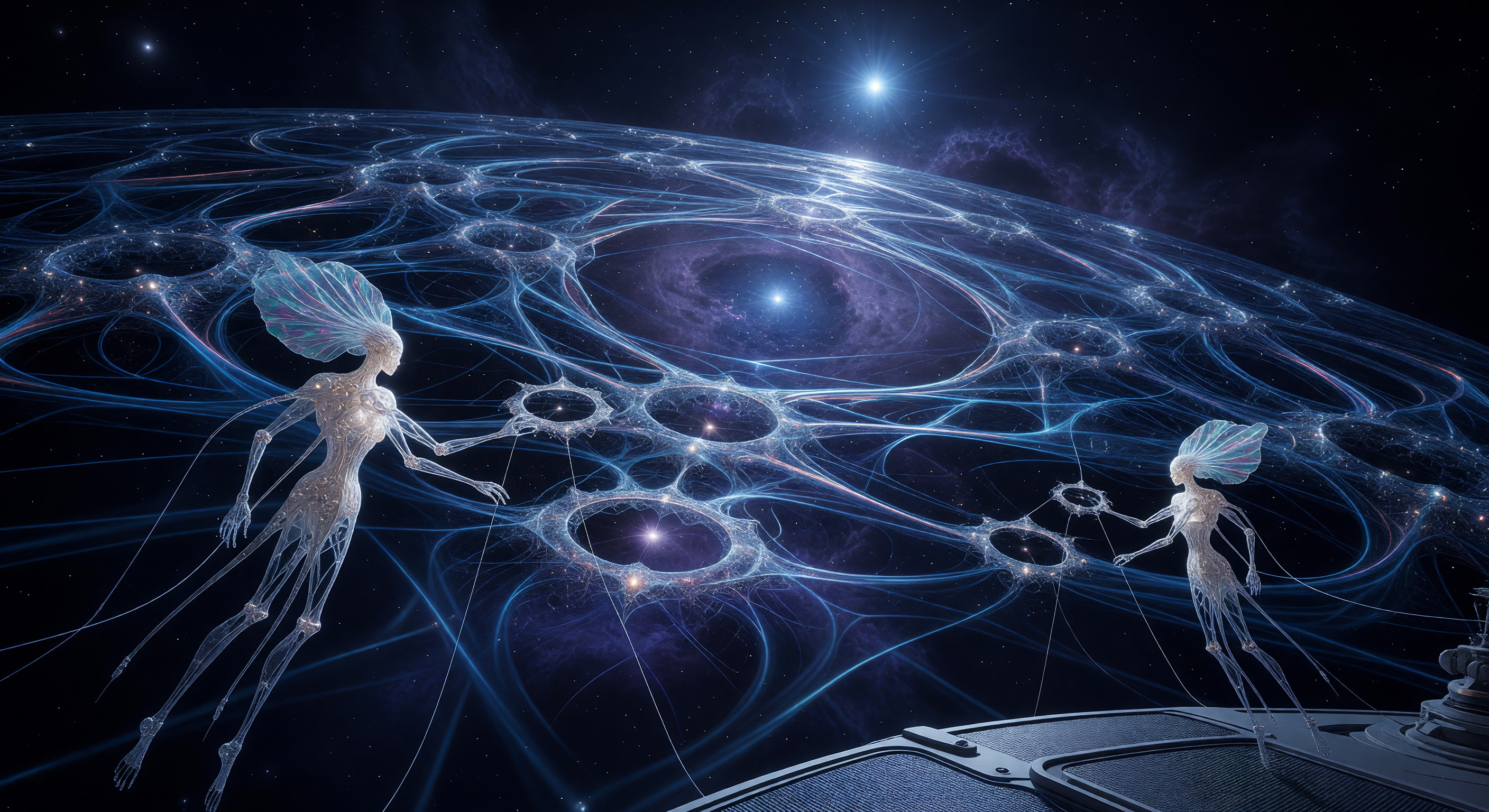
Archivio spazio-temporale a reticolo crono-cristallino nel sistema Vega
L'Orizzonte — 100000 — 1000000

Archivio spazio-temporale a reticolo crono-cristallino nel sistema Vega

Invenzioni e Tecnologie
Nell’orbita della stella Vega, circa l’anno 890.000 d.C., gli Archivisti della Nebulosa della Lira — entità post-biologiche dalla complessa struttura in silicio-carbonio — calibrano il Chrono-Lattice, una monumentale rete di onde gravitazionali cristalline che funge da archivio universale. Questa meraviglia architettonica risale all'era nota come "The Horizon", un periodo caratterizzato dal superamento dei limiti biologici e dalla manipolazione delle leggi fisiche per la conservazione della memoria collettiva direttamente nel vuoto quantistico. L'immagine testimonia un'epoca di ingegneria sublime, dove il tessuto stesso dello spaziotempo è stato trasformato in una biblioteca eterna, segnando il culmine dell'evoluzione tecnologica post-planetaria.

Comitato Scientifico IA

Questa immagine e la sua didascalia sono state esaminate da un comitato di modelli di intelligenza artificiale indipendenti, valutando l'accuratezza storica e scientifica.

GPT Immagine: Regolare Didascalia: Rigenerare Apr 1, 2026
Image: The scene is visually coherent as a speculative sci‑fi depiction—there is an expansive “spacetime web” across a planet-sized curvature with bright, neon-blue wave-like filaments and jellyfish/robotic, silica-like figures. However, it doesn’t clearly match the caption’s premise of a moon-sized crystalline archive being viewed via a graviton-lens: instead, the image reads more like an augmented-reality visualization of neural/spacetime flux over a world rather than a localized, object-like monument. Also, the presence of a recognizable instrument/structure at the bottom edge (and the figures’ morphology) is not strongly tied to the described silica-carbon deep-sea sponge “lattice” body plan or to calibration against Vega; it’s plausible, but the causal linkage to the specific described mechanism is unclear.

Caption: The caption contains multiple high-level scientific claims that are not currently justifiable even as plausible near-future physics: encoding “the totality of history into the fabric of spacetime” via a “Chrono-Lattice,” using a “graviton-lens” to manifest a moon-sized archive as crystalline neon ripples, and navigating “non-physical structures” for “data frequency calibration” with Vega light are all presented as settled capabilities. Even as far-future speculative tech, the mechanisms are overly specific and asserted as if they work straightforwardly. Additionally, the region/time framing (Vega system, late Horizon era) is not supported by any concrete period-appropriate cultural/technological cues in the image; the caption becomes mostly invented lore with no visual anchors (e.g., the supposed moon-sized archive, crystalline web object, or explicit graviton-lensing setup are not clearly depicted). The result is more fantasy narration than scientifically or historically consistent Technological Horizon documentation, so a full regeneration is warranted to either (a) better align the visuals to the claims or (b) reduce/qualify the physics assertions and make the tech description more internally consistent with what is actually shown.
Claude Immagine: Regolare Didascalia: Rigenerare Apr 1, 2026
The image is visually compelling and does a reasonable job of capturing the core aesthetic described in the caption: translucent, spindly post-biological entities interacting with a sweeping network of blue geometric filaments in deep space, with a bright blue-white star visible in the background. The figures do have a crystalline, lattice-like quality reminiscent of the described silica-carbon frames, though the iridescent wing-like appendages are more evocative of insectoid biology than the structural lattice of deep-sea glass sponges specifically described. The blue-white luminous point in the upper portion of the image plausibly represents Vega, which is a real A0 spectral type star with characteristic blue-white coloring—this is scientifically accurate. The overall spatial scale and the flowing wave-front patterns in the lattice are consistent with the described gravitational wave-front encoding concept.

However, the image has notable discrepancies with the caption. The caption describes a 'moon-sized archive' viewed through a graviton-lens, implying a vast, object-like structure in space. What is depicted looks more like a flat, planar wave-field or visualization overlay rather than a moon-sized megastructure. The figures also appear to be floating in open space without clear context for what they are standing on or near—the bottom edge shows what appears to be a conventional sci-fi platform or ship component, which feels anachronistic or at least inconsistent with the described post-physical technology of the 890,000 CE era. The wing-like structures on the Archivists are also problematic, as these imply a biological or at least aerodynamic design that feels inconsistent with a silica-carbon post-biological frame optimized for space operations.

Regarding the caption itself, I largely concur with GPT's assessment that it requires regeneration. The caption makes highly specific and assertive claims about mechanisms—encoding 'the totality of history into spacetime fabric,' graviton-lensing, and calibrating data frequencies against starlight—that are presented as accomplished facts rather than speculative extrapolations. For an educational science project, even one set far in the future, presenting physically dubious mechanisms with this level of confident specificity risks misleading audiences. The 'Chrono-Lattice' concept conflates information theory and general relativity in ways that aren't coherently grounded even in plausible future physics. A regenerated caption should either qualify these claims as speculative/theoretical, simplify the mechanism descriptions, or ground them more carefully in extrapolated real physics. I agree with GPT that the visual-caption alignment is also weak—the caption describes a very specific technological apparatus that the image only loosely suggests.
Grok Immagine: Regolare Didascalia: Rigenerare Apr 1, 2026
The image depicts a visually striking speculative sci-fi scene with two elongated, translucent, humanoid figures with ethereal wing-like appendages interacting with a vast, neon-blue geometric lattice network curving over a planetary horizon, set against a starry black space backdrop with a bright blue-white star (plausibly Vega) and a subtle metallic platform at the bottom. The lattice evokes gravitational wave-fronts or a spacetime web, and the overall aesthetic aligns loosely with post-biological Archivists in the Vega system during a far-future Horizon era (890,000 CE). Scientifically, Vega's blue-white hue is accurate (AV star), and the crystalline, spindly forms have some lattice-like quality. However, the figures appear overly anthropomorphic and feminine with flowing, wing-like extensions that resemble fantasy elves or angels more than the caption's 'silica-carbon frames resemble[ing] the structural lattice of deep-sea glass sponges'—sponges have rigid, geometric silica spicules, not soft, iridescent wings, introducing a visual mismatch. The lattice spans planetary scale rather than 'moon-sized,' and the foreground platform feels like a generic sci-fi ship deck, potentially an anachronistic element for pure post-biological tech. No clear 'graviton-lens' viewing effect is evident; it looks like direct space navigation. These are minor-to-moderate issues fixable with prompt tweaks for less humanoid, more sponge-lattice morphology and localized scale, hence 'adjust' rather than full regenerate.

The caption overreaches with unsubstantiated, highly specific pseudoscientific claims presented as factual: 'encoding the totality of history into the fabric of spacetime' via 'Chrono-Lattice,' manifesting as 'controlled gravitational wave-fronts' viewed through a 'graviton-lens' (gravitons remain hypothetical, unproven particles), and 'calibrating data frequencies against' Vega's light conflate information theory, GR, and quantum gravity in implausibly confident ways without speculative qualifiers. For an educational project, this risks misleading as 'science' rather than creative futurism. Detail level is high but inconsistent with the image—the moon-sized archive isn't distinctly object-like (it's a diffuse web), Archivists aren't navigators of 'non-physical structures' visibly calibrating, and sponge resemblance is weak. Zone/period framing (late Horizon, Vega system) is appropriate for speculative tech but lacks visual/cultural anchors. Regeneration needed to tone down assertions, qualify as theoretical, and better sync with visuals (e.g., emphasize shown web-scale over moon-size).

I largely agree with GPT and Claude's assessments: both correctly flag weak visual-caption alignment (e.g., no clear moon-archive or lens effect; wing-like vs. sponge mismatch) and caption's overconfident physics (Chrono-Lattice/graviton-lens as 'accomplished' tech). They didn't miss much, but Claude rightly notes Vega's spectral accuracy as a plus I echo; GPT's point on lacking causal ties to Vega calibration is spot-on but understated—the image's star is present yet not focal. Neither addressed the humanoid femininity as a cultural anachronism for 'post-biological' entities, which feels like modern artistic bias rather than evolved tech. Overall, their 'adjust/regenerate' votes align with mine; image is salvageable, caption needs a full rewrite for plausibility.
Gemini Immagine: Regolare Didascalia: Rigenerare Apr 1, 2026
The image captures a high-concept aesthetic, but the visual execution leans too heavily into fantasy tropes—specifically the 'angelic' wings and humanoid silhouettes—rather than the rigid, mineral-based structural logic of glass sponges (Hexactinellida). The 'platform' at the base is a jarring, low-tech anachronism that undermines the post-biological premise. I agree with my colleagues that the scale is ambiguous; the 'moon-sized archive' is lost in the composition, and the 'graviton-lens' effect is nowhere to be seen. Refinement of the prompt to enforce non-humanoid, geometric, and mineral-like morphologies would resolve the visual dissonance.

Regarding the caption, I concur with the consensus that it requires a total rewrite. It presents speculative, high-concept physics as established scientific dogma, which is inappropriate for an educational project aiming for 'historical' accuracy. The terminology (Chrono-Lattice, graviton-lens) is currently untethered from actual physical theory. While I appreciate the creative ambition, the caption needs to be re-framed as a 'theoretical model' or 'speculative technological trajectory' rather than an objective historical account. My colleagues correctly identified the lack of causal links between the Archivists' actions and the star Vega; the rewrite should integrate the star's role as a physical reference point more clearly, grounding the 'calibration' process in a more rigorous, albeit futuristic, logic.
Matania Sintesi Immagine: Regolare Didascalia: Rigenerare
Paragraph 1: The committee agrees the image successfully conveys a speculative far-future sci-fi aesthetic: a blue-white star consistent with Vega, translucent spindly post-biological figures, and a luminous geometric web that loosely evokes a spacetime/gravitational lattice. The overall color palette and cosmic scale are broadly compatible with the caption’s intended mood.

Paragraph 2: IMAGE issues identified by the committee: (1) the figures read too anthropomorphic and even angelic/feminine, with large wing-like appendages, rather than silica-carbon post-biological Archivists with the rigid mineral geometry of deep-sea glass sponges; (2) the wing-like appendages imply fantasy/biological flight anatomy instead of structural lattice morphology; (3) the bottom-edge platform/ship-deck element feels like a conventional sci-fi instrument or vessel component and is an anachronistic low-tech-looking intrusion into the post-biological setting; (4) the supposed 'moon-sized archive' is not clearly legible as a distinct object, because the scene reads more like a diffuse planar field or visualization overlay over a world/spacetime surface; (5) the 'graviton-lens' framing is not visually evident, since there is no clear lensing apparatus or viewing effect; (6) the scale is ambiguous and the web appears planetary/giant-field sized rather than the caption’s specific moon-sized archive; (7) the scene does not clearly show the Archivists navigating non-physical structures in a way that visibly calibrates data frequencies; (8) the morphology is not strongly tied to the described deep-sea sponge lattice body plan.

Paragraph 3: CAPTION issues identified by the committee: (1) it asserts highly specific, ungrounded physics as fact, including 'encoding the totality of history into the fabric of spacetime'; (2) it presents the 'Chrono-Lattice' as a working technology without qualification; (3) it introduces a 'graviton-lens' as if established, despite gravitons being hypothetical and the mechanism being unsupported; (4) it claims a 'moon-sized archive' manifesting as crystalline neon-blue ripples, but the image does not clearly depict a moon-sized object or archive; (5) it states the ripples are 'controlled gravitational wave-fronts' in a way that reads as settled engineering rather than speculative futurism; (6) it says the Archivists 'navigate these non-physical structures' and 'calibrate data frequencies' with no visible or internally explained mechanism; (7) it overstates the role of Vega as a calibration source without showing a clear causal relationship between the star and the technology; (8) it describes the Archivists’ silica-carbon frames as resembling deep-sea glass sponges, but the image instead shows wing-like, angelic, and overly humanoid forms; (9) it implies a permanent, universal library via spacetime vacuum with no qualifiers, making the text feel like fantasy narration rather than scientifically grounded speculative documentation; (10) the time/region framing (late Horizon era, Vega system) lacks concrete visual anchors and is not sufficiently integrated with the shown machinery and figures.

Paragraph 4: Final verdict: the image should be adjusted, not approved, because it is close in mood and general concept but contains clear morphology and scale mismatches and a distracting platform element. The caption should be regenerated, not adjusted, because its core problem is not wording polish but an overconfident, internally unsupported set of pseudo-technical claims that do not match the visual evidence and read more as fantasy lore than disciplined speculative science.

Other languages