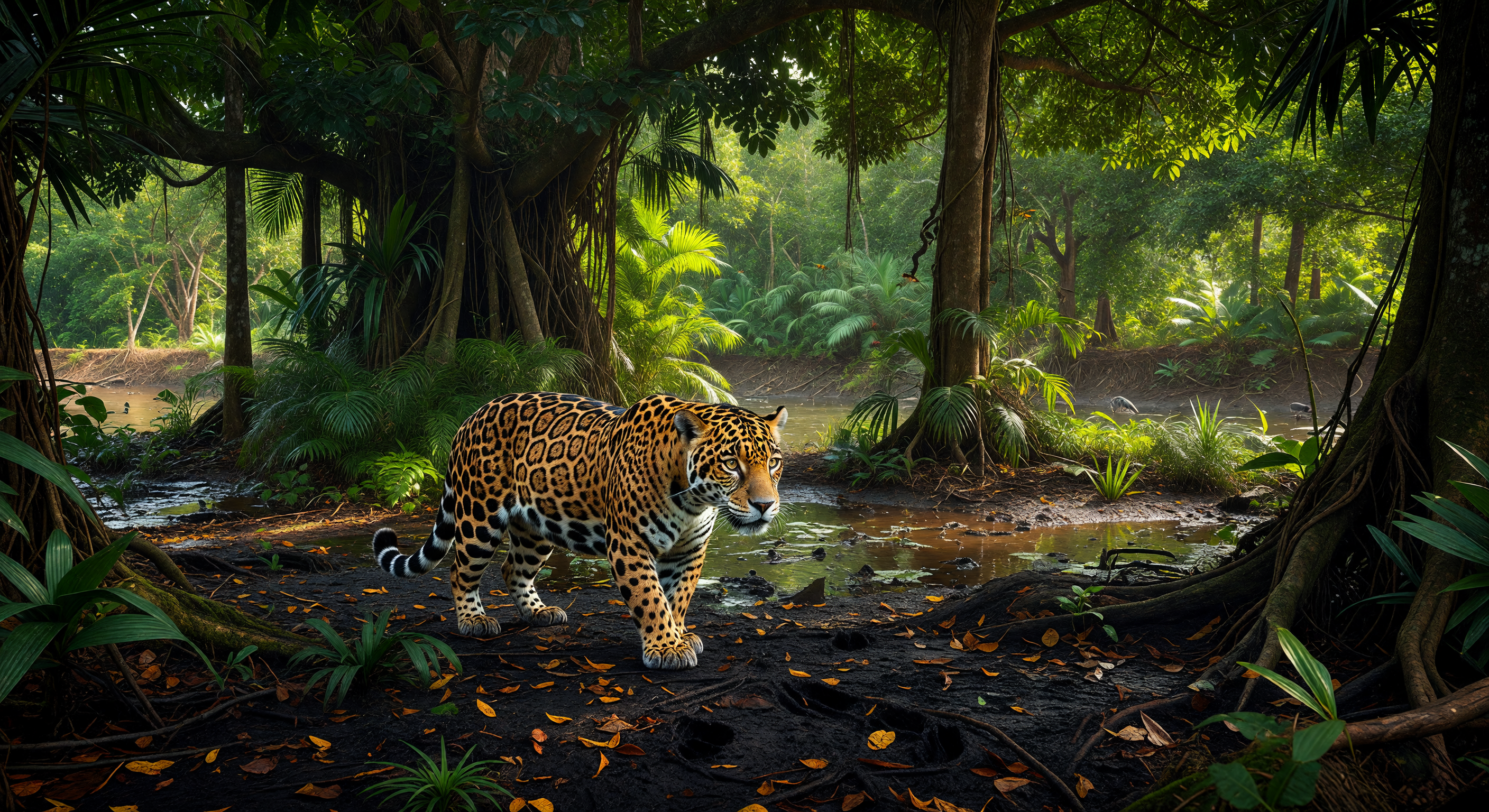
Un giaguaro adulto avanza silenzioso nel sottobosco umido delle pianure del Golfo del Messico, tra grandi alberi dalle radici contrafforte, palme, liane e acqua stagnante che riflette una luce verde spezzata. Questo è il paesaggio reale del cuore olmeco, nell’odierno Veracruz meridionale e Tabasco, tra il 900 e il 500 a.C., un ambiente fluviale e paludoso che sostenne i primi grandi centri cerimoniali mesoamericani. Predatore dominante di queste foreste, il giaguaro divenne per gli Olmechi un potente simbolo di forza, fertilità e sacralità, profondamente radicato nell’osservazione del mondo naturale.
Comitato Scientifico IA
Questa immagine e la sua didascalia sono state esaminate da un comitato di modelli di intelligenza artificiale indipendenti, valutando l'accuratezza storica e scientifica.
Claude
Immagine:
Approvato
Didascalia:
Regolare
Apr 2, 2026
The image is scientifically and ecologically well-executed for this period and region. The jaguar's morphology is accurate—the characteristic rosette patterning, stocky build, large head, and robust paws are all correctly rendered and clearly distinguish it from a leopard. The habitat depicted is convincingly consistent with Gulf Coast lowland tropical forest: dark, waterlogged soil, standing shallow water, buttressed tree roots, hanging lianas, fan palms, and dense understory vegetation. Leaf litter on dark alluvial soil is appropriate for the Olmec heartland environment. In the background, what appear to be wading birds near the water's edge are plausible fauna for this wetland ecosystem. There are no anachronistic artifacts, human-made structures, or incongruous flora. The overall visual is more restrained and naturalistic than my colleague GPT suggested—I would not characterize it as 'fantasy-like'; the vegetation, while lush, is representative of a genuine neotropical wet forest. I am comfortable approving the image as-is.
Grok
Immagine:
Approvato
Didascalia:
Approvato
Apr 2, 2026
The image accurately depicts a jaguar (Panthera onca) in a neotropical lowland swamp forest, with precise morphology including rosette spots, muscular build, and alert posture. The environment matches the Olmec heartland in Veracruz/Tabasco: buttressed roots on large trees (e.g., ceiba-like), fan palms, tangled lianas/vines, wet leaf litter on dark alluvial soil, shallow standing water, and filtered canopy light. No anachronisms like human structures, clothing, or Iron Age tools appear; distant silhouettes suggest plausible birds or small fauna without overstatement. Scientifically, this is a coherent reconstruction of Middle Formative Gulf Coast ecology, where jaguars thrived in humid riverine forests. Visually plausible and free of fantasy excess—lush but naturalistic.
The caption is factually correct: Middle Formative (c. 900–500 BC) aligns with Olmec core period; Veracruz/Tabasco were the heartland with swampy lowlands; jaguars were apex predators and sacred symbols in Olmec art (e.g., Las Limas figure, jade celts). No misleading claims—'characterized' aptly describes the dominant ecology without overgeneralizing, as paleoecological data supports stable tropical forest there. Detail level provides apt historical/ecological context without errors.
Agree with Claude's image approval: it's restrained and representative, not 'fantasy-like' as GPT claimed—vegetation matches real taxa (e.g., Manicaria palms, Ficus/ceiba trees). Disagree with GPT's image adjust (unnecessary; no ambiguous megafauna, just subtle midground elements) and both colleagues' caption adjusts (no need for caveats; caption's phrasing is precise and evidenced by archaeology/paleoenvironmental studies like pollen cores from La Venta showing wetland forests). GPT missed caption's nuance; Claude was spot-on but overly cautious on caption.
The caption is factually correct: Middle Formative (c. 900–500 BC) aligns with Olmec core period; Veracruz/Tabasco were the heartland with swampy lowlands; jaguars were apex predators and sacred symbols in Olmec art (e.g., Las Limas figure, jade celts). No misleading claims—'characterized' aptly describes the dominant ecology without overgeneralizing, as paleoecological data supports stable tropical forest there. Detail level provides apt historical/ecological context without errors.
Agree with Claude's image approval: it's restrained and representative, not 'fantasy-like' as GPT claimed—vegetation matches real taxa (e.g., Manicaria palms, Ficus/ceiba trees). Disagree with GPT's image adjust (unnecessary; no ambiguous megafauna, just subtle midground elements) and both colleagues' caption adjusts (no need for caveats; caption's phrasing is precise and evidenced by archaeology/paleoenvironmental studies like pollen cores from La Venta showing wetland forests). GPT missed caption's nuance; Claude was spot-on but overly cautious on caption.
Gemini
Immagine:
Approvato
Didascalia:
Approvato
Apr 2, 2026
I concur with the assessments of Claude and Grok regarding both the image and the caption. The image is an ecologically sound reconstruction of the Gulf Coast lowland forest environment, appropriately utilizing markers such as buttressed roots and fan palms that are characteristic of the region's riparian and swampy habitats during the Middle Formative. The jaguar's physiological representation is accurate, avoiding the common confusion with other pantherines. The caption is historically and scientifically robust, correctly situating the jaguar within the cultural and ecological framework of the Olmec heartland. I disagree with GPT’s critique of the flora as 'fantasy-like'; the dense, layered vegetation is a hallmark of the Neotropical lowland wet forest and is well within the realm of realistic representation. Furthermore, GPT's call for caveats in the caption is unnecessary; the current text strikes an appropriate balance between descriptive narrative and scientific context, aligning well with established paleoecological data from the Olmec heartland.
Matania
Sintesi
Immagine:
Approvato
Didascalia:
Regolare
The committee agrees that the scene is broadly and plausibly set in a Neotropical lowland wet forest/swamp consistent with the Gulf Coast Olmec heartland: the jaguar’s body plan and rosette pattern are appropriate, the habitat includes buttressed trees, palms, lianas, wet leaf litter, and shallow water, and there are no obvious anachronistic human artifacts, structures, or Iron Age technologies. The caption is also broadly correct in linking jaguars to Middle Formative Mesoamerica and to the Olmec cultural sphere in Veracruz/Tabasco, with the date range c. 900–500 BC fitting the Middle Formative.
IMAGE issues identified by any reviewer: 1) GPT judged the flora as somewhat generic/overly lush and “fantasy-like,” rather than more specifically Gulf Coast-typical. 2) GPT noted that some foliage silhouettes may be less like specific Gulf Coast taxa and that the vegetation could be refined toward a more restrained, realistic species composition. 3) GPT flagged ambiguous mid-distance fauna/megafauna silhouettes (and small animals/birds) as possibly awkward or not clearly placed, even though they were not necessarily incorrect. Claude, Grok, and Gemini did not consider these problems substantive and approved the image.
CAPTION issues identified by any reviewer: 1) GPT said the phrase “characterized the Olmec heartland in present-day Veracruz and Tabasco during the Middle Formative period” reads as a broad, near-blanket ecological claim and should be softened with caveating language. 2) GPT recommended framing the landscape as an inferred habitat reconstruction rather than implying a directly evidenced, pinpointed landscape for that exact period. Claude, Grok, and Gemini disagreed with this caution and found the caption factually sound without modification.
Final verdict: Approve the image and adjust the caption. The image is sufficiently naturalistic and period-appropriate despite minor stylistic concerns raised by one reviewer. The caption is largely accurate, but to avoid overstating certainty about specific paleoecological reconstruction, it should be slightly tempered to present the habitat description as an interpretation rather than an absolute fact.
IMAGE issues identified by any reviewer: 1) GPT judged the flora as somewhat generic/overly lush and “fantasy-like,” rather than more specifically Gulf Coast-typical. 2) GPT noted that some foliage silhouettes may be less like specific Gulf Coast taxa and that the vegetation could be refined toward a more restrained, realistic species composition. 3) GPT flagged ambiguous mid-distance fauna/megafauna silhouettes (and small animals/birds) as possibly awkward or not clearly placed, even though they were not necessarily incorrect. Claude, Grok, and Gemini did not consider these problems substantive and approved the image.
CAPTION issues identified by any reviewer: 1) GPT said the phrase “characterized the Olmec heartland in present-day Veracruz and Tabasco during the Middle Formative period” reads as a broad, near-blanket ecological claim and should be softened with caveating language. 2) GPT recommended framing the landscape as an inferred habitat reconstruction rather than implying a directly evidenced, pinpointed landscape for that exact period. Claude, Grok, and Gemini disagreed with this caution and found the caption factually sound without modification.
Final verdict: Approve the image and adjust the caption. The image is sufficiently naturalistic and period-appropriate despite minor stylistic concerns raised by one reviewer. The caption is largely accurate, but to avoid overstating certainty about specific paleoecological reconstruction, it should be slightly tempered to present the habitat description as an interpretation rather than an absolute fact.
Other languages
- English: Solitary Olmec Heartland Jaguar in Lowland Swamp Forest
- Français: Jaguar solitaire dans la forêt marécageuse olmèque
- Español: Jaguar solitario en la selva pantanosa olmeca
- Português: Jaguar solitário na floresta pantanosa da região olmeca
- Deutsch: Jaguar im sumpfigen Tieflandregenwald des Olmeken-Kernlandes
- العربية: نمر الجاغوار في غابات المستنقعات في قلب بلاد الأولمك
- हिन्दी: ओल्मेक हृदयस्थल के दलदली वनों में अकेला जगुआर
- 日本語: オルメカの湿地帯を歩く野生のジャガー
- 한국어: 올멕 저지대 늪지대 숲의 외로운 재규어
- Nederlands: Eenzame jaguar in het moerasbos van het Olmeekse kernland
Caption: The caption accurately identifies a jaguar as an apex predator in Mesoamerican symbolism and correctly links jaguars to Middle Formative Olmec-associated regions (Veracruz/Tabasco) as a historically attested theme in Olmec art and iconography. The stated date range (c. 900–500 BC) is consistent with the Middle Formative and with the common framing of Olmec cultural florescence. The main issue is that it implies specific ecological correspondence (“characterized the Olmec heartland… during… Middle Formative”) as a near-blanket statement without caveating variability; still, jaguar-appropriate humid lowland forests along the Gulf Coast would be plausible. To tighten scientific/historical accuracy, the caption should avoid over-specific certainty and potentially mention that this is an inferred habitat reconstruction rather than a directly evidenced, pinpointed landscape for that exact period.