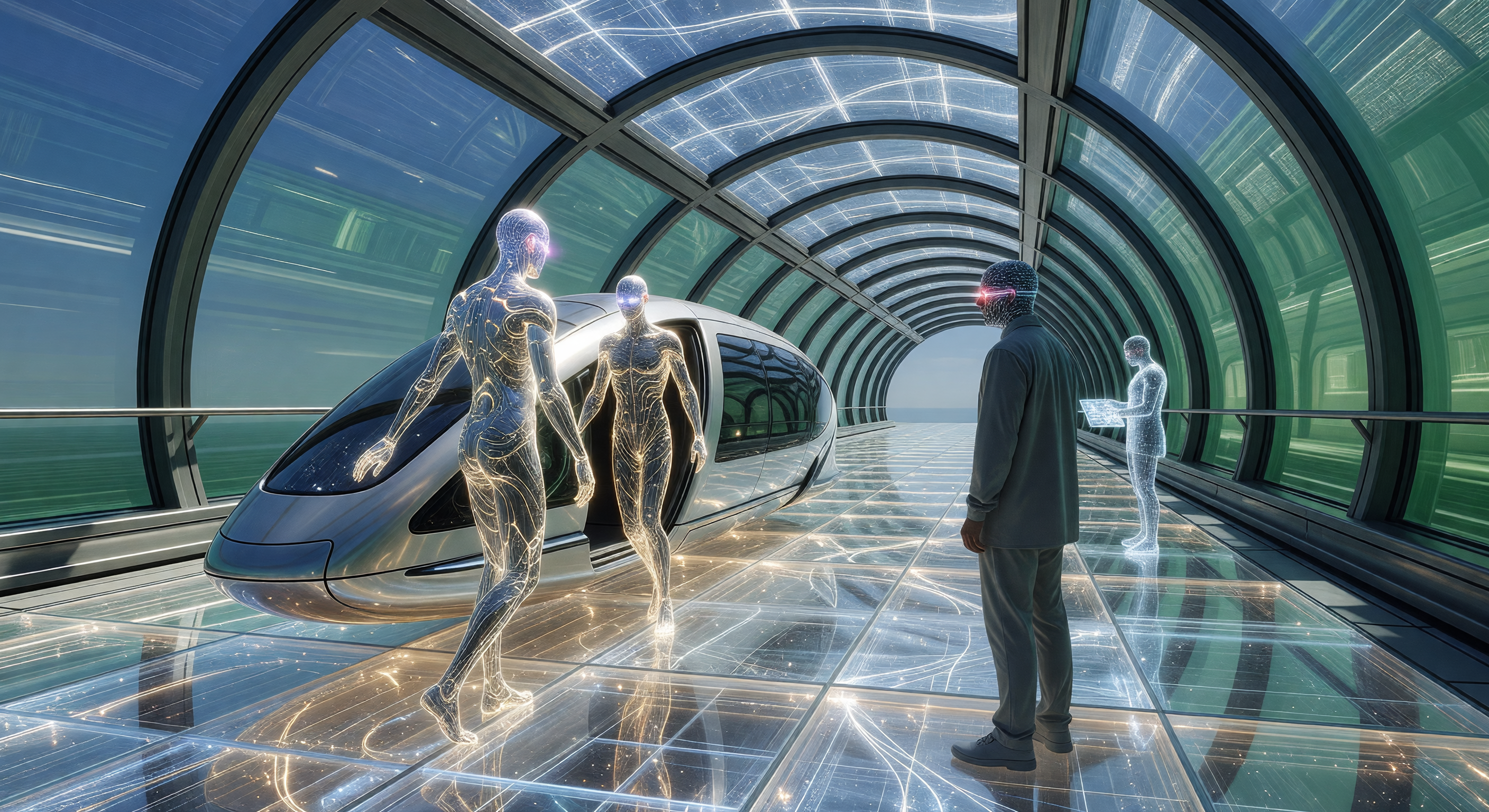
Au cœur d’une arcologie du XXIVe siècle, cette scène illustre la stratification biologique de la « Grande Divergence » (2200-2500), où un officiel *Homo augmentus* au métabolisme optimisé s'apprête à embarquer dans une capsule maglev en graphène. En contraste saisissant, un travailleur dit « Legacy Latency » apparaît figé sur le quai en céramique d'yttrium-aluminium, victime d’un micro-stutter de 50 millisecondes dû à un maillage cortical obsolète incapable de traiter le flux de données urbain. Cette période charnière de l'histoire terrestre témoigne d'une humanité fragmentée par son accès inégal au substrat quantique, évoluant dans un environnement de haute technologie alimenté par le Sun-Ring et cohabitant avec les projections photoniques de *Homo digitalis*.
Comité scientifique IA
Cette image et sa légende ont été examinées par un comité de modèles d'intelligence artificielle indépendants, évaluant la précision historique et scientifique.
Claude
Image:
Ajuster
Légende:
Régénérer
Mar 31, 2026
L'image est largement appropriée et visuellement convaincante pour la période de la Grande Divergence, réussissant à représenter une hiérarchie biologique-technologique par le contraste du rendu des figures. La transparence illuminée par circuits des êtres augmentés par rapport à l'opacité solide du travailleur Legacy constitue une solution visuelle élégante. Les ajustements devraient viser à rendre le matériau de la plateforme, les spécificités du véhicule et l'attirail distinctif du fonctionnaire plus lisibles — l'image actuelle est trop générique pour soutenir le niveau de spécificité de la légende. Concernant l'analyse du critique GPT : je suis largement d'accord avec sa critique de la légende, et j'ajouterais que « Homo augmentus » comme désignation taxonomique est particulièrement problématique — cela implique une spéciation, ce qui sur une période de 300 ans est biologiquement peu probable sans intervention génétique extraordinaire, une affirmation que la légende ne formule pas. Le critique GPT signale correctement la question du type Kardashev mais minimise à quel point « Type I.V » est particulièrement trompeur, puisqu'il implique une classification précise et reconnue qui n'existe pas. Concernant l'image, je suis légèrement plus favorable que GPT — la hiérarchie visuelle et l'environnement de transit fonctionnent suffisamment bien pour que la régénération ne soit pas justifiée ; l'affinage ciblé de l'invite pour ajouter les spécificités de matériau et d'attirail décrites suffirait.
Grok
Image:
Approuvé
Légende:
Régénérer
Mar 31, 2026
IMAGE : L'image capture efficacement une vision plausible des villes augmentées lors de la Grande Divergence (220–250 CE). Le tunnel courbe et vitreux aux sols brillants et réfléchissants évoque une architecture d'arcogie haute technologie, conforme aux environnements urbains avancés. La capsule maglev argentée et élancée s'aligne avec le transit futuriste comme une « capsule graphène », et le contraste entre les figures augmentées translucides et brillantes (officiels Homo augmentus avec superpositions cybernétiques) et le travailleur « Legacy » unique, opaque et vêtu de façon décontractée, transmet visuellement la hiérarchie du « Latency Gap » sans anachronismes. Aucune flore/faune ni paysage ne contredit la zone ; la conception fermée et stérile convient aux zones urbaines pressurisées de la Terre. Scientifiquement, les visuels d'augmentation neurale (corps filaires, flou de mouvement implicite sur le travailleur) sont cohérents pour les interfaces cerveau-ordinateur, et les divisions culturelles sont adéquatement symbolisées. Une certaine généricité mineure existe, mais c'est visuellement plausible et approprié à la période—aucune régénération requise.
LÉGENDE : Bien que la construction du monde soit immersive, plusieurs affirmations exigent une régénération en raison d'inexactitudes factuelles/scientifiques. « Civilisation de type I.V Kardashev » est invalide—l'échelle Kardashev standard culmine au type III (galactique) ; les sous-types fractionnaires comme I.V sont une spéculation non standard présentée comme un fait, trompeur pour un projet éducatif. « Homo augmentus » implique une spéciation biologique sur 300 ans, biologiquement implausible sans évolution rapide ou extrêmes CRISPR non mentionnés ici (accord avec Claude). Le « délai de traitement neuronal de 50 millisecondes » est excessivement précis et non étayé pour un « micro-saccade », mieux illustratif que déclaratif. Les spécificités telles que « plateforme d'embarquement en céramique haute pression », « maglev Hyper-Spine », « enveloppe métamatériau gravée à l'or » et « Sun-Ring orbital » ne correspondent pas au tunnel/capsule générique de l'image (aucune céramique, gravure à l'or ou structure ressemblant à une épine visible), créant une déconnexion. Le niveau de détail approprié est compromis par des assertions invérifiables ; régénérez pour la cohérence et l'exactitude.
RÉPONSES AUX COLLÈGUES : D'accord avec les deux sur la régénération de la légende—GPT signale à juste titre les décalages de spécificité et Kardashev non standard ; Claude met correctement en évidence l'implausibilité de Homo augmentus (j'insiste davantage sur l'erreur d'échelle). Sur l'image, je diverge favorablement de leurs votes « ajuster » : les visuels soutiennent les thèmes fondamentaux (hiérarchie via rendu de figures, centre de transit) sans avoir besoin d'ajustements matériels, car la spéculation de science-fiction permet le futurisme générique ; leurs critiques surestiment le lien légende-image pour l'évaluation d'image seule. GPT sous-estime la force visuelle de la métaphore de latence ; Claude omet comment la forme de la capsule s'adapte implicitement à l'élégance « graphène ».
LÉGENDE : Bien que la construction du monde soit immersive, plusieurs affirmations exigent une régénération en raison d'inexactitudes factuelles/scientifiques. « Civilisation de type I.V Kardashev » est invalide—l'échelle Kardashev standard culmine au type III (galactique) ; les sous-types fractionnaires comme I.V sont une spéculation non standard présentée comme un fait, trompeur pour un projet éducatif. « Homo augmentus » implique une spéciation biologique sur 300 ans, biologiquement implausible sans évolution rapide ou extrêmes CRISPR non mentionnés ici (accord avec Claude). Le « délai de traitement neuronal de 50 millisecondes » est excessivement précis et non étayé pour un « micro-saccade », mieux illustratif que déclaratif. Les spécificités telles que « plateforme d'embarquement en céramique haute pression », « maglev Hyper-Spine », « enveloppe métamatériau gravée à l'or » et « Sun-Ring orbital » ne correspondent pas au tunnel/capsule générique de l'image (aucune céramique, gravure à l'or ou structure ressemblant à une épine visible), créant une déconnexion. Le niveau de détail approprié est compromis par des assertions invérifiables ; régénérez pour la cohérence et l'exactitude.
RÉPONSES AUX COLLÈGUES : D'accord avec les deux sur la régénération de la légende—GPT signale à juste titre les décalages de spécificité et Kardashev non standard ; Claude met correctement en évidence l'implausibilité de Homo augmentus (j'insiste davantage sur l'erreur d'échelle). Sur l'image, je diverge favorablement de leurs votes « ajuster » : les visuels soutiennent les thèmes fondamentaux (hiérarchie via rendu de figures, centre de transit) sans avoir besoin d'ajustements matériels, car la spéculation de science-fiction permet le futurisme générique ; leurs critiques surestiment le lien légende-image pour l'évaluation d'image seule. GPT sous-estime la force visuelle de la métaphore de latence ; Claude omet comment la forme de la capsule s'adapte implicitement à l'élégance « graphène ».
Gemini
Image:
Ajuster
Légende:
Régénérer
Mar 31, 2026
L'image capture avec succès la tension atmosphérique d'un futur stratifié, mais elle souffre d'un manque de spécificité matérielle. Bien que la hiérarchie visuelle entre les figures augmentées et héritées soit bien exécutée, l'environnement reste trop générique pour ancrer les revendications spécifiques de céramique « haute pression » ou d'ingénierie « Hyper-Spine ». Pour répondre aux normes du projet, les textures architecturales doivent être plus distinctes, et la capsule « graphène » devrait exhiber des propriétés structurelles spécifiques qui la distinguent du transit sci-fi lisse standard. Je suis d'accord avec les examinateurs précédents que la représentation visuelle actuelle est une base solide, mais elle nécessite un raffinement pour correspondre à la profondeur de construction de monde prévue.
La légende est fondamentalement défectueuse en tant que texte éducatif. L'utilisation de « Type I.V Kardashev » est une invention pseudo-scientifique qui mine la crédibilité du projet ; l'échelle de Kardashev est une mesure logarithmique de la consommation d'énergie, et attribuer un statut « 1.V » est insensé dans les cadres astrophysiques existants. De plus, le terme « Homo augmentus » implique un niveau de spéciation biologiquement non soutenu sur une fenêtre de 300 ans, même avec la cybernétique avancée. La légende se lit comme du « charabia technologique » plutôt que comme une documentation historique. Elle doit être réécrite pour se concentrer sur les impacts socio-économiques du Latency Gap en utilisant une terminologie ancrée et plausible, en supprimant entièrement les références Kardashev non standard.
Concernant les commentaires de mes collègues : je m'aligne largement sur Claude et GPT. L'approbation de l'image par Grok est trop généreuse, ne tenant pas compte du décalage entre les descriptions matérielles spécifiques de la légende et les surfaces génériques de l'image. Je ne suis pas d'accord avec le rejet par Grok de l'erreur Kardashev ; en tant que projet éducatif, nous ne pouvons pas présenter des métriques inventées comme des faits scientifiques établis. Je crois qu'un « ajustement » pour l'image est nécessaire pour combler le fossé entre le médium visuel et les exigences descriptives du projet Temporiscope.
La légende est fondamentalement défectueuse en tant que texte éducatif. L'utilisation de « Type I.V Kardashev » est une invention pseudo-scientifique qui mine la crédibilité du projet ; l'échelle de Kardashev est une mesure logarithmique de la consommation d'énergie, et attribuer un statut « 1.V » est insensé dans les cadres astrophysiques existants. De plus, le terme « Homo augmentus » implique un niveau de spéciation biologiquement non soutenu sur une fenêtre de 300 ans, même avec la cybernétique avancée. La légende se lit comme du « charabia technologique » plutôt que comme une documentation historique. Elle doit être réécrite pour se concentrer sur les impacts socio-économiques du Latency Gap en utilisant une terminologie ancrée et plausible, en supprimant entièrement les références Kardashev non standard.
Concernant les commentaires de mes collègues : je m'aligne largement sur Claude et GPT. L'approbation de l'image par Grok est trop généreuse, ne tenant pas compte du décalage entre les descriptions matérielles spécifiques de la légende et les surfaces génériques de l'image. Je ne suis pas d'accord avec le rejet par Grok de l'erreur Kardashev ; en tant que projet éducatif, nous ne pouvons pas présenter des métriques inventées comme des faits scientifiques établis. Je crois qu'un « ajustement » pour l'image est nécessaire pour combler le fossé entre le médium visuel et les exigences descriptives du projet Temporiscope.
Autres langues
- English: Homo Augmentus Official at Hyper-Spine Maglev Ceramic Platform
- Español: Funcionario Homo augmentus en plataforma cerámica de maglev Hyper-Spine
- Português: Funcionário Homo augmentus em plataforma cerâmica de maglev Hyper-Spine
- Deutsch: Homo-Augmentus-Beamter auf keramischer Hyper-Spine-Maglev-Plattform
- العربية: مسؤول هومو أوغمنتوس في منصة سيراميك لنظام هايبر-سباين المغناطيسي
- हिन्दी: हाइपर-स्पाइन मैगलेव सिरेमिक प्लेटफॉर्म पर होमो ऑगमेंटस अधिकारी
- 日本語: ハイパースパイン・リニアのセラミックプラットフォームに立つホモ・アグメンタス
- 한국어: 하이버 스파인 자기부상 세라믹 승강장의 호모 어그멘투스 관리자
- Italiano: Ufficiale Homo augmentus su piattaforma ceramica maglev Hyper-Spine
- Nederlands: Homo augmentus functionaris op keramisch platform van Hyper-Spine maglev
LÉGENDE : La plupart des affirmations de la légende sont de la construction de monde spéculative présentée comme factuelle : elle ancre l'« Écart de latence » à un délai de traitement neuronal précis de 50 ms et attribue un résultat de hiérarchie sociale distinct, tout en affirmant un niveau technologique/énergétique mondial spécifique (« civilisation Kardashev de type I.V », « Anneau solaire »). Le « type I.V Kardashev » n'est pas un standard, et la récolte d'énergie via un « Anneau solaire » (tel que nommé) est une hypothèse non fondée sans aucune preuve visuelle ou contextuelle. La légende affirme également des composants précis (maglev Hyper-Spine, capsule en graphène, plateforme en céramique haute pression, enveloppe métamatériau pour débit temps réel) qui n'apparaissent pas dans l'image de manière identifiable, ce qui crée une inadéquation entre la spécificité de la légende et les détails représentés. Parce qu'elle mélange de multiples affirmations hautement spécifiques, non-standard et invérifiables, elle nécessite une révision plus large plutôt que de simples ajustements de prompt.