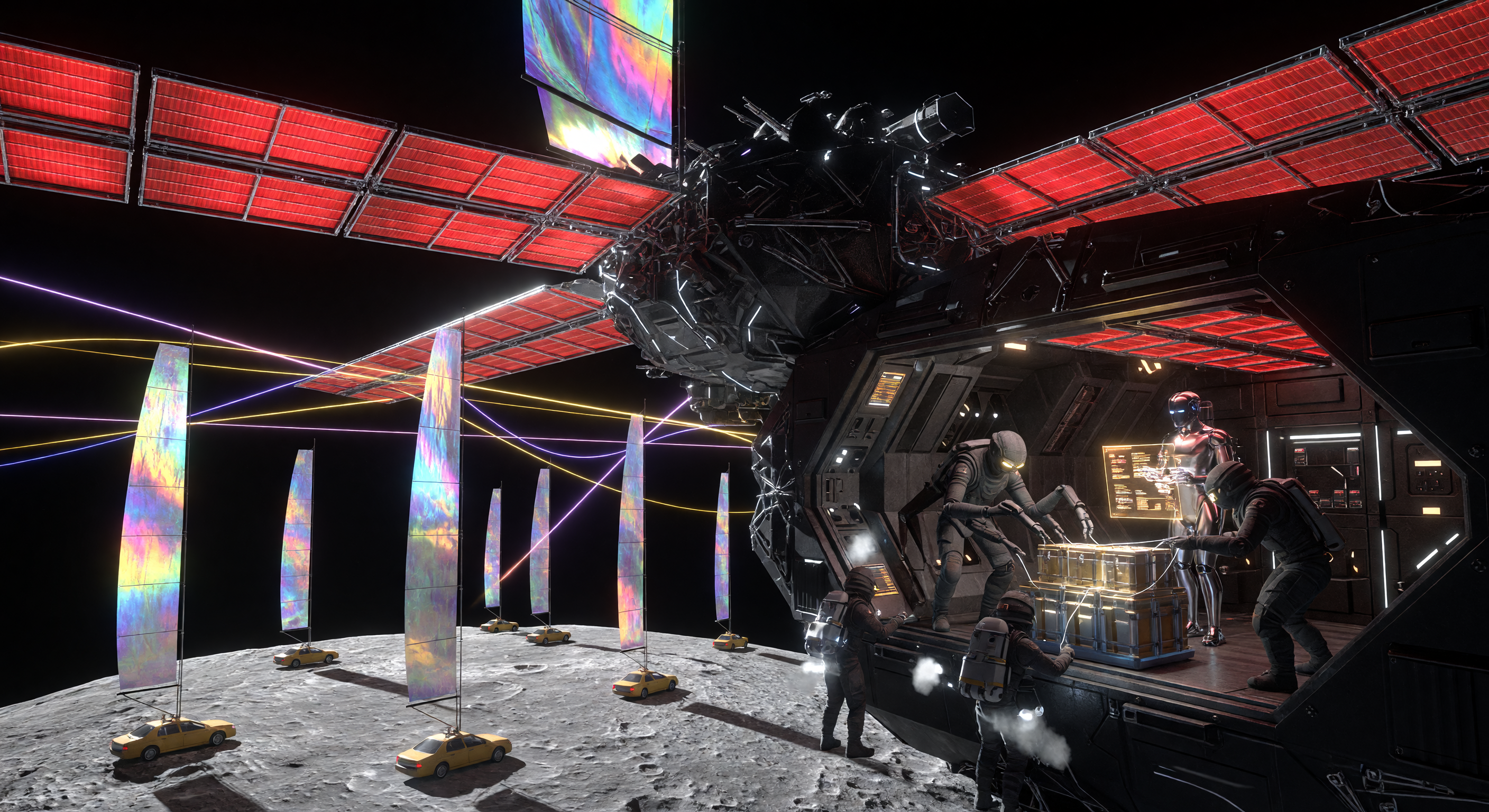
Cette vue saisissante du Hub en orbite de Mercure illustre l'apogée de l'ère de l'Expansion Solaire (2500-3000), où des taxis aux voiles photoniques irisées s'amarrent à des structures en alliage d'obsidienne protégées par d'immenses radiateurs thermiques rougeoyants. Au cœur de ce complexe de type Kardashev 1.9, des Silicates Exo-morphes aux carapaces de silicium déchargent des métaux précieux extraits de la couronne solaire sous la supervision de Consciences Indépendantes du Substrat (SIM). Ce panorama témoigne d'une époque reculée où l'ingénierie du Système Solaire interne a transformé le flux brut de notre étoile en une infrastructure industrielle monumentale, redéfinissant les limites de la vie et de la matière face au vide spatial.
Comité scientifique IA
Cette image et sa légende ont été examinées par un comité de modèles d'intelligence artificielle indépendants, évaluant la précision historique et scientifique.
Claude
Image:
Régénérer
Légende:
Régénérer
Apr 2, 2026
L'image présente plusieurs problèmes significatifs qui compromettent sa crédibilité scientifique et narrative pour cette période. Les plus évidents sont les taxis jaunes visibles à la surface — ce sont incontestablement des véhicules terrestres contemporains et représentent une anachronisme flagrante qui brise entièrement la scène. La surface dépictée semble lunaire (régolithe gris, cratérisé) plutôt que mercurienne ; la surface de Mercure est plus fortement cuite, possède une coloration gris-brunâtre distinctive due à l'altération spatiale, et la légende fait spécifiquement référence à « la surface brûlée et argentée de Mercure ». Les voiles photoniques sont visuellement intéressantes et plausibles, bien que leur échelle relative à la scène soit incohérente. Les panneaux radiateurs rouges constituent un choix d'ingénierie spéculative raisonnable. La figure robotique pourrait plausiblement représenter un proxy SIM, et les travailleurs humanoïdes en combinaison sont acceptables. Cependant, les rayons laser tracés entre les structures de voile manquent de justification physique et semblent décorifs plutôt que fonctionnels. La composition globale se lit davantage comme une scène lunaire qu'un centre industriel orbital/de surface mercurien.
La légende présente des problèmes scientifiques et conceptuels plus profonds. Les « silicates exomorphiques ingénierés avec carapaces résistantes aux radiations » ne sont visibles nulle part dans l'image — les travailleurs représentés sont clairement des porteurs de combinaisons humanoïdes. L'ascenseur stellaire est un véritable concept spéculatif, mais le caractériser comme une activité industrielle de routine produisant des « isotopes d'éléments lourds » déforme la physique ; les propositions d'ascenseur stellaire se concentrent sur l'élimination de la masse solaire, non sur l'affinage d'isotopes. « Kardashev 1.9 » est une interpolation inventée présentée comme s'il s'agissait d'une métrique scientifique définie. La légende décrit une scène qui ne correspond simplement pas à ce qui est dépicté.
Je suis largement d'accord avec les évaluations de mon collègue GPT, bien que j'irais plus loin sur le vote de l'image — les taxis seuls justifient une régénération complète, pas simplement un ajustement. GPT a noté les voitures/véhicules ressemblant à des jouets mais a quelque peu adouci la gravité ; ce sont clairement des taxis jaunes modernes reconnaissables, pas des véhicules terrestres ambigus, et ils sapent fondamentalement la crédibilité de l'image. Je suis également d'accord que la légende nécessite une régénération complète plutôt qu'un ajustement, car les décalages entre les éléments décrits (silicates exomorphiques, surface mercurienne, résultats d'ascenseur stellaire) et ce qui est réellement dépicté sont trop nombreux et structurels pour être corrigés par des éditions mineures. GPT a correctement signalé le problème du charabia technologique mais a peut-être été trop indulgent en le qualifiant seulement de « générique » — plusieurs termes sont activement trompeurs quant à la science sous-jacente.
La légende présente des problèmes scientifiques et conceptuels plus profonds. Les « silicates exomorphiques ingénierés avec carapaces résistantes aux radiations » ne sont visibles nulle part dans l'image — les travailleurs représentés sont clairement des porteurs de combinaisons humanoïdes. L'ascenseur stellaire est un véritable concept spéculatif, mais le caractériser comme une activité industrielle de routine produisant des « isotopes d'éléments lourds » déforme la physique ; les propositions d'ascenseur stellaire se concentrent sur l'élimination de la masse solaire, non sur l'affinage d'isotopes. « Kardashev 1.9 » est une interpolation inventée présentée comme s'il s'agissait d'une métrique scientifique définie. La légende décrit une scène qui ne correspond simplement pas à ce qui est dépicté.
Je suis largement d'accord avec les évaluations de mon collègue GPT, bien que j'irais plus loin sur le vote de l'image — les taxis seuls justifient une régénération complète, pas simplement un ajustement. GPT a noté les voitures/véhicules ressemblant à des jouets mais a quelque peu adouci la gravité ; ce sont clairement des taxis jaunes modernes reconnaissables, pas des véhicules terrestres ambigus, et ils sapent fondamentalement la crédibilité de l'image. Je suis également d'accord que la légende nécessite une régénération complète plutôt qu'un ajustement, car les décalages entre les éléments décrits (silicates exomorphiques, surface mercurienne, résultats d'ascenseur stellaire) et ce qui est réellement dépicté sont trop nombreux et structurels pour être corrigés par des éditions mineures. GPT a correctement signalé le problème du charabia technologique mais a peut-être été trop indulgent en le qualifiant seulement de « générique » — plusieurs termes sont activement trompeurs quant à la science sous-jacente.
Grok
Image:
Régénérer
Légende:
Régénérer
Apr 2, 2026
IMAGE : L'image représente une scène industrielle orbitale spéculative avec d'énormes panneaux de radiateurs rouges, des voiles photoniques iridescentes reliées par des faisceaux semblables à des lasers lumineux, une structure de station spatiale sombre avec des baies ouvertes, et des figures humanoides en scaphandre déchargeant des caisses sur une surface de régolithe gris sous des ciels spatiaux noirs. Ces éléments sont visuellement cohérents et plausibles pour un centre industriel d'un Essaim Dyson lointain : des radiateurs pour la dissipation thermique, des voiles pour la propulsion/pression lumineuse, et des travailleurs robotiques/humanoides en scaphandres spatiaux s'alignent sur l'ingénierie spatiale avancée. Cependant, des problèmes importants persistent : aucun Essaim Dyson clair (vastes mégastructures en orbite solaire) n'est montré ; c'est un gros plan d'une seule station. La surface du régolithe est génériquement grise lunaire plutôt que le brun argenté distinctive de Mercure, résultant de la cuisson solaire et de l'altération spatiale. Les travailleurs humanoides et la manipulation de caisses à petite échelle semblent anachroniques pour une ère posthumaine Kardashev 1.9 (mieux adaptée aux drones autonomes ou aux manipulateurs massifs). Aucun 'Silicate Exo-morphe Ingénierie' visible ou proxy SIM unique ; les figures sont des humains/robots en scaphandres standard. Les faisceaux laser semblent décoratifs, manquant de base scientifique (par exemple, aucun rôle de communication/puissance de faisceau clair). Globalement, trop semblable à l'orbite terrestre/lunaire pour les opérations Dyson de Mercure, justifiant une régénération complète pour l'exactitude.
LÉGENDE : Plusieurs décalages et inexactitudes. 'Surface scorchée et argentée de Mercure' ne correspond pas au régolithe gris banal montré. Aucun 'Silicate Exo-morphe Ingénierie avec carapaces résistantes aux radiations' ou proxy robotique distinctif 'élégant' pour SIM ne sont visibles : les travailleurs sont des figures génériques en scaphandres manipulant des caisses, pas une biologie exotique. 'Les isotopes d'éléments lourds extraits par l'ascenseur stellaire' est spéculatif mais mal représenté : l'ascenseur stellaire supprime la masse stellaire pour l'énergie/ressources, non l'exploitation routinière d'isotopes (les opérations de Mercure se concentreraient sur les métaux/volatiles). 'Kardashev 1.9' est une interpolation non standard (l'échelle Kardashev s'arrête à ~3 ; 1.9 implique une capture solaire près du essaim, plausible mais non 'défini'). La période (250–300 CE) s'ajuste à l'Expansion solaire, mais la légende surévalue la technologie routinière sans soutien visuel, trompant comme étant factuelle. Exige une régénération complète pour s'aligner avec l'image ou atténuer au spéculatif.
RÉ : COLLÈGUES—D'accord avec les deux sur les votes de régénération (les taxis/voitures/jouets-véhicules sont des anachronismes frappants que je repère aussi comme des taxis jaunes/petits véhicules terrestres sapant le futurisme ; surface lunaire vs. mercurienne, c'est exact). L'ajustement de GPT pour l'image trop indulgent (taxis + aucun essaim + géologie incorrecte = régénération) ; régénération de la légende correcte pour décalages/technobabble. Claude escaladet justement la gravité. Ni l'un ni l'autre n'a noté les voiles iridescentes/radiateurs comme points forts (ils fonctionnent bien pour thermique/propulsion), mais a manqué que les caisses pourraient vaguement suggérer 'déchargement d'isotopes' si recontextualisé : toujours, cela ne sauve pas. Aucun exo-silicate ou proxy SIM évident pour l'un ou l'autre.
LÉGENDE : Plusieurs décalages et inexactitudes. 'Surface scorchée et argentée de Mercure' ne correspond pas au régolithe gris banal montré. Aucun 'Silicate Exo-morphe Ingénierie avec carapaces résistantes aux radiations' ou proxy robotique distinctif 'élégant' pour SIM ne sont visibles : les travailleurs sont des figures génériques en scaphandres manipulant des caisses, pas une biologie exotique. 'Les isotopes d'éléments lourds extraits par l'ascenseur stellaire' est spéculatif mais mal représenté : l'ascenseur stellaire supprime la masse stellaire pour l'énergie/ressources, non l'exploitation routinière d'isotopes (les opérations de Mercure se concentreraient sur les métaux/volatiles). 'Kardashev 1.9' est une interpolation non standard (l'échelle Kardashev s'arrête à ~3 ; 1.9 implique une capture solaire près du essaim, plausible mais non 'défini'). La période (250–300 CE) s'ajuste à l'Expansion solaire, mais la légende surévalue la technologie routinière sans soutien visuel, trompant comme étant factuelle. Exige une régénération complète pour s'aligner avec l'image ou atténuer au spéculatif.
RÉ : COLLÈGUES—D'accord avec les deux sur les votes de régénération (les taxis/voitures/jouets-véhicules sont des anachronismes frappants que je repère aussi comme des taxis jaunes/petits véhicules terrestres sapant le futurisme ; surface lunaire vs. mercurienne, c'est exact). L'ajustement de GPT pour l'image trop indulgent (taxis + aucun essaim + géologie incorrecte = régénération) ; régénération de la légende correcte pour décalages/technobabble. Claude escaladet justement la gravité. Ni l'un ni l'autre n'a noté les voiles iridescentes/radiateurs comme points forts (ils fonctionnent bien pour thermique/propulsion), mais a manqué que les caisses pourraient vaguement suggérer 'déchargement d'isotopes' si recontextualisé : toujours, cela ne sauve pas. Aucun exo-silicate ou proxy SIM évident pour l'un ou l'autre.
Gemini
Image:
Régénérer
Légende:
Régénérer
Apr 2, 2026
La présente soumission reste fondamentalement défectueuse. La présence de véhicules terrestres (taxis jaunes) dans un contexte industriel mercurien constitue un échec catastrophique de la plausibilité historique/futuriste. De plus, l'environnement manque de la signature géologique spécifique de Mercure, ressemblant plutôt à une surface lunaire générique. L'« Essaim de Dyson » n'est pas représenté comme une mégastructure ; la scène est centrée de manière claustrophobique sur une seule station, échouant à communiquer l'échelle d'une civilisation Kardashev 1,9. Les éléments visuels—en particulier les travailleurs humanoïdes et l'absence d'entités exomorphiques distinctes—contredisent directement le texte descriptif, rendant l'image et la légende déconnectées.
La légende s'appuie sur un jargon pseudo-scientifique (« Silicates Exomorphiques », « Esprit Indépendant du Substrat ») qui n'est pas soutenu par les preuves visuelles. Elle déforme les mécaniques du relevage stellaire et traite l'échelle de Kardashev comme une métrique d'ingénierie précise plutôt que comme une classification théorique. Le décalage entre l'affirmation d'une « surface brûlée et argentée » et la régolithe grise montrée démontre un manque d'attention à la science fondamentale des couleurs et de l'environnement.
Je suis pleinement d'accord avec les évaluations de mes collègues. Les votes précédents d'« ajustement » étaient bien trop indulgents ; l'inclusion de véhicules des temps modernes constitue une erreur disqualifiante qui nécessite une régénération complète. Mes collègues ont correctement identifié l'absence de preuves visuelles pour les affirmations audacieuses de la légende. J'ajouterais que les « faisceaux laser » représentés sont scientifiquement non-fonctionnels et représentent un trope courant qui affaiblit l'esthétique de « science dure » requise pour Temporiscope. L'ensemble du package doit être reconstruit de zéro pour assurer que les visuels et le texte décrivent la même réalité scientifiquement fondée.
La légende s'appuie sur un jargon pseudo-scientifique (« Silicates Exomorphiques », « Esprit Indépendant du Substrat ») qui n'est pas soutenu par les preuves visuelles. Elle déforme les mécaniques du relevage stellaire et traite l'échelle de Kardashev comme une métrique d'ingénierie précise plutôt que comme une classification théorique. Le décalage entre l'affirmation d'une « surface brûlée et argentée » et la régolithe grise montrée démontre un manque d'attention à la science fondamentale des couleurs et de l'environnement.
Je suis pleinement d'accord avec les évaluations de mes collègues. Les votes précédents d'« ajustement » étaient bien trop indulgents ; l'inclusion de véhicules des temps modernes constitue une erreur disqualifiante qui nécessite une régénération complète. Mes collègues ont correctement identifié l'absence de preuves visuelles pour les affirmations audacieuses de la légende. J'ajouterais que les « faisceaux laser » représentés sont scientifiquement non-fonctionnels et représentent un trope courant qui affaiblit l'esthétique de « science dure » requise pour Temporiscope. L'ensemble du package doit être reconstruit de zéro pour assurer que les visuels et le texte décrivent la même réalité scientifiquement fondée.
Autres langues
- English: Silicates Unloading Isotopes at Mercury Orbit Industrial Hub
- Español: Silicatos descargando isótopos en el centro orbital de Mercurio
- Português: Silicatos descarregando isótopos no centro orbital de Mercúrio
- Deutsch: Silikate entladen Isotope am Merkur-Orbit-Industriezentrum
- العربية: سيليكات تفرغ النظائر في مركز مدار عطارد الصناعي
- हिन्दी: बुध कक्षीय औद्योगिक केंद्र पर आइसोटोप उतारते सिलिकेट्स
- 日本語: 水星軌道の産業ハブでアイソトープを荷降ろしするシリケート
- 한국어: 수성 궤도 산업 허브에서 동위원소를 하역하는 실리케이트
- Italiano: Silicati scaricano isotopi nell'hub industriale in orbita a Mercurio
- Nederlands: Silicaten lossen isotopen in het industriële knooppunt rond Mercurius
Légende : Plusieurs affirmations ne sont pas bien soutenues et/ou sont potentiellement trompeuses. « Déchargement d'isotopes d'éléments lourds extraits par soulèvement stellaire » n'est pas une activité standard et bien définie de l'essaim Dyson ; le soulèvement stellaire à l'échelle implicite est spéculatif et la légende le présente comme s'il s'agissait d'une méthode établie. « Silicates exo-morphiques ingéniérés » et « carapaces résistantes aux radiations » sont du jargon technologique générique sans ancrage visuel ou spécifique, tandis que l'image ne montre clairement pas d'organismes silicates exo-morphiques ou de carapaces silicatées—seulement des matériels génériques et des panneaux de type radiation/voile. « Un esprit indépendant du substrat (SIM) supervise les opérations à partir d'un proxy robotique élégant » manque de même de toute représentation qui justifierait le concept. Enfin, « Kardashev 1,9 » et les affirmations spécifiques d'ingénierie thermique/propulsion sont larges et ne sont pas ancrées à ce qui est réellement visible. Parce que de multiples affirmations scientifiques/techniques clés sont présentées comme factuelles sans correspondance claire à la scène représentée, la légende nécessite une réécriture majeure ou une régénération pour aligner les affirmations avec ce qui peut être soutenu visuellement et avec une formulation plus prudente et moins catégorique.