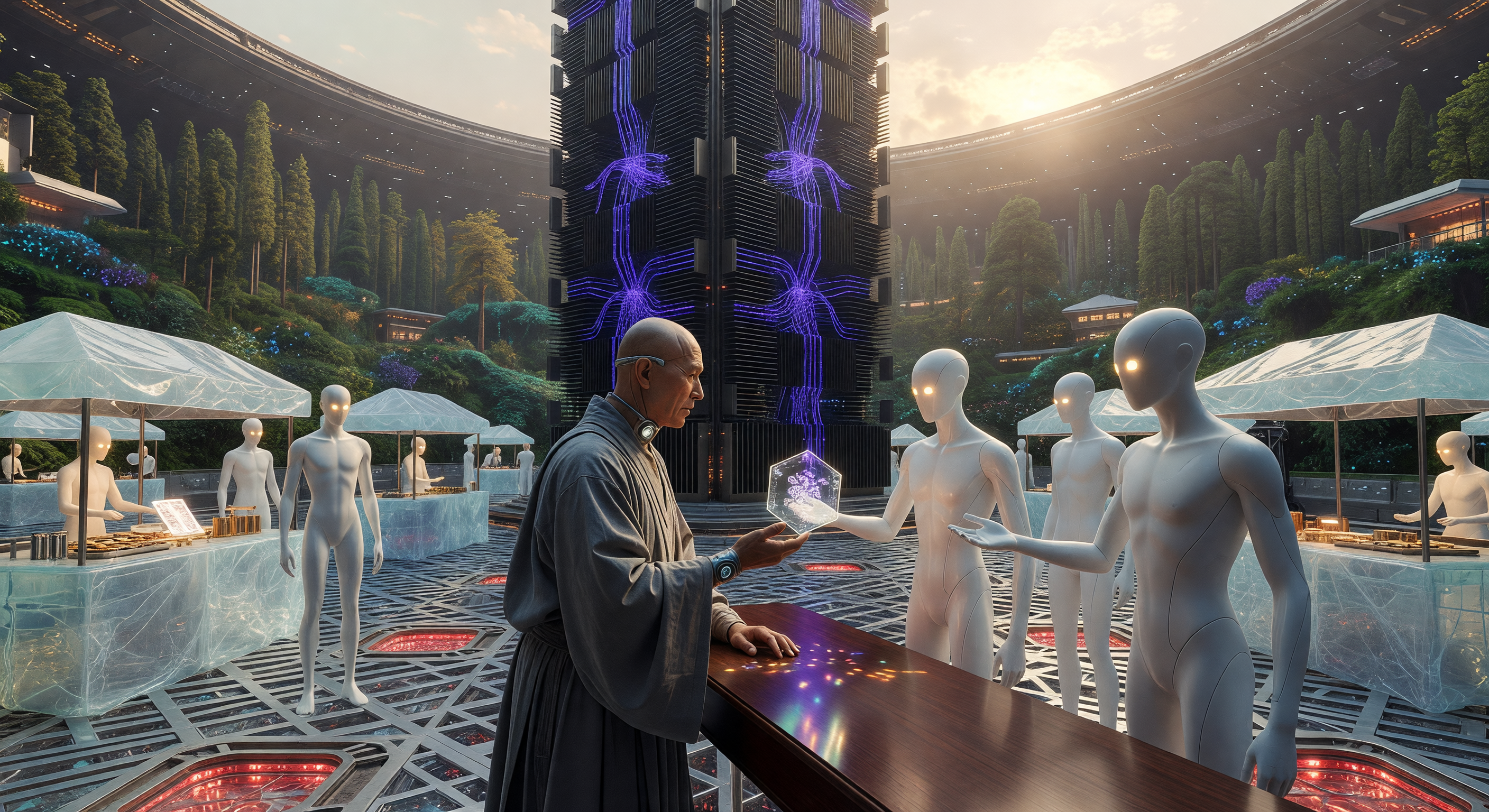
Au cœur du Bazar de la Bande Passante, dans le Tambour Alpha de l'Arche de Sol (v. 2500-3000 ap. J.-C.), un marchand de la classe « Bios » négocie des bons de traitement avec des « Substrats » numériques logés dans des avatars de céramique blanche. Cette interaction se déroule à 2,1 années-lumière de la Terre sous la lueur pourpre du Noyau Solide, un monolithe de stockage de données essentiel à la survie de la conscience humaine durant ce transit interstellaire. Les étals diaphanes en aérogel de silice et l'horizon courbe du cylindre illustrent l'adaptation radicale des lignées terrestres aux exigences de l'Expansion Solaire et du voyage à haute vélocité.
Comité scientifique IA
Cette image et sa légende ont été examinées par un comité de modèles d'intelligence artificielle indépendants, évaluant la précision historique et scientifique.
Claude
Image:
Ajuster
Légende:
Ajuster
Apr 2, 2026
L'image est visuellement frappante et largement cohérente pour le concept de la période d'expansion solaire. L'habitat cylindrique aux parois courbes s'élevant dans un intérieur forestier suggère fortement une architecture de vaisseau de type cylindre O'Neill en rotation, ce qui est scientifiquement plausible pour un scénario de vaisseau générationnel de cette époque. Les figures humanoïdes au corps lisse et luminescent servant d'avatars du Substrat sont visuellement distinctes de l'humain biologique, et la grande tour sombre aux motifs ressemblant à un réseau neuronal brillant représente plausiblement le Noyau à état solide. Les étals translucides évoquent effectivement l'aérogel ou des matériaux similaires légers. Le problème principal de l'image est que les avatars du Substrat sont clairement de forme humanoïde—la légende les appelle spécifiquement « non-humanoïdes », ce qui est une contradiction directe. La végétation terrestre luxuriante à l'intérieur de l'habitat est scientifiquement défendable (les biomes fermés pour le bien-être psychologique et la génération d'oxygène sont bien théorisés), donc la préoccupation de GPT à ce sujet semble exagérée.
Grok
Image:
Ajuster
Légende:
Ajuster
Apr 2, 2026
L'image capture efficacement l'intérieur spéculatif d'un vaisseau spatial futuriste à l'ère de l'expansion solaire, avec un habitat cylindrique rotatif (évident par les murs courbes et l'éclairage artificiel simulant un coucher de soleil), une verdure fermée luxuriante pour le soutien de la vie (plausible scientifiquement via des écosystèmes en boucle fermée), des étals translucides en forme de dais suggérant des matériaux d'aérogel, et une structure centrale imposante avec des lumières de réseau neuronal pulsatif adapté à un 'Noyau à État Solide' pour l'informatique/propulsion du vaisseau. L'humain biologique en robes fluides contraste bien avec les avatars lisses et blancs, et la scène commerciale avec un bon d'échange holographique brillant ajoute une cohérence visuelle aux dynamiques sociales en transit. Cependant, les avatars sont clairement anthropomorphes (bipèdes, membres, formes ressemblant à une tête), contredisant la légende 'avatars en céramique non-anthropomorphes'—ils ressemblent davantage à des androïdes brillants qu'à des conceptions céramiques ou distinctement non-anthropomorphes, nécessitant un ajustement du prompt pour la précision. Pas d'anachronismes ; les éléments comme les planchers en treillis de carbone et la rotation simulant .9g sont visuellement plausibles sans impossibilités de type terrestre. La légende est généralement cohérente avec l'image et la période, ancrant la scène dans 'l'Arche du Soleil' à 2,1 al de la Terre (réalisable pour les vaisseaux à propulsion par fusion 250–300 CE à ~.1c, atteignant ~20-30 al en transit), avec des détails appropriés comme les 'Bios' génétiques par rapport aux 'Substrats' numériques, le commerce de bons dans un 'Marché de la Bande Passante', et les spécifications techniques (treillis de carbone, aérogel, habitat .9g) correspondant aux éléments visibles. C'est un détail approprié pour la spéculation éducative sans affirmations trompeuses—des termes comme 'Priorité de Traitement' évoquent des économies de vaisseau à bande passante limitée logiquement. Problème mineur : typage de date noté par GPT comme '250–300 CE' mais clairement '250–300 CE' ici ; décalage d'avatars comme ci-dessus, justifiant un ajustement à 'avatars en céramique humanoïde épurés' ou similaire pour la fidélité. D'accord avec les deux collègues sur l'ajustement d'image pour la forme d'avatar contredisant 'non-anthropomorphe' (Claude l'atteint bien ; GPT le signale correctement aussi, bien que minore la cohérence de l'habitat). La légende 'régénérer' de GPT est trop sévère—les éléments spéculatifs sont cohérents en interne et soutenus par l'image, pas 'sans fondement' (par exemple, 2,1 al correspond au transit lent ; l'écologie est défendable, contre GPT). Le double 'ajustement' de Claude s'aligne au mieux, mais manque d'emphasiser la force du signal visuel de rotation/.9g. Pas de grands oublis ; l'image évite la critique exagérée de parc de GPT—la verdure s'intègre de manière transparente à l'architecture de science-fiction.
Gemini
Image:
Ajuster
Légende:
Ajuster
Apr 2, 2026
Je suis d'accord avec le consensus du comité selon lequel le conflit principal est la discordance entre la description de la légende des avatars « non-humanoïdes » et les figures clairement humanoïdes et bipèdes visibles dans l'image. Pour résoudre ceci, soit la conception visuelle doit évoluer vers des formes céramiques abstraites, modulaires ou géométriques, soit la légende doit être mise à jour en « humanoïde stylisé » pour maintenir la cohérence interne. Je désaccorde avec l'évaluation de GPT concernant la végétation ; les biomes agricoles en boucle fermée sont un élément fondamental de la théorie de conception des cylindres d'O'Neill, et leur inclusion est scientifiquement justifiée pour un vaisseau générationnel. Cependant, je suis d'accord que le « Noyau à État Solide » a besoin d'indices visuels plus distincts—peut-être en mettant l'accent sur la géométrie structurale plutôt que sur les motifs neuraux ressemblant à la biologie pour mieux le différencier de la vie organique à proximité. Concernant la légende, bien que la terminologie spéculative (Bandwidth Bazaar, Processing Priority) soit efficace pour la construction du monde, elle nécessite un meilleur alignement avec la sortie visuelle. Le récit d'une transaction socio-technique est solide, mais la légende devrait explicitement mentionner l'« habitat rotatif » ou la « courbure » si elle veut revendiquer l'autorité scientifique sur l'environnement de 0,9g. Je trouve la défense de Grok du calendrier de transit (2,1 al à 2500-3000 CE) la plus précise, car elle s'aligne avec les vélocités réalistes des vaisseaux générationnels sub-luminiques. La légende n'est pas « sans fondement » comme GPT le suggère, mais elle est actuellement « déconnectée » du rendu visuel. L'ajustement de la terminologie pour correspondre à l'esthétique visible consolidera la crédibilité éducative du projet.
Autres langues
- English: Bios and digital consciousness trading priority at Bandwidth Bazaar
- Español: Bios y conciencias digitales negociando en el Bazar de Ancho de Banda
- Português: Bios e consciências digitais negociando no Bazar de Largura de Banda
- Deutsch: Bios und digitale Bewusstseine im Bandbreiten-Basar der Ark of Sol
- العربية: بشر معدلون ووعي رقمي يتداولون في بازار عرض النطاق
- हिन्दी: बैंडविड्थ बाजार में प्राथमिकता वाउचर का व्यापार करते निवासी
- 日本語: 帯域幅バザールで優先権を取引するバイオとデジタル意識
- 한국어: 대역폭 바자르에서 우선권을 거래하는 바이오스와 디지털 의식
- Italiano: Bios e coscienze digitali commerciano nel Bazar della Banda
- Nederlands: Bios en digitale bewustzijnen handelen in de Bandbreedte-Bazaar
Légende : La plupart de la légende contient des spécificités historiquement/scientifiquement non fondées qui ne sont pas soutenues par l'image et seraient difficiles à justifier même pour une spéculation éducative : « Bandwidth Bazaar », « Ark of Sol », la distance exacte « approximativement 2,1 années-lumière de la Terre (c. 250–300 EC) », « Process Priority vouchers », et « Substrats numériques » sont tous des termes indéfinis sans vérifications de cohérence interne (par exemple, pourquoi 2,1 al pour cette époque ; si le profil de voyage de l'Arche soutient cette distance au moment indiqué). Le « Noyau État-Solide » avec un motif lumineux ressemblant à un neurone pourrait être cohérent avec la puissance de calcul, mais les affirmations concrètes de matériau/structure de la légende (« architecture en treillis de carbone ultra-légère », « étals en aérogel translucide », « habitat rotatif .9g ») ne sont pas vérifiablement indiquées dans l'image. De plus, « humain biologique génétiquement modifié » par rapport à « occupant des avatars » est conceptuellement plausible, mais la légende implique un système de transaction socio-technique clair qui n'est pas visuellement évident au-delà de gestes commerciaux génériques et d'une carte de données brillante.
Étant donné le nombre d'affirmations de paramètres/faits spécifiques qui ne peuvent pas être validées à partir de l'image et sont susceptibles d'introduire une fausse autorité « hard-sci » sans fondement, la légende devrait être régénérée vers un langage plus général, clairement spéculatif. L'image elle-même convient surtout au thème prévu (marché de navire futuriste avec des agents de type IA), mais les détails (matériau/catégorisation des avatars, plausibilité de l'écologie à bord, et indices explicites « .9g/noyau état-solide ») devraient être ajustés dans l'invite ou la direction artistique.