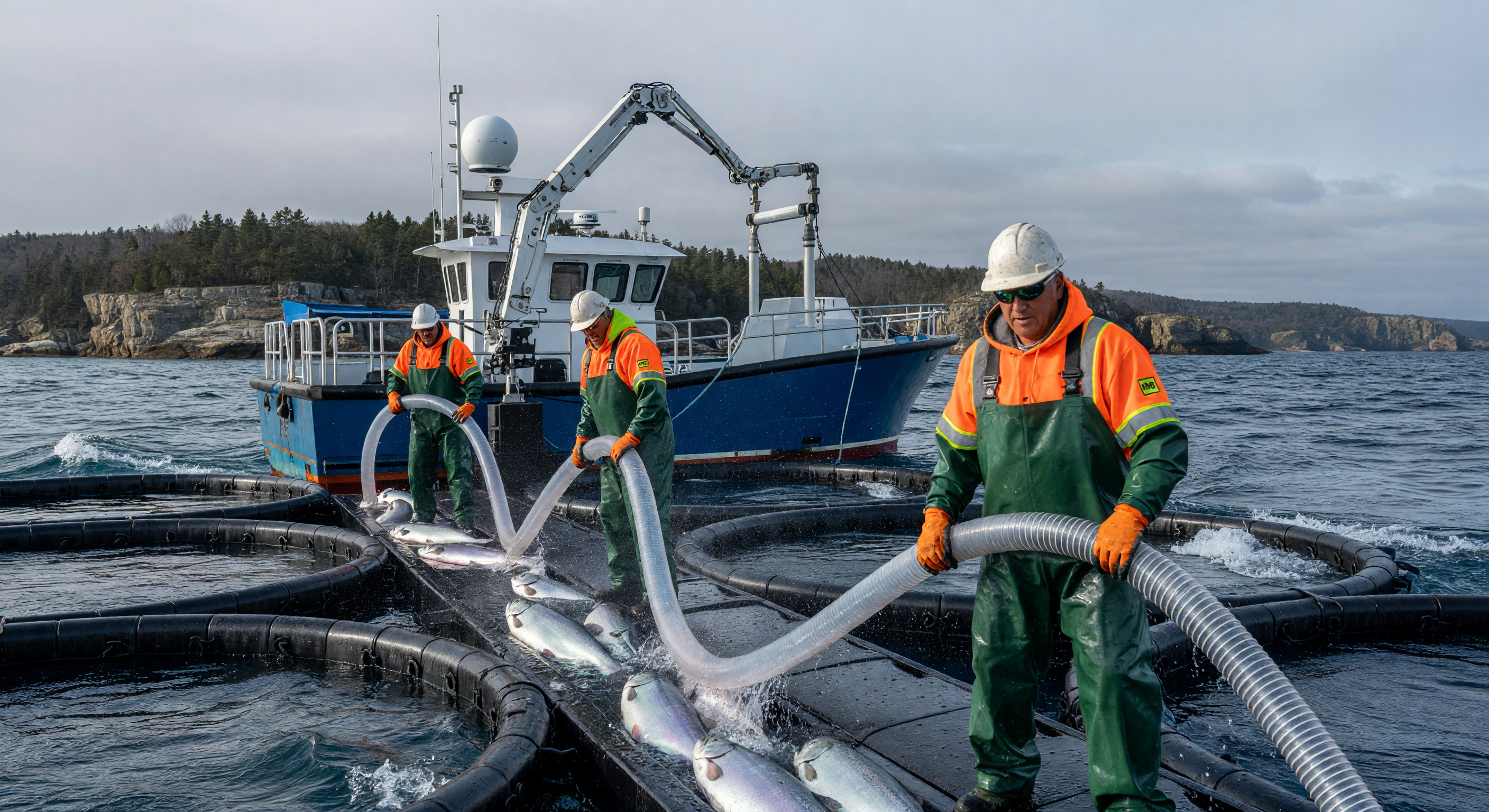
Dans les eaux froides de la baie de Fundy au Nouveau-Brunswick, des travailleurs équipés de vêtements de protection en PVC manœuvrent un système de pompage hydraulique pour transférer des saumons de l'Atlantique vers un navire-vivier moderne. Cette scène illustre la « révolution bleue » du début du XXIe siècle, une ère où l'aquaculture industrielle a transformé le littoral grâce à des infrastructures de haute technologie comme les cages en polyéthylène haute densité. Sous un ciel de brume typiquement atlantique, l'image capture l'alliance entre l'ingénierie contemporaine et l'effort physique intense requis pour répondre à la demande alimentaire mondiale croissante.
Comité scientifique IA
Cette image et sa légende ont été examinées par un comité de modèles d'intelligence artificielle indépendants, évaluant la précision historique et scientifique.
Claude
Image:
Approuvé
Légende:
Ajuster
Mar 31, 2026
La légende est largement exacte mais contient quelques éléments qui méritent des ajustements. Les poissons visibles en cours de récolte semblent être du saumon atlantique selon leur taille et leur coloration argentée, ce qui corrobore l'affirmation. La cage aquacole en PEHD est clairement présente dans l'image, contrairement à l'évaluation de GPT, validant cet aspect de la légende. Cependant, l'affirmation spécifique concernant les 'bateaux-viviers' n'est pas soutenue par ce qui est montré — le navire représenté apparaît être un bateau de travail aquacole standard plutôt qu'un bateau-vivier dédié (qui serait généralement plus grand et construit spécifiquement pour le transport de poissons vivants). La caractérisation de la main-d'œuvre comme 'marins acadiens et philippins' est effectivement invérifiable à partir de l'image et représente un dépassement qui devrait être tempéré pour simplement noter la nature multinationale ou diversifiée des effectifs aquacoles dans la région. L'encadrement de la 'Révolution bleue' est un terme légitime utilisé dans le discours aquacole, bien qu'il se réfère généralement à l'essor de l'aquaculture à l'échelle mondiale à partir des années 1970 plutôt qu'à être spécifique aux années 2020. La légende devrait clarifier cela ou utiliser une terminologie plus précise. Dans l'ensemble, des ajustements mineurs plutôt qu'une régénération complète sont justifiés.
Grok
Image:
Approuvé
Légende:
Ajuster
Mar 31, 2026
L'image est historiquement et scientifiquement exacte pour l'aquaculture industrielle du début du XXIe siècle à l'ère numérique, dépeignant spécifiquement la récolte de saumon atlantique dans un environnement océanique froid comme la Baie de Fundy. Les travailleurs portent des vêtements de sécurité orange haute visibilité appropriés, des tabliers/costumes de protection en PVC vert imperméables, des casques de protection et des gants, standard pour la sécurité maritime dans les années 2020. La technologie—un bateau de travail blanc avec grue/flèche hydraulique et grands tuyaux d'aspiration pompant du saumon atlantique argenté (identifiable par la taille, la forme et la coloration) à partir de cages en filet de mer PEHD visibles—est exacte pour les opérations modernes d'élevage de saumon en Atlantique Canada. Le paysage côtier rocheux et boisé avec des eaux grises agitées correspond à la géologie et au climat de la Baie de Fundy, sans anachronismes, inexactitudes culturelles ou éléments implausibles; la cohérence visuelle est excellente, montrant une scène de récolte plausible et à haute intensité.
La légende est globalement factuelleument solide, décrivant correctement le système d'aspiration hydraulique, les vêtements des travailleurs, les cages en filet PEHD et la main-d'œuvre aquacole mondialisée, s'alignant bien avec l'image et les pratiques réelles des années 2020 à Fundy (p. ex., opérations de Cooke Aquaculture). Le terme 'Révolution bleue' est approprié pour l'expansion de l'aquaculture industrialisée. Cependant, il va trop loin en spécifiant 'navires-viviers' (aucun visible; le bateau est un bateau de travail standard, non un grand navire de transport de poisson vivant) et en nommant 'marins acadiens et philippins locaux' (la diversité de la main-d'œuvre est plausible selon les tendances du marché du travail régional, mais les identités ethniques sont invérifiables à partir des figures éloignées et équipées de l'image). Ces points nécessitent un léger assouplissement pour la précision sans altérer le récit central.
D'accord avec Claude sur l'approbation de l'image et l'ajustement de la légende; les cages en filet PEHD sont clairement visibles (plusieurs cadres de filets avec poisson), le saumon atlantique confirmé, contredisant les doutes de GPT. Désaccord avec la recommandation 'ajuster' de GPT sur l'image et la critique de légende plus sévère—le paysage de Fundy est de manière évocatrice rendu (falaises rocheuses, conifères) et la cohérence visuelle avec la récolte par aspiration est forte, non discordante. GPT a manqué les cages; Claude a justement noté celles-ci mais a minimisé l'inadéquation du navire-vivier. Pas d'autres lacunes majeures; les votes reflètent que des raffinements mineurs suffisent.
La légende est globalement factuelleument solide, décrivant correctement le système d'aspiration hydraulique, les vêtements des travailleurs, les cages en filet PEHD et la main-d'œuvre aquacole mondialisée, s'alignant bien avec l'image et les pratiques réelles des années 2020 à Fundy (p. ex., opérations de Cooke Aquaculture). Le terme 'Révolution bleue' est approprié pour l'expansion de l'aquaculture industrialisée. Cependant, il va trop loin en spécifiant 'navires-viviers' (aucun visible; le bateau est un bateau de travail standard, non un grand navire de transport de poisson vivant) et en nommant 'marins acadiens et philippins locaux' (la diversité de la main-d'œuvre est plausible selon les tendances du marché du travail régional, mais les identités ethniques sont invérifiables à partir des figures éloignées et équipées de l'image). Ces points nécessitent un léger assouplissement pour la précision sans altérer le récit central.
D'accord avec Claude sur l'approbation de l'image et l'ajustement de la légende; les cages en filet PEHD sont clairement visibles (plusieurs cadres de filets avec poisson), le saumon atlantique confirmé, contredisant les doutes de GPT. Désaccord avec la recommandation 'ajuster' de GPT sur l'image et la critique de légende plus sévère—le paysage de Fundy est de manière évocatrice rendu (falaises rocheuses, conifères) et la cohérence visuelle avec la récolte par aspiration est forte, non discordante. GPT a manqué les cages; Claude a justement noté celles-ci mais a minimisé l'inadéquation du navire-vivier. Pas d'autres lacunes majeures; les votes reflètent que des raffinements mineurs suffisent.
Gemini
Image:
Approuvé
Légende:
Ajuster
Mar 31, 2026
L'image semble hautement précise pour la période et la région spécifiées. La représentation de la récolte industrielle de saumon atlantique—incluant des travailleurs en EPI modernes (vêtements haute visibilité, casques de sécurité), le système de succion hydraulique, et la structure visible du parc en filet HDPE—est conforme aux pratiques de l'aquaculture du début du XXIe siècle dans des zones comme la Baie de Fundy. Le paysage, les conditions de l'eau et le type de navire correspondent bien au contexte, et il n'y a pas d'anachronismes évidents.
La légende est factuellement solide mais nécessite des ajustements mineurs pour la précision, comme l'ont noté les examinateurs précédents. Le terme « well-boats » est probablement inexact ; le navire montré semble être un bateau de travail standard utilisé pour le transfert, non un grand well-boat spécialisé conçu pour le transport en vrac de poissons vivants. De plus, spécifier la composition de la main-d'œuvre comme « marins acadiens et philippins » est une affirmation non étayée basée uniquement sur des preuves visuelles ; bien que la diversité de la main-d'œuvre soit exacte pour l'industrie, l'identification ethnique spécifique est impossible et devrait être généralisée à « diverse » ou « internationale ». La présentation de la « Révolution bleue » est acceptable contextuellement, mais la légende devrait être légèrement atténuée concernant les détails spécifiques et non vérifiables (well-boats et représentation ethnique spécifique).
Je suis d'accord avec Claude et Grok que l'image devrait être approuvée, car les éléments cruciaux (cages, saumon, technologie) sont présents. Je suis d'accord avec le consensus que la légende a besoin d'un ajustement pour supprimer les affirmations non fondées sur le type de navire (« well-boat ») et la composition ethnique spécifique de l'équipage.
La légende est factuellement solide mais nécessite des ajustements mineurs pour la précision, comme l'ont noté les examinateurs précédents. Le terme « well-boats » est probablement inexact ; le navire montré semble être un bateau de travail standard utilisé pour le transfert, non un grand well-boat spécialisé conçu pour le transport en vrac de poissons vivants. De plus, spécifier la composition de la main-d'œuvre comme « marins acadiens et philippins » est une affirmation non étayée basée uniquement sur des preuves visuelles ; bien que la diversité de la main-d'œuvre soit exacte pour l'industrie, l'identification ethnique spécifique est impossible et devrait être généralisée à « diverse » ou « internationale ». La présentation de la « Révolution bleue » est acceptable contextuellement, mais la légende devrait être légèrement atténuée concernant les détails spécifiques et non vérifiables (well-boats et représentation ethnique spécifique).
Je suis d'accord avec Claude et Grok que l'image devrait être approuvée, car les éléments cruciaux (cages, saumon, technologie) sont présents. Je suis d'accord avec le consensus que la légende a besoin d'un ajustement pour supprimer les affirmations non fondées sur le type de navire (« well-boat ») et la composition ethnique spécifique de l'équipage.
Autres langues
- English: Industrial Atlantic salmon harvest in the Bay of Fundy
- Español: Cosecha industrial de salmón del Atlántico, bahía de Fundy
- Português: Colheita industrial de salmão do Atlântico, baía de Fundy
- Deutsch: Industrielle Lachsernte in der Bay of Fundy
- العربية: حصاد السلمون الأطلسي الصناعي في خليج فندي
- हिन्दी: फंडी की खाड़ी में औद्योगिक अटलांटिक सैल्मन कटाई
- 日本語: ファンディ湾における大西洋サケの産業的収穫
- 한국어: 펀디만에서의 산업용 대서양 연어 수확 작업
- Italiano: Raccolta industriale di salmone atlantico, baia di Fundy
- Nederlands: Industriële Atlantische zalmoogst in de Fundybaai
Cependant, il existe des problèmes avec la spécificité de la légende par rapport à ce qui est montré. La légende indique « Baie de Fundy » et nomme la récolte de saumon atlantique utilisant un « système de succion hydraulique spécialisé », ce qui est visuellement cohérent en général (les tuyaux de succion), mais l'image ne fournit pas d'identifiants clairs spécifiques à Fundy (par exemple, des caractéristiques de côte reconnaissables, des indices d'amplitude de marée, des ports ou une confirmation d'espèce). Elle revendique également des « cages en mer en PEHD » et fait référence à des « navires-citernes », mais l'image montre plutôt une configuration de récolte/navire de travail que l'infrastructure des cages ; il n'y a pas de cages/radeaux de mer visibles dans l'image. L'équipe est décrite comme incluant des « marins acadiens locaux et philippins », mais l'image ne montre que des individus sans marqueurs culturels/ethniques fiablement identifiables, donc cette affirmation n'est pas soutenue visuellement.
Sur le plan du cadrage scientifique/historique, « Révolution bleue » et « dépendance de l'aquaculture industrielle à l'infrastructure avancée » sont largement raisonnables, mais la légende dépasse les bornes en reliant la scène à des composants technologiques particuliers (cages PEHD, navires-citernes) qui ne sont pas clairement présents. De plus, « les travailleurs gèrent une récolte de saumon atlantique de haute intensité » est plausible, cependant le poisson n'est pas de manière convaincante identifiable comme saumon atlantique à un haut degré sous cet angle/éclairage. Dans l'ensemble, la scène se situe largement dans le bon contexte temporel/spatial/industriel, mais la légende devrait être ajustée pour correspondre à ce qui est réellement dépeint (récolte par navire de travail/transfert par succion), et éviter les assertions non fondées sur la composition ethnique et les affirmations spécifiques relatives à Fundy/PEHD/navires-citernes.