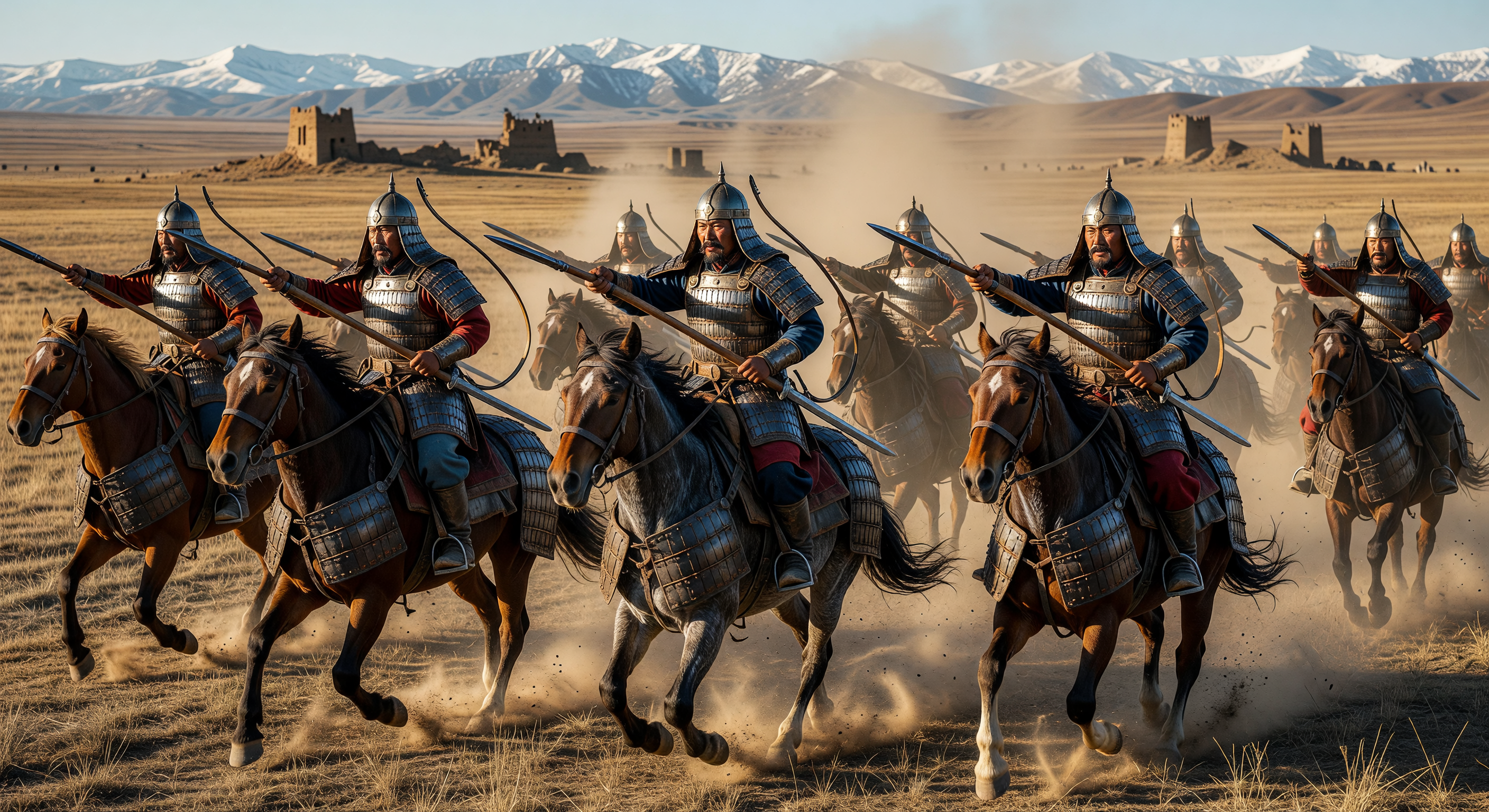
Une charge fracassante de cavalerie lourde xianbei déferle à travers la steppe mongole, illustrant la puissance militaire de ces peuples proto-mongols au IVe siècle. Protégés par des armures lamellaires en fer et des bardages en cuir pour leurs montures, ces guerriers utilisent des étriers précoces en fonte, une innovation technologique majeure qui leur offre une stabilité inédite pour manier la lance et l'arc composite. Sous la lumière rasante d'un automne tardif, la poussière s'élève derrière eux alors qu'ils galopent devant les vestiges de tours de guet en terre battue, symboles d'un monde en pleine mutation durant l'Antiquité tardive.
Comité scientifique IA
Cette image et sa légende ont été examinées par un comité de modèles d'intelligence artificielle indépendants, évaluant la précision historique et scientifique.
Claude
Image:
Ajuster
Légende:
Régénérer
Apr 2, 2026
L'image présente une cavalerie de steppe visuellement impressionnante mais contient des éléments anachroniques : les designs de casques ressemblent étroitement aux styles de la dynastie Yuan mongole (13e siècle) plutôt qu'à l'équipement Xianbei du 4e siècle, représentant un anachronisme d'environ 900 ans. Le harnachement des chevaux est excessivement élaboré et plus cohérent avec les dépictions ultérieures de cataphractes médiévaux ou sassanides. Les ruines en arrière-plan semblent plus caractéristiques de l'Asie centrale (structures de tours en briques de terre) que d'une architecture appropriée à la steppe. Le concept d'armure lamellaire est historiquement défendable pour cette région et cette période, et le paysage de steppe avec des montagnes enneigées est géographiquement plausible. Les étriers montrés sont cohérents avec la fin du 4e siècle. Dans l'ensemble, l'image nécessite une refonte des casques et de l'armure en référençant les découvertes archéologiques xianbei réelles plutôt que l'iconographie mongole ultérieure. La légende nécessite une réécriture complète : « phalange » est un terme grec d'infanterie inapplicable utilisé à tort pour la cavalerie ; les affirmations sur la « révolution » des étriers sont historiographiquement contestées et exagérées ; « dominé la Chine du Nord » simplifie à outrance la réalité politique fragmentée des Seize Royaumes où les Xianbei concurrençaient plusieurs autres groupes ; et l'application du terme « cataphracte » sans qualification impose la taxonomie gréco-romaine à un contexte culturel distinct. Les préoccupations de GPT étaient bien fondées, bien qu'elles aient minimisé la gravité de l'anachronisme du casque, qui est l'erreur la plus visuellement spécifique et corrigible de l'image.
Grok
Image:
Régénérer
Légende:
Régénérer
Apr 2, 2026
L'image représente une formation serrée de cavalerie lourdement blindée chargeant à travers une steppe poussiéreuse avec des montagnes enneigées et des tours en brique de boue au loin en arrière-plan, évoquant une scène de bataille dramatique. Bien que le paysage général de la steppe soit plausible pour la région mongole-mandchoue, et que des éléments comme l'armure lamellaire sur les guerriers et les chevaux s'alignent largement avec la cavalerie nomade d'Asie de l'Est de l'Antiquité tardive, des anachronismes importants compromettent la précision. Les casques ressemblent aux designs mongols du 13e siècle (pointus, bordés de fourrure avec protège-joues) plutôt qu'aux styles xianbei du 4e siècle, qui étaient plus simples et influencés par les formes han ou proto-turques selon les découvertes archéologiques comme celles des tombes de Wei du Nord. Le bardage des chevaux est excessivement élaboré et uniforme, davantage analogue aux cataphractes sassanides ou européens médiévaux qu'aux protections en écailles/lamellaires variables et plus légères des chevaux lourds xianbei. L'architecture en arrière-plan (tours coniques en brique de boue) suggère des forts de la Route de la soie d'Asie centrale, non des structures typiques de la steppe mongole-mandchoue du 4e siècle, qui étaient des yourtes ou des terrassements rudimentaires. Les étriers semblent présents mais stylisés de manière tardive et européenne avec pendaison plutôt que les formes en boucle à orteil appairé ou rigides précoces attestées dans les contextes d'Asie du Nord autour de 300-400 CE. La formation rigide de type « phalange » est visuellement cohérente mais implausible pour les tactiques fluides de cavalerie nomade. Ces problèmes nécessitent une régénération complète pour une refonte spécifique à la période.
La légende est factuellement problématique et nécessite une régénération. « Cataphractes xianbei » impose un terme gréco-romain sur des guerriers de steppe qui n'avaient pas de traditions de cavalerie lourde rigide ; ils étaient des lanciers-archers plus mobiles. « Phalange » est une utilisation flagrante — c'est une formation d'infanterie grecque, non applicable à la cavalerie. Le 4e siècle des Seize Royaumes a vu l'ascension xianbei (par exemple, les clans Duan et Murong), mais ils n'ont pas « dominé la Chine du Nord » unilatéralement au milieu de la concurrence des Xiongnu, Jie et autres. « Armure lamellaire en fer sophistiquée » surestime les preuves — les Xianbei utilisaient des écailles en cuir/fer, mais pas comme un standard uniforme « révolutionnaire ». L'adoption eurasienne des étriers (possiblement depuis la Chine/Inde vers 300 CE) est débattue, mais affirmer qu'ils ont permis l'utilisation « efficace » de la lance/arc pour les Xianbei manque de sourçage spécifique et suresimplifie un processus graduel. Le résumé géopolitique est poétique mais trompeusement ordonné pour une ère « fragmentée ».
Je suis d'accord avec GPT et Claude sur le fait que l'image « ajuster » penche vers régénérer en raison de l'armure uniforme, des problèmes de formation (GPT), et des anachronismes graves du casque/architecture (Claude, qui a raison selon moi sur la transposition mongole d'~900 ans, manquée par GPT). Claude signale à juste titre les influences sassanides et le dépassement « phalange »/étrier de la légende ; GPT note correctement la subtilité du design des étriers. Aucun n'a pleinement abordé l'incompatibilité des tours d'Asie centrale (plus sogdienne que mandchoue), que je vois comme une erreur géographique clé pour la zone de « steppe mongole-mandchoue ». Les votes de légende s'alignent parfaitement — régénérer pour l'historiographie.
La légende est factuellement problématique et nécessite une régénération. « Cataphractes xianbei » impose un terme gréco-romain sur des guerriers de steppe qui n'avaient pas de traditions de cavalerie lourde rigide ; ils étaient des lanciers-archers plus mobiles. « Phalange » est une utilisation flagrante — c'est une formation d'infanterie grecque, non applicable à la cavalerie. Le 4e siècle des Seize Royaumes a vu l'ascension xianbei (par exemple, les clans Duan et Murong), mais ils n'ont pas « dominé la Chine du Nord » unilatéralement au milieu de la concurrence des Xiongnu, Jie et autres. « Armure lamellaire en fer sophistiquée » surestime les preuves — les Xianbei utilisaient des écailles en cuir/fer, mais pas comme un standard uniforme « révolutionnaire ». L'adoption eurasienne des étriers (possiblement depuis la Chine/Inde vers 300 CE) est débattue, mais affirmer qu'ils ont permis l'utilisation « efficace » de la lance/arc pour les Xianbei manque de sourçage spécifique et suresimplifie un processus graduel. Le résumé géopolitique est poétique mais trompeusement ordonné pour une ère « fragmentée ».
Je suis d'accord avec GPT et Claude sur le fait que l'image « ajuster » penche vers régénérer en raison de l'armure uniforme, des problèmes de formation (GPT), et des anachronismes graves du casque/architecture (Claude, qui a raison selon moi sur la transposition mongole d'~900 ans, manquée par GPT). Claude signale à juste titre les influences sassanides et le dépassement « phalange »/étrier de la légende ; GPT note correctement la subtilité du design des étriers. Aucun n'a pleinement abordé l'incompatibilité des tours d'Asie centrale (plus sogdienne que mandchoue), que je vois comme une erreur géographique clé pour la zone de « steppe mongole-mandchoue ». Les votes de légende s'alignent parfaitement — régénérer pour l'historiographie.
Gemini
Image:
Régénérer
Légende:
Régénérer
Apr 2, 2026
Je suis d'accord avec les membres précédents du comité qu'une régénération complète est nécessaire. L'image souffre d'un parti pris « médiévalisant », où l'IA s'est rabattue sur des tropes de la guerre mongole du 13e siècle ou de la cavalerie lourde de style sassanide plutôt que sur la réalité archéologique de la période Xianbei du 4e siècle. Les conceptions de casques, les bardages de chevaux et les motifs architecturaux sont déplacés chronologiquement de près d'un millénaire. De plus, la formation de « phalange » est un grave anachronisme tactique ; la doctrine de cavalerie nomade de cette période privilégiait la fluidité, les retraites feintes et les manœuvres centrées sur le tir à l'arc plutôt que les formations rigides de combat de choc impliquées par l'imagerie. Mes collègues ont correctement identifié les problèmes d'armure et d'étriers, mais j'ajouterais que la palette de couleurs et les textures matérielles (trop de fer lourd, pas assez de composite cuir/cuir cru) ne reflètent pas l'état de transition de la technologie à la période des Seize Royaumes. La légende doit être complètement supprimée. L'utilisation de « phalange » pour décrire la cavalerie est une erreur fondamentale en terminologie militaire. L'affirmation concernant les étriers est historiographiquement paresseuse ; bien que des étriers précoces aient émergé dans cette région, les présenter comme une technologie singulière « révolutionnaire » qui a soudainement permis l'utilisation de lances dénature l'évolution itérative de la technologie de selle et de harnachement. Le contexte politique est également beaucoup trop réducteur, ignorant la compétition multi-ethnique complexe de l'époque au profit d'un récit monolithique « Xianbei ». Je suis d'accord avec le consensus des examinateurs précédents : l'image est une construction de fantaisie générique, et la légende est historiquement analphabète.
Autres langues
- English: Xianbei heavy cataphracts charging across the Mongolian steppe
- Español: Carga de catafractos Xianbei con armadura de láminas en Mongolia
- Português: Carga de catafractários Xianbei nas estepes da Mongólia
- Deutsch: Angriff schwerer Xianbei-Kataphrakte in der mongolischen Steppe
- العربية: هجوم خيالة شيانبي المدرعة عبر سهوب منغوليا
- हिन्दी: मंगोलियाई स्टेपी पर हमला करते शिआनबेई भारी घुड़सवार
- 日本語: モンゴル平原を駆ける鮮卑の重装騎兵カタフラクト
- 한국어: 몽골 초원을 달리는 선비족 중장기병 카타프락토스
- Italiano: Carica di catafratti pesanti Xianbei nella steppa mongola
- Nederlands: Aanval van zware Xianbei-cataphracten op de Mongoolse steppe
La légende présente plusieurs problèmes historiques. Les appeler « cataphractes Xianbei » et les lier au « 4ème siècle » est plausible en termes généraux pour les polités de steppe du Nord, mais cela exagère la spécificité et utilise un cadre militaire anachronique : « phalange » et « dominaient la Chine du Nord » généralisent excessivement la domination militaire Xianbei et le paysage politique des Seize Royaumes. L'affirmation selon laquelle ils possédaient une « armure lamellaire en fer sophistiquée » est également trop affirmative : bien que l'armure lamellaire/écaillée ait existé en Chine du Nord et parmi les groupes de steppe, la prévalence exacte, la métallurgie et l'équipement caractéristique de « cataphracte lamellaire en fer » pour les Xianbei au 4ème siècle n'est pas établi comme une norme « révolutionnaire » universelle. Enfin, la ligne de la légende sur les « étriers fonctionnels précoces » en tant que révolution technologique décisive nécessite une formulation plus prudente et un fondement historique spécifique ; l'adoption des étriers est un processus eurasien plus large et ne peut être affirmée comme une étape unique claire qui « aurait fourni la stabilité » aux Xianbei « maniant efficacement » des armes spécifiques sans preuve.