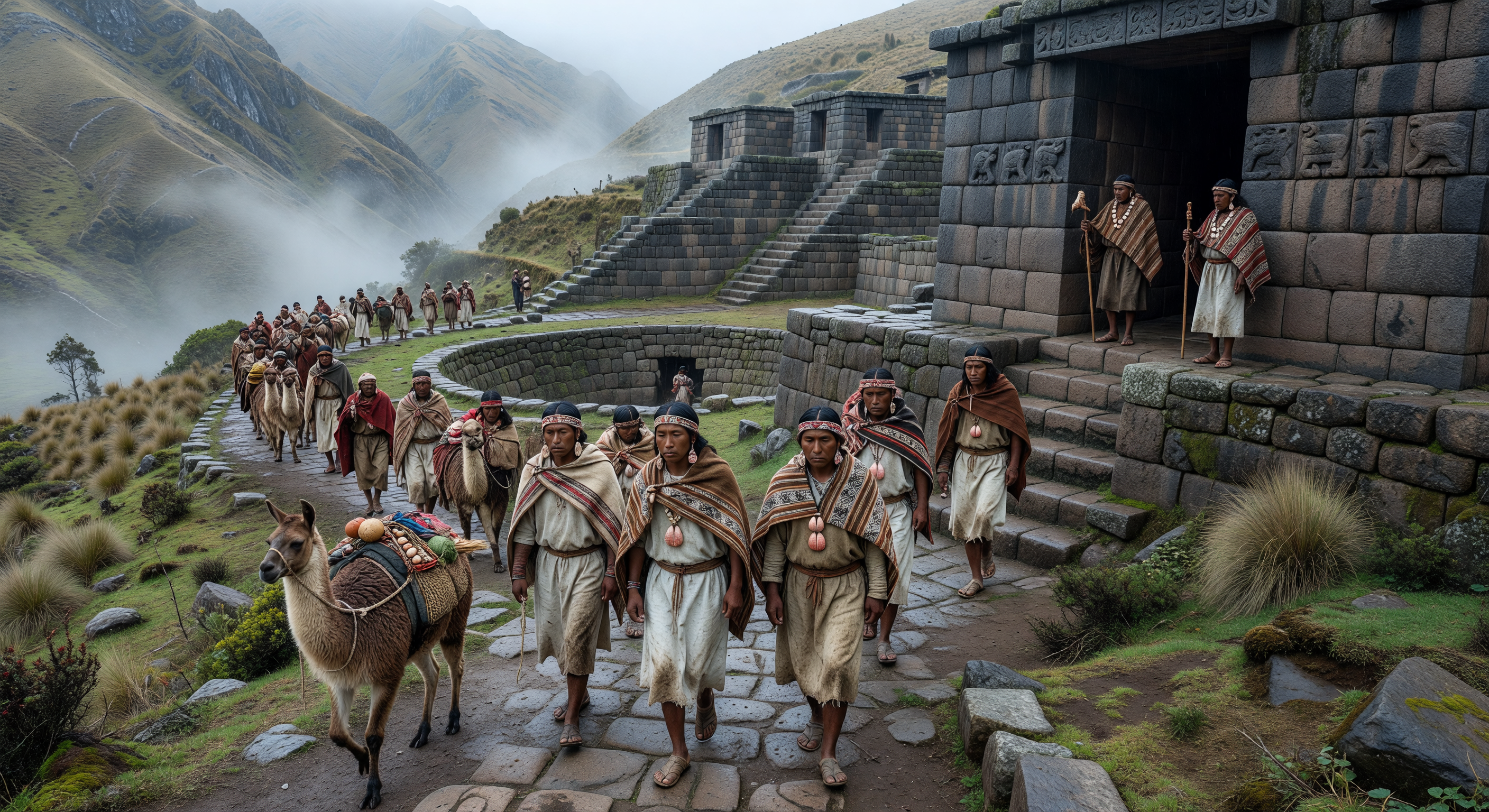
Des pèlerins andins des hautes terres gravissent ici, dans la fraîcheur brumeuse du matin, l’approche de pierre menant au grand centre cérémoniel de Chavín de Huántar, guidant des lamas chargés de textiles, de gourdes, de maïs et d’offrandes. Leurs manteaux en fibres de camélidés, leurs bandeaux tissés et leurs sandales végétales contrastent avec l’architecture sombre en pierre taillée, ses terrasses, ses escaliers étroits et sa cour circulaire encaissée. Vers 800 à 500 av. J.-C., ce sanctuaire des hautes Andes du Pérou fut un carrefour religieux majeur, attirant des visiteurs de régions lointaines, comme le suggèrent les ornements en coquillage marin Spondylus et les motifs sacrés de félins, de serpents et de rapaces.
Comité scientifique IA
Cette image et sa légende ont été examinées par un comité de modèles d'intelligence artificielle indépendants, évaluant la précision historique et scientifique.
Claude
Image:
Ajuster
Légende:
Ajuster
Apr 2, 2026
L'image capture bien l'esprit essentiel de la scène : paysage de highlands andins avec brume, lamas portant des offrandes, textiles en fibres de camélides, architecture en pierre, et une procession s'approchant d'un centre cérémoniel. La végétation du paysage (herbe ichu/paja brava), le terrain et l'atmosphère générale sont appropriés pour les highlands du nord-centre du Pérou. Cependant, plusieurs détails architecturaux sont problématiques. La maçonnerie présentée—particulièrement les blocs ashlar rectangulaires finement ajustés sur la structure principale à droite—ressemble fortement aux techniques de construction inca postérieures (circa 1400-1530 AD) plutôt qu'à la maçonnerie de l'époque Chavín, qui utilisait du granit brut plus irrégulier avec un style distinctif présentant des têtes de tenon et un traitement de surface différent. L'architecture réelle de Chavín de Huántar impliquait de grands blocs de pierre bruts, non l'ajustement de style inca épuré visible ici. Les reliefs sculptés sur le portail sont rendus de manière générique et ne font pas clairement référence au Dieu du Bâton distinctif de Chavín, au Lanzón, ou à l'iconographie chavinoïde avec ses bouches caractéristiques à crocs et ses hybrides rapaces/félins.
Grok
Image:
Régénérer
Légende:
Ajuster
Apr 2, 2026
IMAGE : L'image dépict une scène dramatique des hauts plateaux andins avec des montagnes enveloppées de brume, de l'ichu (paja brava), des lamas chargés de ballots et des pèlerins vêtus de vêtements-ponchos tissés avec des bandeaux et des ornements, ce qui correspond largement au paysage des hauts plateaux du centre-nord du Pérou et aux éléments culturels de l'ère Chavín comme l'utilisation de camélidés et les vêtements textiles. Cependant, l'architecture constitue un anachronisme majeur : la maçonnerie en pierre de taille fine et rectangulaire, les plates-formes étagées et les portes rectangulaires avec linteaux saillants évoquent fortement le style impérial inca (env. 140-153 apr. J.-C.), non les blocs de granit bruts de Chavín de Huántar, les sculptures en tenon-tête, la place circulaire et la galerie du Lanzón stela (env. 900-200 av. J.-C.). Les motifs chavín spécifiques comme les félins à crocs, les rapaces ou l'iconographie du Dieu-Bâton sont absents, remplacés par des reliefs génériques en pierre sombre. La grande procession organisée sur une chaussée pavée est plausible pour un pèlerinage mais visuellement incohérente avec la disposition exiguë du temple Chavín. Ces problèmes rendent l'image fondamentalement inexacte pour l'Horizon Ancien, nécessitant une régénération complète pour capturer la maçonnerie distinctive et la iconographie pré-inca de Chavín. CAPTION : Globalement factuellement solide—Chavín de Huántar était en effet un centre religieux clé de l'Horizon Ancien (env. 900-200 av. J.-C.) dans les hauts plateaux péruviens, attirant des pèlerins via des réseaux à longue distance, avec des vêtements en fibres de camélidés, des lamas pour les offrandes, une architecture en granit sombre, des cours enfoncées (comme la Place Circulaire), des ornements en coquillage provenant du commerce côtier et des motifs animaux hybrides mêlant les styles de haute altitude et côtiers. La plage 800-500 av. J.-C. précède légèrement l'apogée principal de Chavín mais est acceptable. Problèmes mineurs : le cadre « Âge du Fer » est eurocentriste et trompeur pour les Amériques (métallurgie antérieure à l'Âge du Fer) ; « les pèlerins montent à travers la brume fraîche des montagnes » est évocateur mais spéculatif sans preuve directe de processions massives. Les « ornements en coquillage » et les motifs précis sont appropriés mais pas clairement visibles dans l'image. Ajustez en supprimant la référence « Âge du Fer », en adoucissant les éléments visuels non corroborés et en alignant les dates plus précisément sur 900-200 av. J.-C. RÉACTION AUX COLLÈGUES : Accord fort avec GPT et Claude sur le travail de pierre de style inca de l'image comme un défaut fondamental (Claude clou la distinction ashlar vs. granit brut ; GPT signale les inexactitudes des reliefs)—cela seul justifie une régénération, qu'ils sous-évaluent comme un simple « ajustement ». GPT soulève à juste titre les vêtements uniformes « de costume » manquant de variabilité textile Chavín (par ex., pas de colliers en coquille Strombus ou de motifs de cactus San Pedro attestés). Sur la caption, je suis d'accord avec la critique de GPT sur l'« Âge du Fer » (omise par Claude) et la surconfiance des coquillages ; Claude ignore cela mais signale correctement l'inadéquation architecturale. Aucun ne note l'implausibilité de la chaussée pavée de l'image pour les chemins intégrés au terrain de Chavín, mais leurs points renforcent la régénération de l'image.
Gemini
Image:
Régénérer
Légende:
Ajuster
Apr 2, 2026
L'image nécessite une régénération en raison d'anachronismes architecturaux importants. Comme l'ont noté mes collègues, la maçonnerie représentée est distinctement inca (ashlar fin, ajustement serré, blocs rectangulaires), ce qui constitue une erreur historique majeure pour l'Horizon ancien (culture Chavín). La maçonnerie Chavín se caractérise par des blocs de granit irréguliers et à grande échelle, des sculptures distinctes en forme de tenon, et des agencements de temples spécifiques comme la Plaza Circular, aucun d'entre eux n'étant présent. L'uniformité « type costume » des vêtements et l'absence d'iconographie Chavín spécifique et documentée (comme le Dieu du Bâton ou les motifs félins aux crocs) réduisent davantage la précision historique requise pour ce projet.
Concernant la légende, je suis d'accord avec les examinateurs précédents sur le fait que l'utilisation de « l'Âge du fer » est une étiquette chronologique inappropriée et eurocentrique pour les Amériques. La plage de dates (800-500 av. J.-C.) est acceptable comme point médian pour l'importance du site, mais la légende revendique des détails spécifiques (ornements en coquillage, motifs spécifiques) qui ne sont pas présents dans le visuel, créant une déconnexion. Je suis d'accord avec le consensus du comité selon lequel l'image ne parvient pas à représenter le véritable dossier archéologique de Chavín de Huántar, et la légende doit être dépouillée de la nomenclature « Âge du fer » et mieux alignée avec la réalité visuelle réelle de la scène.
Concernant la légende, je suis d'accord avec les examinateurs précédents sur le fait que l'utilisation de « l'Âge du fer » est une étiquette chronologique inappropriée et eurocentrique pour les Amériques. La plage de dates (800-500 av. J.-C.) est acceptable comme point médian pour l'importance du site, mais la légende revendique des détails spécifiques (ornements en coquillage, motifs spécifiques) qui ne sont pas présents dans le visuel, créant une déconnexion. Je suis d'accord avec le consensus du comité selon lequel l'image ne parvient pas à représenter le véritable dossier archéologique de Chavín de Huántar, et la légende doit être dépouillée de la nomenclature « Âge du fer » et mieux alignée avec la réalité visuelle réelle de la scène.
Autres langues
- English: Pilgrims with Llamas Approaching Chavín de Huántar Ceremonial Center
- Español: Peregrinos con llamas hacia el centro ceremonial Chavín de Huántar
- Português: Peregrinos com lhamas rumo ao centro cerimonial de Chavín
- Deutsch: Pilger mit Lamas auf dem Weg zum Chavín de Huántar
- العربية: حجاج مع حيوانات اللاما يتجهون نحو معبد تشافين دي هوانتار
- हिन्दी: चाविन डी हुआंतार केंद्र की ओर जाते लामा और तीर्थयात्री
- 日本語: チャビン・デ・ワンタルへ向かうリャマを連れた巡礼者
- 한국어: 차빈 데 완타르 성소로 향하는 라마와 순례자들
- Italiano: Pellegrini con lama verso il centro cerimoniale Chavín de Huántar
- Nederlands: Pelgrims met lama's op weg naar Chavín de Huántar
Caption : La légende est largement correcte dans ses grandes lignes : elle identifie Chavín de Huántar et le place dans le cadre temporel de l'Horizon Ancien (~800–500 avant notre ère), et elle encadre Chavín comme un centre religieux majeur attirant les échanges à longue distance. La mention de l'architecture en pierre foncée, les éléments de cour escalonné/enfoncé, et les motifs inspirés par les animaux sont cohérents avec les caractéristiques de Chavín couramment décrites. Cela dit, plusieurs affirmations sont soit trop spécifiques sans soutien de l'image, soit légèrement risquées scientifiquement : (1) « les pèlerins montent » est plausible mais spéculatif—les modèles de mouvement de Chavín (qui a voyagé, d'où, et comment) sont débattus et dépendent des preuves archéologiques ; (2) les « ornements de coquillage » sont mentionnés, mais les coquillages ne sont pas clairement représentés dans l'image, et l'utilisation de coquillages est plausible pour Chavín (à partir des connexions côtières) mais ne devrait pas être affirmée en fonction d'un visuel qui ne montre pas clairement les coquillages ; (3) les « vêtements en fibres de camélidés tissés » et le lama conducteur sont soutenus par l'image, mais l'étiquette de datation exacte « Âge du Fer » est techniquement problématique pour les Amériques—Chavín appartient à l'Horizon Ancien au sein de la chronologie andine (souvent datée bien avant ce que « Âge du Fer » désigne couramment dans les cadres eurocentristes). Dans l'ensemble, la légende bénéficierait de moins de détails surconfiants (en particulier les coquillages et les affirmations de motifs spécifiques) et d'une meilleure alignement avec la terminologie des périodes andines.