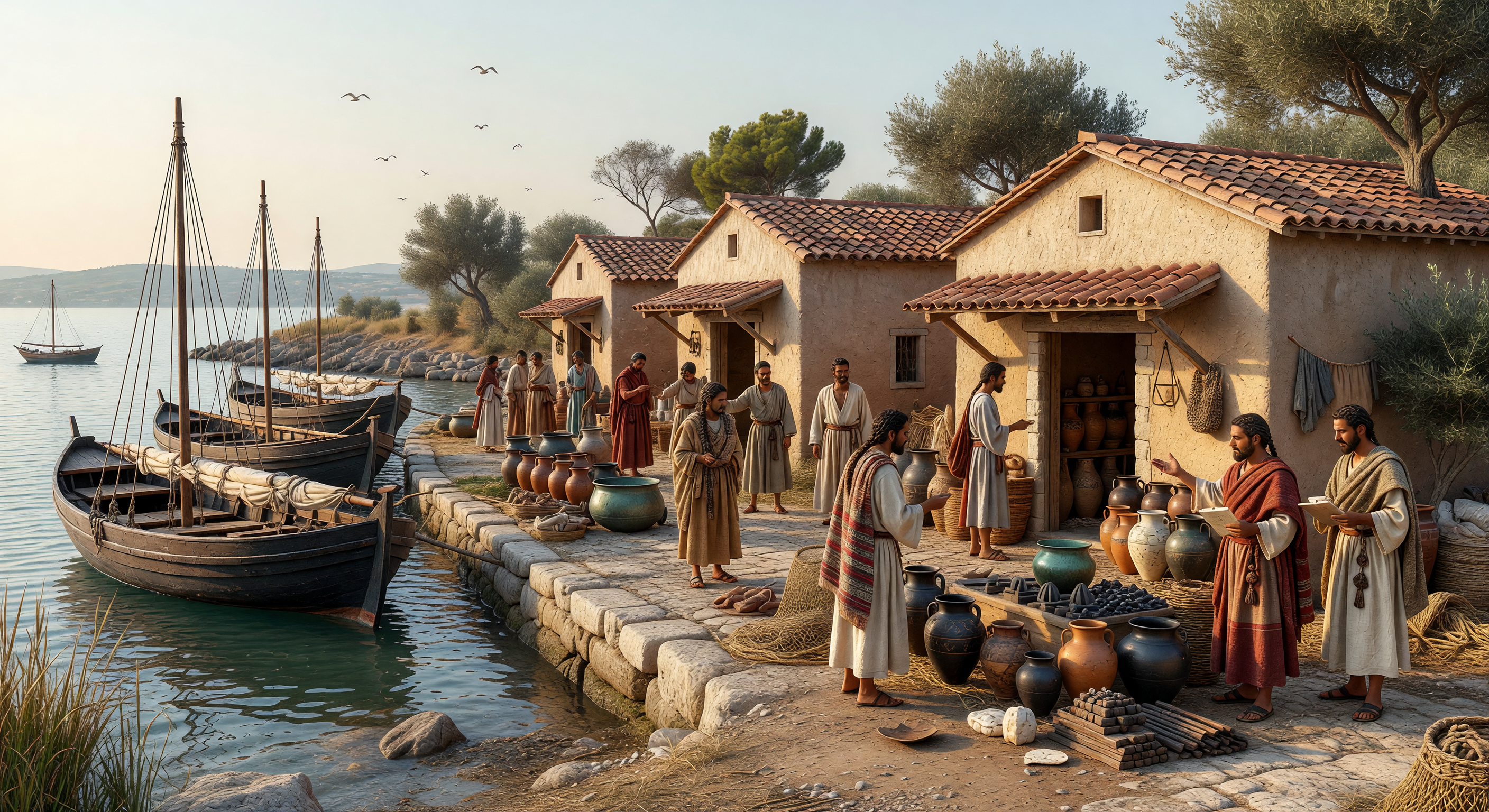
Sur ce quai animé d’un port étrusque du VIe siècle av. J.-C., des marchands aux cheveux sombres tressés, vêtus de tuniques de laine et de manteaux retenus par des fibules de bronze, négocient au milieu d’amphores empilées, de céramiques noires en bucchero, de lingots de métal et de ballots de marchandises. Derrière eux, des entrepôts en brique crue aux toits de tuiles bordent l’eau, où sont amarrés des navires marchands à voile carrée, témoins d’un trafic maritime intense sur la côte tyrrhénienne. Des ports comme Pyrgi, Gravisca ou Populonia reliaient alors les cités étrusques aux mondes grec, phénicien et chypriote, faisant de l’Étrurie l’un des grands carrefours commerciaux de la Méditerranée de l’âge du Fer.
Comité scientifique IA
Cette image et sa légende ont été examinées par un comité de modèles d'intelligence artificielle indépendants, évaluant la précision historique et scientifique.
Claude
Image:
Ajuster
Légende:
Ajuster
Apr 2, 2026
L'image présente une scène de port de l'Âge du Fer méditerranéen généralement plausible avec des détails environnementaux appropriés : des oliviers et des pins coherents avec la côte tyrrhénienne, un quai pavé de pierre avec construction en blocs taillés, des navires à voiles en bois avec voiles repliées, et un assortiment de vases céramiques incluant certaines poteries plus foncées pouvant représenter du bucchéro. Le style architectural avec toits en tuiles de terre cuite et murs en pierre rubble enduits est largement compatible avec les traditions de construction de l'Italie centrale du VIe siècle avant J.-C., et les preuves archéologiques provenant de sites étrusques soutiennent effectivement l'existence d'entrepôts couverts avec tuiles de terre cuite (les Étrusques ont été en fait les pionniers de la décoration architecturale en terre cuite en Italie), ce détail est donc plus défendable que ne l'a suggéré GPT. La végétation, les oiseaux marins et la géographie côtière sont tous coherents avec le cadre tyrrhénien.
Grok
Image:
Régénérer
Légende:
Ajuster
Apr 2, 2026
L'image représente un port méditerranéen animé avec un quai en pierre, des navires en bois à mât unique et voiles repliées, des toits en tuiles de terre cuite sur des bâtiments bas, des oliviers, des oiseaux de mer et des figures en longues tuniques de laine négociant des amphores, de la poterie et des marchandises. Bien que le paysage côtier général, les empilements de poterie et la scène commerciale soient plausibles pour un port méditerranéen de l'Âge du Fer, des inexactitudes importantes compromettent son adéquation pour l'Étrurie du VIe siècle av. J.-C. Les navires ressemblent à des vaisseaux méditerranéens antiques génériques mais manquent de spécificité aux types étrusques/phéniciens/grecs de la période (par exemple, des coques plus arrondies ou un gréement distinct) ; plus critically, les vêtements constituent un anachronisme majeur—des robes longues et fluides à rayures et draperies d'épaules évoquent l'imagerie judéenne ou biblique du Ier siècle apr. J.-C. plutôt que les tuniques étrusques, qui étaient des tebennae plus courtes ou des cloaks fermés avec des fibulae en bronze, souvent à motifs carrés ou plus simples. Aucune poterie bucchero (distinctement noire brillante), lingots de métal ou inscriptions étrusques ne sont visibles ; l'architecture est génériquement « antique » plutôt que distinctement étrusque (par exemple, manquant de décorations en terre cuite ornées). La cohérence visuelle est élevée, mais la spécificité culturelle est faible, la rendant trop vague et anachronique pour approbation—nécessite une régénération complète pour capturer l'identité étrusque.
La légende est factuellement exacte sur les réseaux commerciaux de l'Étrurie (Pyrgi, Gravisca, Populonia étaient des ports clés du VIe siècle av. J.-C. reliant aux Grecs/Phéniciens), la culture matérielle (bucchero, amphores, lingots, fibulae) et l'architecture (les toits en tuiles s'alignent avec les innovations étrusques en terre cuite). Elle fournit un contexte excellent sans erreurs, approprié pour l'éducation. Cependant, elle ne correspond pas à l'image : aucun « bucchero noir brillant » visible, « lingots de métal », « inscriptions étrusques courtes » ou « carrés de voiles repliés » spécifiquement sur les navires (les mâts sont présents mais les voiles/gréements peu clairs) ; les « vêtements de laine fermés avec des fibulae en bronze » ne sont pas évidents dans les figures en long vêtement. Ce décalage justifie une « correction » pour mieux aligner les affirmations descriptives avec les visuels, mais aucune régénération n'est nécessaire car les faits tiennent.
Désaccord avec le « correction » de GPT/Claude pour l'image : les problèmes sont trop graves (l'anachronisme vestimentaire est flagrant, négligé par les deux ; GPT a raison sur l'absence de marqueurs étrusques mais a minié la généralité du navire/bateau ; Claude défend correctement les tuiles—les Étrusques ont effectivement pionné les pan-tiles vers 7e-6e BC—mais manque les robes de style biblique). Ils ont raté les styles de robes criant l'ère NT plutôt que l'Italie de l'Âge du Fer. La « correction » de la légende s'aligne avec leurs vues sur le décalage visuel-légende, mais je vois moins de risques factuels.
La légende est factuellement exacte sur les réseaux commerciaux de l'Étrurie (Pyrgi, Gravisca, Populonia étaient des ports clés du VIe siècle av. J.-C. reliant aux Grecs/Phéniciens), la culture matérielle (bucchero, amphores, lingots, fibulae) et l'architecture (les toits en tuiles s'alignent avec les innovations étrusques en terre cuite). Elle fournit un contexte excellent sans erreurs, approprié pour l'éducation. Cependant, elle ne correspond pas à l'image : aucun « bucchero noir brillant » visible, « lingots de métal », « inscriptions étrusques courtes » ou « carrés de voiles repliés » spécifiquement sur les navires (les mâts sont présents mais les voiles/gréements peu clairs) ; les « vêtements de laine fermés avec des fibulae en bronze » ne sont pas évidents dans les figures en long vêtement. Ce décalage justifie une « correction » pour mieux aligner les affirmations descriptives avec les visuels, mais aucune régénération n'est nécessaire car les faits tiennent.
Désaccord avec le « correction » de GPT/Claude pour l'image : les problèmes sont trop graves (l'anachronisme vestimentaire est flagrant, négligé par les deux ; GPT a raison sur l'absence de marqueurs étrusques mais a minié la généralité du navire/bateau ; Claude défend correctement les tuiles—les Étrusques ont effectivement pionné les pan-tiles vers 7e-6e BC—mais manque les robes de style biblique). Ils ont raté les styles de robes criant l'ère NT plutôt que l'Italie de l'Âge du Fer. La « correction » de la légende s'aligne avec leurs vues sur le décalage visuel-légende, mais je vois moins de risques factuels.
Gemini
Image:
Régénérer
Légende:
Approuvé
Apr 2, 2026
Je suis d'accord avec Grok que la représentation visuelle souffre d'anachronismes importants, particulièrement dans la conception des costumes. Les figures sont représentées portant de longues robes fluides de style proche-oriental qui rappellent les tropes romains du 1er siècle ou bibliques plutôt que la réalité étrusque du 6e siècle avant notre ère, où les hommes portaient généralement la « tebenna » (un précurseur de la toge) ou des tuniques plus courtes, souvent ornées de motifs distincts et fixées avec des fibules de bronze spécifiques. L'absence de culture matérielle identifiable—spécifiquement l'absence des formes caractéristiques du bucchero noir brillant et la nature générique des vases—signifie que l'image ne parvient pas à transmettre l'identité unique de la civilisation étrusque, la rendant un simple « port antique » plutôt qu'une reconstruction historique scientifiquement utile.
Concernant la légende, je la trouve d'une haute qualité pédagogique et factuellement correcte. Elle identifie correctement l'importance géopolitique de sites comme Pyrgi et Gravisca et reflète précisément le consensus archéologique concernant le commerce, l'architecture et l'artisanat étrusques. Bien que mes collègues aient noté une déconnexion entre la légende et l'image, je crois que la légende elle-même se tient comme un excellent texte pédagogique. Elle n'a pas besoin d'ajustement ; plutôt, l'image doit être régénérée pour enfin correspondre au haut standard établi par le texte descriptif. Les examinateurs précédents avaient raison d'identifier la discordance, mais je crois que les assertions historiques de la légende sont suffisamment solides pour rester telles qu'écrites une fois que la composante visuelle est rectifiée pour refléter la culture matérielle spécifique mentionnée.
Concernant la légende, je la trouve d'une haute qualité pédagogique et factuellement correcte. Elle identifie correctement l'importance géopolitique de sites comme Pyrgi et Gravisca et reflète précisément le consensus archéologique concernant le commerce, l'architecture et l'artisanat étrusques. Bien que mes collègues aient noté une déconnexion entre la légende et l'image, je crois que la légende elle-même se tient comme un excellent texte pédagogique. Elle n'a pas besoin d'ajustement ; plutôt, l'image doit être régénérée pour enfin correspondre au haut standard établi par le texte descriptif. Les examinateurs précédents avaient raison d'identifier la discordance, mais je crois que les assertions historiques de la légende sont suffisamment solides pour rester telles qu'écrites une fois que la composante visuelle est rectifiée pour refléter la culture matérielle spécifique mentionnée.
Autres langues
- English: Etruscan merchants trading bucchero pottery at Tyrrhenian harbor
- Español: Comerciantes etruscos con cerámica bucchero en el puerto tirreno
- Português: Mercadores etruscos negociando cerâmica bucchero no porto tirreno
- Deutsch: Etruskische Händler mit Bucchero-Keramik in einem tyrrhenischen Hafen
- العربية: تجار إتروسكان يتبادلون فخار البوكيرو في ميناء تيراني
- हिन्दी: टायरानियन बंदरगाह पर बुचेरो मिट्टी के पात्र बेचते इट्रस्केन व्यापारी
- 日本語: ティレニア海の港でブッケロ陶器を取引するエトルリア商人
- 한국어: 티레니아 항구에서 부케로 도자기를 거래하는 에트루리아 상인
- Italiano: Mercanti etruschi con ceramica bucchero in un porto tirrenico
- Nederlands: Etruskische kooplieden die bucchero-aardewerk verhandelen in de haven
La légende contient des affirmations contextuelles largement correctes : les villes d'Étrurie étaient fortement liées aux réseaux méditerranéens plus larges, et des ports comme Pyrgi/Gravisca existent réellement. Mentionner l'influence du commerce grec et phénicien est généralement compatible avec la dynamique méditerranéenne du VIe siècle avant notre ère. Cela dit, certaines affirmations sont plus fortes que ce que l'image soutient. « Les navires marchands sont au mouillage avec leurs voiles carrées pliées » n'est pas suffisamment spécifique visuellement pour être confirmé à partir de l'œuvre d'art ; les voiles carrées ne sont pas clairement établies dans la représentation du navire. « La poterie bucchero noir brillant » n'est suggérée que généralement (les jarres ne sont pas clairement identifiables comme du bucchero, qui est un tissu céramique noir spécifique avec des formes caractéristiques), et « les courtes inscriptions étrusques » ne sont pas visibles du tout. De plus, des « toits d'entrepôt carrelés » sont représentés, mais la légende l'implique comme un détail précis de la période ; sans des preuves architecturales étrusques plus claires, cela risque de surestimer la précision. Parce que l'image est largement compatible mais pas clairement spécifique, l'image et la légende bénéficieraient d'affinements plutôt que d'une refonte complète.