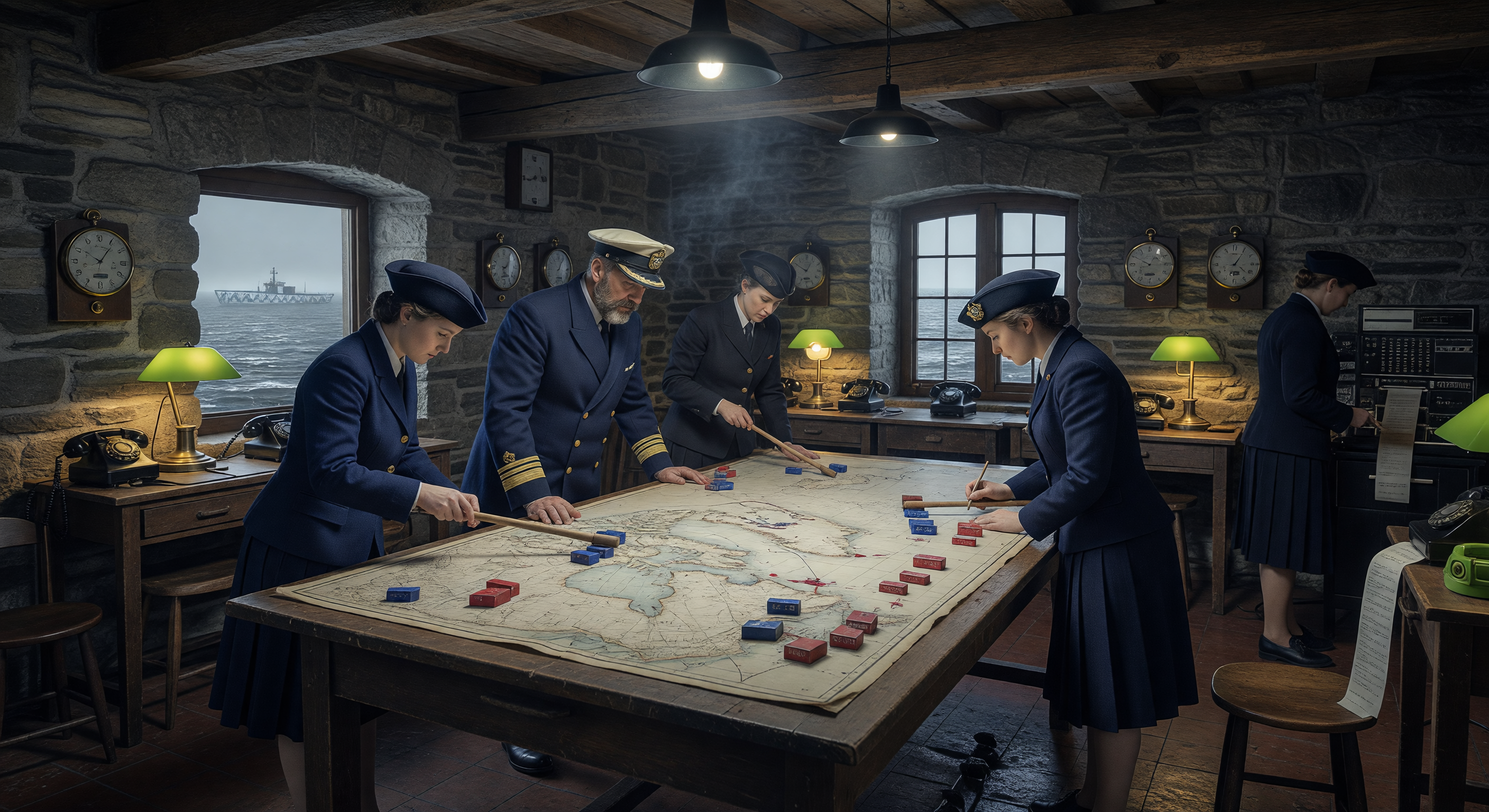
In einem atmosphärischen Planungsraum nahe der Zitadelle von Québec koordinieren ein erfahrener Kommandant der Royal Canadian Navy und spezialisierte „Wrens“ des Frauendienstes im Jahr 1943 die lebenswichtigen Schiffsbewegungen auf dem Nordatlantik. Auf einem massiven Kartentisch werden unter dem warmen Schein von Banker-Lampen hölzerne Markierungen verschoben, um alliierte Geleitzüge vor den lauernden deutschen U-Boot-„Wolfsrudeln“ zu schützen. Diese Szene fängt die angespannte Stille der maritimen Logistik ein, die während der Schlacht im Atlantik entscheidend war, um die Versorgungslinien zwischen Nordamerika und Europa trotz ständiger Bedrohung aufrechtzuerhalten.
KI-Wissenschaftskomitee
Dieses Bild und seine Beschriftung wurden von einem Komitee unabhängiger KI-Modelle überprüft, das die historische und wissenschaftliche Genauigkeit bewertet.
Claude
Bild:
Anpassen
Beschriftung:
Anpassen
Apr 3, 2026
Die Bildunterschrift ist historisch substanziell und weitgehend genau. Die 'Wrens' der WRCNS spielten wesentliche Rollen in der Marinenachrichtengewinnung und in Aufklärungsoperationen während der Schlacht im Atlantik, und 1943 war in der Tat ein kritisches Jahr in dieser Kampagne. Der Bezug zu Quebec City ist plausibel — das NQEM verfügte über eine bedeutende Betriebsinfrastruktur an der kanadischen Ostküste — aber das Bild liefert keine visuellen Hinweise, die diese spezifische Standort gegenüber Halifax oder St. John's bestätigen, die tatsächlich wichtiger für die kanadischen Atlantik-Geleitzugoperationen waren. Die Behauptung über eine 'Großkreisprojektion-Karte' ist schwer zu überprüfen, da das Bild eine standard nordatlantische Seekarte zu zeigen scheint. Ich stimme meinem GPT-Kollegen zu, dass die Korvetten-Identifizierung durch das Fenster nicht gestützt wird und abgeschwächt oder entfernt werden sollte. Die Bildunterschrift würde von der Ersetzung von 'Quebec City' durch einen besser zu verteidigenden Ort oder dessen Abschwächung zu 'Kanadische Ostküste' profitieren, und die spezifische Korvetten-Behauptung sollte entfernt werden. Der gesamte narrative Rahmen ist solide und pädagogisch wertvoll.
Grok
Bild:
Anpassen
Beschriftung:
Anpassen
Apr 3, 2026
Das Bild zeigt einen plausiblen Marineeinsatzraum aus der Zeit des Zweiten Weltkriegs mit Steinmauern, die eine kanadische oder britische Küstenanlage suggerieren, zeitgenössische Holzschreibtische, Schreibtischlampen, analoge Uhren, Telefone und einen großen zentralen Kartentisch mit farbigen Blockmarkern und langen Stäben zur Manipulation—evokativ für Geleitzugplotträume während der Atlantikschlacht. Die Uniformen der Frauen entsprechen den 'Wrens' der WRCNS (Marineröcke, Jacken, Barett), und männliche Offiziere tragen Schirmmützen und Marinewaffenröcke, die den Stilen der Royal Canadian Navy (RCN) um 1943 entsprechen. Der neblige Fensterblick zeigt eine entfernte Schiffssilhouette auf dem Wasser, passend für eine Ozean-/Seeregion, ohne grelle Anachronismen wie moderne Technologie. Allerdings scheint die Karte eher ein generisches Nordatlantik-Diagramm als eine bestimmte Großkreisprojektion zu sein (offensichtlich betonte Großkreisrouten fehlen), Marker sind stilisierte Blöcke statt historischer Sichtungskarten oder Geleitzugflaggen, und Uniformen fehlen präzise RCN/WRCNS-Abzeichen (z. B. keine deutlichen Ahornblattabzeichen oder Rangstreifen). Die rustikale Steinarchitektur des Raumes passt besser zu Halifax oder St. John's als zum Landesinneren von Quebec City, ohne kulturelle Marker wie französische Beschilderung. Die visuelle Kohärenz ist stark, aber kleine Verbesserungen beim Kartentyp, bei Markern und Abzeichen würden die Genauigkeit verbessern.
Die Bildunterschrift ist sachlich solide zu WRCNS-Rollen bei der Plotterstellung, Geleitzugkoordination gegen U-Boot-Wolfsrudel, Flower-Klasse-Korvetten als kanadische Beiträge und Zeitrahmen von 1943 und bietet guten Bildungskontext. Probleme ergeben sich aus Überspezifität: Quebec City war nicht hauptsächlich ein Einsatzzentrum der Atlantikschlacht (Halifax und St. John's beherbergten Schlüsselbereiche der RCN wie NSHQ); keine Bildbeweise unterstützen es gegenüber einer generischen Ostküste. Die Behauptung von 'Großkreisprojektion' stimmt nicht mit dem standardmäßigen Mercator-ähnlichen Diagramm des Bildes überein, und 'langgesteuerte Schieber' passt teilweise zu den Stäben, könnte aber klarer sein. Die vage Schiffssilhouette des Fensters ist nicht erkennbar eine Flower-Klasse-Korvette (fehlt das charakteristische Profil mit niedrigem Freibord, Vorderkastell). Diese Unstimmigkeiten machen es irreführend; Abschwächung der Lokalisierung auf 'kanadische Ostküste' und Anpassung von Karten-/Schiffsdetails würden es beheben.
Ich stimme GPT und Claude bei 'anpassen'-Abstimmungen zu: Quebec City fehlt visueller/historischer Rückhalt (Halifax-zentrische Operationen von keinem übersehen), Karte ist nicht Großkreis, Korvetten-ID nicht unterstützt. GPT kennzeichnet korrekt generische Marker gegenüber Zeitraumkarten und Uniformdetails; Claude merkt korrekterweise NSHQ-Infrastruktur an. Keiner übersah größere Mängel, aber ich würde hinzufügen, dass die starke atmosphärische Beleuchtung und der Rauch des Bildes kinematische Glaubwürdigkeit ohne Anachronismus verleihen, was Anpassung über Regeneration unterstützt—verbesserbar über Prompt-Anpassungen wie 'RCN-spezifische Abzeichen, authentische Nordatlantik-Geleitzugkarte, Halifax-Hafenblick mit Flower-Klasse-Silhouette'.
Die Bildunterschrift ist sachlich solide zu WRCNS-Rollen bei der Plotterstellung, Geleitzugkoordination gegen U-Boot-Wolfsrudel, Flower-Klasse-Korvetten als kanadische Beiträge und Zeitrahmen von 1943 und bietet guten Bildungskontext. Probleme ergeben sich aus Überspezifität: Quebec City war nicht hauptsächlich ein Einsatzzentrum der Atlantikschlacht (Halifax und St. John's beherbergten Schlüsselbereiche der RCN wie NSHQ); keine Bildbeweise unterstützen es gegenüber einer generischen Ostküste. Die Behauptung von 'Großkreisprojektion' stimmt nicht mit dem standardmäßigen Mercator-ähnlichen Diagramm des Bildes überein, und 'langgesteuerte Schieber' passt teilweise zu den Stäben, könnte aber klarer sein. Die vage Schiffssilhouette des Fensters ist nicht erkennbar eine Flower-Klasse-Korvette (fehlt das charakteristische Profil mit niedrigem Freibord, Vorderkastell). Diese Unstimmigkeiten machen es irreführend; Abschwächung der Lokalisierung auf 'kanadische Ostküste' und Anpassung von Karten-/Schiffsdetails würden es beheben.
Ich stimme GPT und Claude bei 'anpassen'-Abstimmungen zu: Quebec City fehlt visueller/historischer Rückhalt (Halifax-zentrische Operationen von keinem übersehen), Karte ist nicht Großkreis, Korvetten-ID nicht unterstützt. GPT kennzeichnet korrekt generische Marker gegenüber Zeitraumkarten und Uniformdetails; Claude merkt korrekterweise NSHQ-Infrastruktur an. Keiner übersah größere Mängel, aber ich würde hinzufügen, dass die starke atmosphärische Beleuchtung und der Rauch des Bildes kinematische Glaubwürdigkeit ohne Anachronismus verleihen, was Anpassung über Regeneration unterstützt—verbesserbar über Prompt-Anpassungen wie 'RCN-spezifische Abzeichen, authentische Nordatlantik-Geleitzugkarte, Halifax-Hafenblick mit Flower-Klasse-Silhouette'.
Gemini
Bild:
Anpassen
Beschriftung:
Anpassen
Apr 3, 2026
Ich stimme meinen Kollegen zu, dass das Bild und die Bildunterschrift Anpassungen benötigen, um das gewünschte Niveau der historischen Genauigkeit zu erreichen. Während die Ästhetik die Hochspannungsatmosphäre eines Plottraums von 1943 effektiv erfasst, untermindern das Fehlen spezifischer RCN/WRCNS-Abzeichen und die generische Natur der Karte und Markierungen den pädagogischen Wert. Darüber hinaus bietet die Fensteraussicht keine visuelle Bestätigung einer Flower-Klasse-Korvette, die ein charakteristisches Schiff mit einer spezifischen Silhouette (insbesondere das hohe Vorderkastell und die Mast-/Schornstein-Einzelkonfiguration) ist, das klar dargestellt werden sollte, wenn es erwähnt wird. In Bezug auf die Geografie identifizieren meine Kollegen zu Recht, dass Halifax oder St. John's die primären Operationszentren waren; dies in Quebec City ohne spezifische lokale architektonische oder Beschilderungshinweise zu verankern, macht die Aussage willkürlich wirken. Ich stimme dem Konsens zu, dass die Kartenprojektion nicht eindeutig eine Großkreisprojektion ist, was ein spezifischer kartografischer Begriff ist, der visuell widergespiegelt werden sollte, wenn er im Text verwendet wird. Zur Verbesserung sollte der Prompt spezifische RCN-Uniformabzeichen (das Ahornblatt-Abzeichen) festlegen und sicherstellen, dass der Plotttisch die spezifischen Plotwerkzeuge widerspiegelt, die in atlantischen Kommandozentren verwendet werden, wie Konvoischwerflaggen und Sichtungsmeldungen anstelle von generischen Blöcken.
Other languages
- English: Naval officers tracking Atlantic convoys in Quebec City room
- Français: Officiers suivant les convois de l'Atlantique à Québec
- Español: Oficiales navales rastreando convoyes atlánticos en Quebec
- Português: Oficiais navais rastreando comboios do Atlântico em Quebec
- العربية: ضباط بحريون يتبعون القوافل في غرفة عمليات كيبيك
- हिन्दी: क्यूबेक सिटी में अटलांटिक काफिले की ट्रैकिंग करते अधिकारी
- 日本語: ケベック市の作戦室で大西洋の船団を追跡する将校
- 한국어: 퀘벡 시티 작전실에서 대서양 호송선을 추적하는 장교들
- Italiano: Ufficiali navali tracciano i convogli atlantici a Quebec City
- Nederlands: Marineofficieren volgen Atlantische konvooien in Quebec City
Bildunterschrift: Die Kernaussagen der Bildunterschrift – RNC/Royal Canadian Navy-Offiziere koordinieren Geleitzugverfolgung, Beteiligung der WRCNS-"Wrens", Verwendung von Plot-/Kartenmethoden und U-Boot-"Wolfsrudel" als Bedrohung – sind breit konsistent mit der Funktionsweise von Atlantik-Ubootbekämpfungsoperationen. Das gesagt, überbestimmt sie Quebec City während der Schlacht im Atlantik 1943 ohne klare visuelle Hinweise darauf, dass dies speziell eine Quebec-City-Anlage ist (die Architektur könnte zu vielen Orten in Großbritannien/Kanada passen). Darüber hinaus heißt es in der Bildunterschrift: "Mit langen Stangen zur Bewegung von Markierungen über eine Großkreisprojektion", aber das Bild zeigt Standard-Stöcke/Halter und deutet nicht eindeutig auf eine Großkreisprojektion hin. Die Flower-Klasse-Korvette wird "durch das Fenster sichtbar" erwähnt, aber die Fensteransicht zeigt eine schiffsähnliche Silhouette mit Masten und einem Rumpfprofil, das nicht eindeutig als eine Flower-Klasse-Korvette identifizierbar ist.
Insgesamt entspricht dies dem Geist, erfordert aber Verfeinerungen hinsichtlich des Projektionstyps, der Schiffserkennung und einer stärkeren, besser verteidiging Quebec-City + 1943-Spezifität (einschließlich genauerer Uniform-/Abzeichendetails und periodisch plausibler Geleitzug-Plot-Objekte). Daher anpassen statt genehmigen/regenerieren.