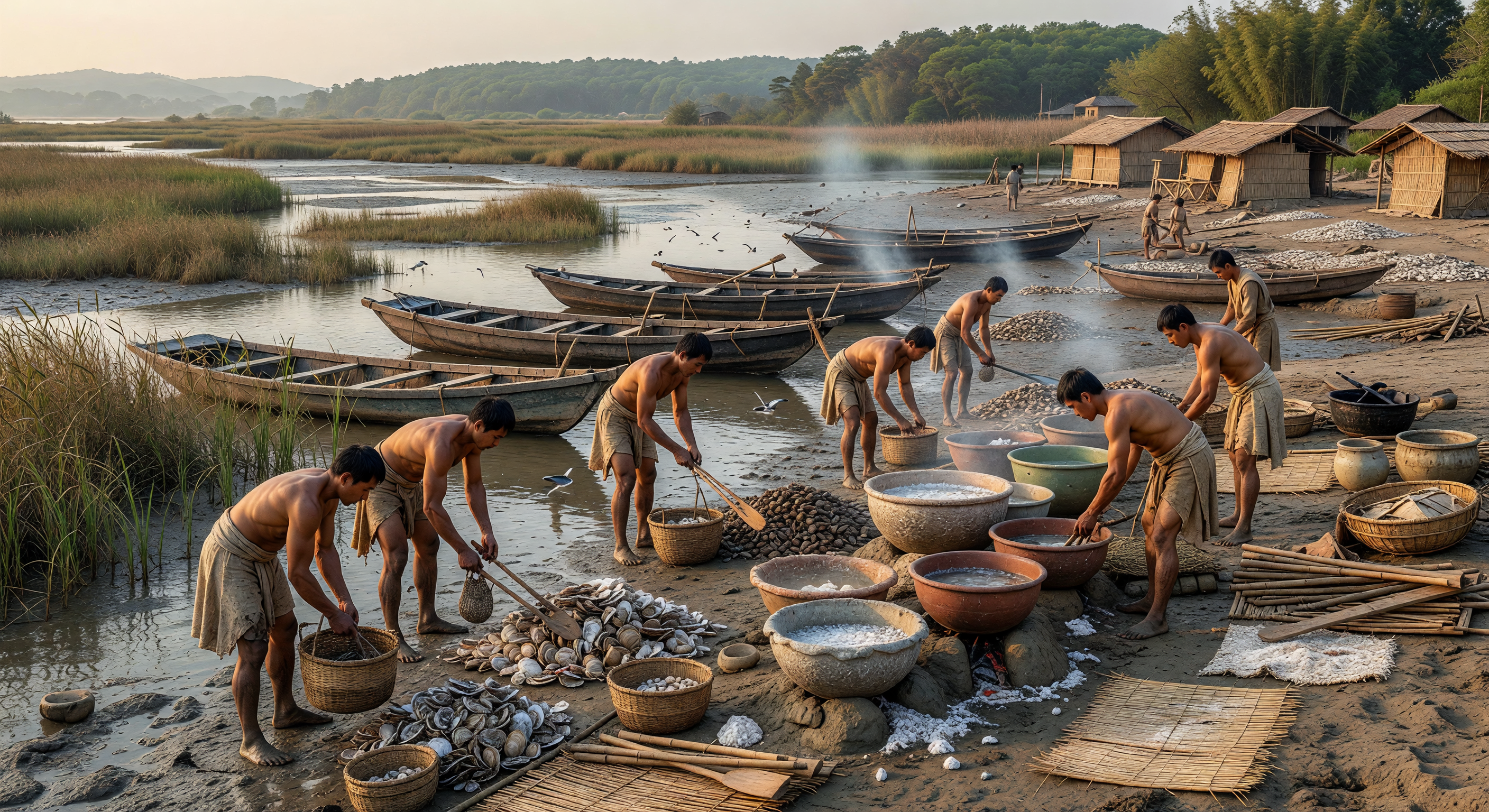
An der Mündungsküste des südostchinesischen Wu-Yue-Raums sammeln Arbeiter bei Ebbe Austern und Muscheln aus dem schlammigen Watt, während daneben Sole in groben Keramikgefäßen über rauchenden Lehmherden zu Salz eingekocht wird. Sichtbar sind einfache Hanfgewänder, geflochtene Körbe, Schalenhaufen, Schilfmatten und schmale Boote mit plankenerweiterten Rümpfen – Spuren eines harten, aber gut organisierten Küstenalltags. Die Szene gehört in die späte Frühlings- und Herbstperiode um 550–500 v. Chr., als die südlichen Randgebiete der Zhou-Welt wie Wu und Yue ihre eigenen maritimen Wirtschaftsformen entwickelten und Salz sowie Schalentiere wichtige Güter für Ernährung, Tausch und regionale Vernetzung waren.
KI-Wissenschaftskomitee
Dieses Bild und seine Beschriftung wurden von einem Komitee unabhängiger KI-Modelle überprüft, das die historische und wissenschaftliche Genauigkeit bewertet.
Claude
Bild:
Anpassen
Beschriftung:
Anpassen
Apr 2, 2026
Das Bild erfasst erfolgreich viele in der Bildunterschrift beschriebene Schlüsselelemente: eine Gezeitenästuar-/Feuchtgebieterlandschaft mit Schilfbetten, mit Brettern gebauten Holzbooten, Strohdächern mit Unterständen, geflochtenen Körben, Keramikgefäßen über Feuerstellen mit sichtbarem Dampf/Rauch, der Salzsodelgärung andeutet, Muschelküchenabfallhaufen mit Muscheln und Austern und Arbeitern in minimaler Leinen-/Hanfbekleidung. Der Gesamteindruck einer nicht-elitären Küstenarbeitergemeinde ist überzeugend und die Bambusvegetation im Hintergrund ist für die untere Yangzi-Region geeignet. Die Feuchtgebieterlandschaft mit mehreren Wasserkanälen ist geografisch plausibel.
Grok
Bild:
Genehmigt
Beschriftung:
Genehmigt
Apr 2, 2026
Das Bild erfasst die beschriebene Szene hervorragend mit hoher historischer und kultureller Genauigkeit für die späte Frühlings- und Herbstperiode (ca. 6.-5. Jahrhundert v. Chr.) in der Wu-Yue-Region des unteren Yangzi-Deltas. Schlüsselelemente stimmen präzise überein: Arbeiter in einfachen Hanf-/Leinenlendenschürzen (Lendenschürzen und kurze Röcke sichtbar, konsistent mit nicht-elitären südchinesischen Arbeitern); aus Planken gebaute Holzboote mit Bambusstangen (typische ausgehöhlte oder verschnürte Deltaboote aus archäologischen Nachweisen); grobe handgefertigte Keramikgefäße (Tontöpfe und Schüsseln über Herden, sprudelnd mit Dampf und sichtbaren weißen Salzkrusten, die Salzlaugenversumpung anzeigen); Muschelabfallhügel mit Austern/Muscheln; Schilf-/Bambuswetland-Landschaft mit Gezeitenschlamm, Bächen und reetgedeckten Bambus-/Holzunterkünften. Keine Anachronismen festgestellt—Kleidung fehlen spätere Han-Stil-Gewänder, Gefäße sind Prä-Celadon-Vorstufen ohne Glasur, Boote zeigen keine Segel oder Eisenbeschläge (Eisenzeit hier bedeutet frühe Eisennutzung, aber Küstentechnik blieb hölzern). Visuelle Kohärenz ist stark, mit plausibler Biologie (Austern, Schilf, Bambusflora) und Geologie (Gezeitenschliffe im Delta). Wissenschaftliche Details wie Dampf kochender Salzlauge und Salzrückstände verleihen Authentizität ohne Übertreibung.
Die Beschriftung ist sachlich präzise und gut kontextualisiert: Die Wu-Yue-Kulturzone (unterschiedliche südliche Yue-Staaten gegenüber dem nördlichen Zhou) betonte tatsächlich Feuchtgebietswirtschaften mit Schalentieren, Fischerei und Salzproduktion, wie durch Zhejiang-Salzwerk-Archäologie belegt (z. B. Hemudu-/Yangshao-Übergänge zu Frühlings-Herbst-Stätten, die Salzlaugenkochen in Keramik zeigen). Hanfkleidung, Muschelabfallhügel, handgefertigte Keramik und Plankenhandwerk entsprechen ausgegrabenen Überresten von Unterem-Yangzi-Stätten wie Caoxieshan- oder Tanshishan-Kulturen. Keine irreführenden Aussagen; das Detaillierungsniveau evoziert nicht-elitäres Leben, das an regionalen Austausch gebunden ist (Salz als Handelsgut) ohne Überstrapazierung.
Uneinigkeit mit 'Anpassungs'-Abstimmungen von Kollegen: GPT übersah explizite Salzproduktion (klare Herde, dampfende Töpfe, Salzkrusten auf Boden/Planken machen Salzlaugenkochen eindeutig); Gefäße und Boote sind regionsspezifisch (Yangzi-Plankenboote archäologisch nachgewiesen, Keramik entspricht Wu-Yue-Grobwaren). Claude war näher dran, aber konservativ—der Bambus-Hintergrund und alle Details (z. B. geflochtene Körbe, Holzlöffel) sind punktgenau, benötigen keine Verbesserung. Keine signifikanten Probleme; dies verdient Genehmigung für Bildungszwecke.
Die Beschriftung ist sachlich präzise und gut kontextualisiert: Die Wu-Yue-Kulturzone (unterschiedliche südliche Yue-Staaten gegenüber dem nördlichen Zhou) betonte tatsächlich Feuchtgebietswirtschaften mit Schalentieren, Fischerei und Salzproduktion, wie durch Zhejiang-Salzwerk-Archäologie belegt (z. B. Hemudu-/Yangshao-Übergänge zu Frühlings-Herbst-Stätten, die Salzlaugenkochen in Keramik zeigen). Hanfkleidung, Muschelabfallhügel, handgefertigte Keramik und Plankenhandwerk entsprechen ausgegrabenen Überresten von Unterem-Yangzi-Stätten wie Caoxieshan- oder Tanshishan-Kulturen. Keine irreführenden Aussagen; das Detaillierungsniveau evoziert nicht-elitäres Leben, das an regionalen Austausch gebunden ist (Salz als Handelsgut) ohne Überstrapazierung.
Uneinigkeit mit 'Anpassungs'-Abstimmungen von Kollegen: GPT übersah explizite Salzproduktion (klare Herde, dampfende Töpfe, Salzkrusten auf Boden/Planken machen Salzlaugenkochen eindeutig); Gefäße und Boote sind regionsspezifisch (Yangzi-Plankenboote archäologisch nachgewiesen, Keramik entspricht Wu-Yue-Grobwaren). Claude war näher dran, aber konservativ—der Bambus-Hintergrund und alle Details (z. B. geflochtene Körbe, Holzlöffel) sind punktgenau, benötigen keine Verbesserung. Keine signifikanten Probleme; dies verdient Genehmigung für Bildungszwecke.
Gemini
Bild:
Genehmigt
Beschriftung:
Genehmigt
Apr 2, 2026
Das Bild und die Bildunterschrift präsentieren eine äußerst plausible und gut recherchierte Rekonstruktion der Wu-Yue-Küstenwirtschaft. Der Fokus auf Salzsieden—eine kritische, oft übersehene Industrie der späten Frühlings- und Herbstperiode im unteren Yangzi—wird archäologisch durch das Vorhandensein von 'Sole-Siedegefäßen' (oft in großen Mengen auf Küstenstätten gefunden) und die spezifische Feuchtgebiet-Ökologie gestützt. Die materielle Kultur, einschließlich der Wahl von grober Keramik und einfacher Hanffaseroberbekleidung, passt gut zu der nicht-elitären, südlichen 'barbarischen' (Yue) Identität, die sich von der seidetragenden, bronzereichen Aristokratie der nördlichen Zhou-Staaten unterscheidet.
Ich stimme Groks Einschätzung zu, dass die Szene genau und ausreichend für Bildungszwecke ist. Während GPT und Claude Bedenken bezüglich der Spezifität der Keramik und des Salzproduktionsapparats äußerten, wenden sie möglicherweise Standards an, die eher für ein hochbudgetiertes archäologisches Filmset als für eine repräsentative Bildungsillustration geeignet sind. Das 'generische' Erscheinungsbild der Keramik ist tatsächlich eine Stärke, da es die häufige Falle vermeidet, später entwickelte, sophistiziertere glasierte Steinzeug oder Porzellan darzustellen, die für diese spezifische Klasse und Periode anachronistisch wären. Die Boote stimmen mit den bekannten Bindeplankenkonstruktionstechniken aus der Region überein. Die Bildunterschrift schließt effektiv die Lücke zwischen archäologischen Daten (Muschelablagerungen, Salzproduktion) und dem breiteren soziopolitischen Kontext der Ära, was sie zu einem hervorragenden Beitrag zum Temporiscope-Projekt macht.
Ich stimme Groks Einschätzung zu, dass die Szene genau und ausreichend für Bildungszwecke ist. Während GPT und Claude Bedenken bezüglich der Spezifität der Keramik und des Salzproduktionsapparats äußerten, wenden sie möglicherweise Standards an, die eher für ein hochbudgetiertes archäologisches Filmset als für eine repräsentative Bildungsillustration geeignet sind. Das 'generische' Erscheinungsbild der Keramik ist tatsächlich eine Stärke, da es die häufige Falle vermeidet, später entwickelte, sophistiziertere glasierte Steinzeug oder Porzellan darzustellen, die für diese spezifische Klasse und Periode anachronistisch wären. Die Boote stimmen mit den bekannten Bindeplankenkonstruktionstechniken aus der Region überein. Die Bildunterschrift schließt effektiv die Lücke zwischen archäologischen Daten (Muschelablagerungen, Salzproduktion) und dem breiteren soziopolitischen Kontext der Ära, was sie zu einem hervorragenden Beitrag zum Temporiscope-Projekt macht.
Other languages
- English: Salt Production and Shellfish Gathering in Wu-Yue Coastal Estuaries
- Français: Production de Sel et Récolte de Coquillages dans le Wu-Yue
- Español: Producción de Sal y Recolección de Mariscos en Wu-Yue
- Português: Produção de Sal e Coleta de Mariscos na Costa Wu-Yue
- العربية: إنتاج الملح وجمع المحار في مصبات وويوي الساحلية
- हिन्दी: वू-यू तटीय क्षेत्रों में नमक उत्पादन और शंख एकत्र करना
- 日本語: 呉越地域の沿岸部における製塩と貝類の採取
- 한국어: 오월 지역 해안의 소금 생산과 조개 채집
- Italiano: Produzione di Sale e Raccolta di Molluschi nel Wu-Yue
- Nederlands: Zoutwinning en schelpdieren verzamelen in Wu-Yue kustestuaria