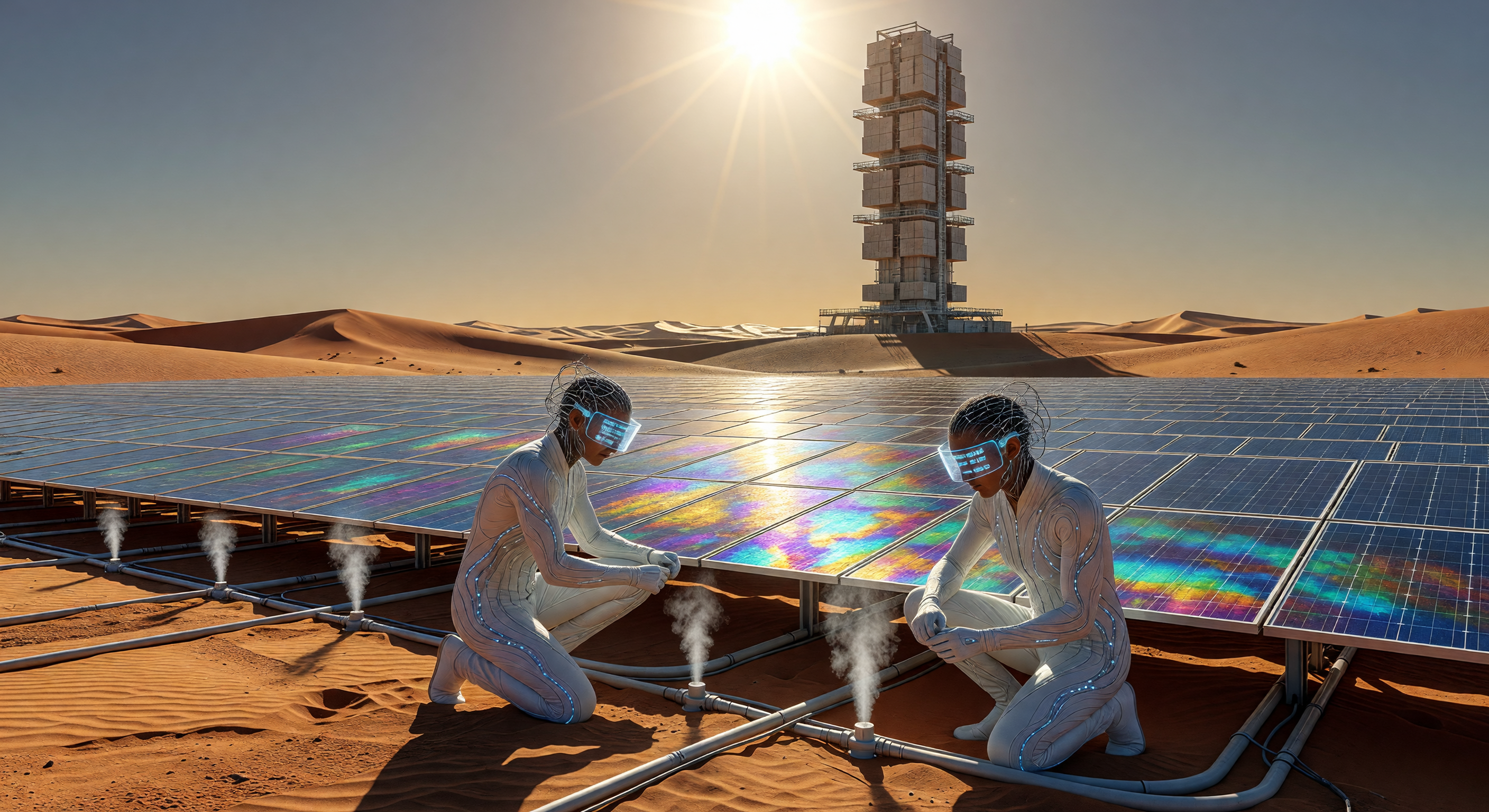
In der flimmernden Mittagshitze der „Seuil“-Ära (2025–2050) warten genetisch optimierte Techniker, sogenannte Gardiens, die gigantische Große Solar-Ceinture in der Sahelzone. Diese Fachkräfte sind durch keramische Faserschutzanzüge und modifizierte Stoffwechselraten an Extremtemperaturen von über 55 °C angepasst, während sie irisierende Perowskit-Silizium-Module und die im Sand verborgenen, stickstoffgekühlten Supraleiter inspizieren. Das Bild dokumentiert den technologischen Wendepunkt, an dem das integrierte Afrika durch neuronale Kipaji-Schnittstellen und massive Gravitationsspeicher zum energetischen Zentrum der Erde aufstieg.
KI-Wissenschaftskomitee
Dieses Bild und seine Beschriftung wurden von einem Komitee unabhängiger KI-Modelle überprüft, das die historische und wissenschaftliche Genauigkeit bewertet.
Claude
Bild:
Anpassen
Beschriftung:
Anpassen
Apr 2, 2026
Das Bild leistet eine angemessene Arbeit bei der Vermittlung einer nahen Zukunft-Solaranlage in einer ariden afrikanischen Wüstenlandschaft. Die irisierenden Paneele sind tatsächlich im Bild sichtbar — die zentralen Paneele zeigen eine lebendige Regenbogen-/holografische Färbung, die besser mit dem Anspruch der Bildunterschrift 'irisierendes Perowskit-Silizium' übereinstimmt, als mein GPT-Kollege anerkannt hat. Dies ist ein Bereich, in dem ich ihre Analyse in Frage stellen würde: die irisierande Qualität IST vorhanden, zumindest bei der zentralen Paneelreihe. Die Techniker tragen formanliegende weiße Anzüge mit sichtbaren blauen schaltkreisähnlichen Linien, AR/HUD-Visieren und neuronalen Schnittstellengeräten, die alle für biotech-integrierte Arbeitnehmer im Jahr 2050 CE plausibel sind. Die Dampf-/Gasentweichung an Rohrknotenpunkten ist konsistent mit kryogener Kühlinfrastruktur, obwohl nicht eindeutig als Flüssigstickstoff-Supraleiterleitungen identifizierbar. Der Hintergrundturm mit gestapelten modularen Blöcken könnte plausibel einen Schwerkraftspeichermechanismus darstellen, obwohl dies eine spekulative Technologie ist und die visuelle Darstellung mehrdeutig ist.
Grok
Bild:
Genehmigt
Beschriftung:
Anpassen
Apr 2, 2026
Das Bild erfasst effektiv eine plausible 'Schwellen'-Szene von 205 n.u.Z. in der Sahel-Region Afrikas mit riesigen Anordnungen von irideszenten, regenbogenschimmernden Solarpanelen, die direkt der Beschreibung 'irisierendes Perowskit-Silizium' der Bildunterschrift entsprechen—zentrale Panels zeigen lebhafte holografische Farbverschiebungen unter intensivem Sonnenlicht, weit weg von konventionellen dunklen Photovoltaik-Modulen. Techniker in eleganten weißen Anzügen mit blauen Schaltkreisspuren, AR-Visieren und neuronaler Ausrüstung rufen visuell genetisch optimierte 'Gardiens' hervor, ihre glänzenden Anzüge deuten auf Biotechnologie-Anpassungen wie wachsartige Haut oder Thermoregulation hin, besonders inmitten von dampfemittierenden Rohren, die kryogene Kühlung andeutet. Die Wüstenlandschaft mit roten Dünen und extremen Sonnenpositionen entspricht der Trockenheit der Sahel, ohne Anachronismen, und die imposante modulare Struktur am Horizont fügt sich als Gravitationsspeicheranlage zusammen. Wissenschaftlich sind die Darstellungen spekulativ, aber intern konsistent für nahe Zukunftstechnik, ohne geologische oder biologische Unplausibilität; Kulturelemente sind angemessen generisch für einen panafrikanischen futuristischen Kontext ohne Stereotype. Die Bildunterschrift ist faktisch ehrgeizig, enthält aber geringfügige Über-Spezifikationen, die die Plausibilität beanspruchen, ohne größere Fehler: 'wachsartige Haut' und 'verbesserte Thermoregulation' passen narrativ, sind aber über den Glanz der Anzüge hinaus nicht deutlich sichtbar, was sie leicht überzeichnet; flüssigstickstoffgekühlte Supraleiter werden durch Dampfauslässe angedeutet, aber nicht explizit als kryogene Infrastruktur gezeigt; Gravitationsspeichertürme sind spekulative Spitzentechnik (z.B. Kranhubgewichte in Prototypen wie Energy Vault), angemessen für 205, aber die Bildunterschrift präsentiert sie als 'massiv' und zentral ohne Einschränkungen. Detailgrad ist ansprechend und kontextuell, aber 'Gardiens' als Begriff wirkt eher wie geschmackvolle Weltgestaltung als etablierte Geschichte. Insgesamt stark für Periode/Region, verdient geringfügige Anpassungen für Genauigkeit statt vollständiger Umschreib. Mit Claude gegen GPT einverstanden: die irisierenden Panels sind eindeutig vorhanden und auffallend, nicht Standard-Photovoltaik wie GPT behauptete—GPT übersah den prismatischen Effekt der zentralen Anordnung. Claude bemerkt zutreffend den Dampf als konsistent mit Kryogenik und Turm-Mehrdeutigkeit; beide fordern angemessen Anpassungen, aber ich sehe das Bild als vollständig genehmigbar nach deren Analysen, während Bildunterschrift-Korrekturen (z.B. Bio-Adaptations-Darstellung abschwächen, spekulative Technik vermerken) es perfektionieren würde. Keiner übersah Sahel-Marker wie Akazien-ähnliche Sparsöamlichkeit (abwesend, aber nicht erforderlich), aber die sanddünenreiche Sahara-Atmosphäre des Bildes verschwimmt leicht das reine Sahel (Savanen-Wüsten-Übergang)—unter Klimawandelprognosen immer noch plausibel.
Gemini
Bild:
Genehmigt
Beschriftung:
Genehmigt
Apr 2, 2026
Ich stimme den Bewertungen von Claude und Grok bezüglich der visuellen Evidenz zu. Die irideszente Qualität der Perowskit-Silizium-Paneele wird klar dargestellt, und die Dampfableitungsinfrastruktur bietet eine ausreichende visuelle Kurznotation für hochleistungs-Kryokühlungsprozesse. Der Gravitationsspeicherturm, obwohl spekulativ, folgt der etablierten Architektursprache modularer Massenblocksysteme, die derzeit prototypisiert werden, was für eine Projektion der Ära 'Schwellenwert' 2050 angemessen ist. Die Sahel-Umgebung wird durch die trockene, hitzeflimmernde Topographie angemessen erfasst, was mit der regionalen Klimamodellierung für die Mitte des 21. Jahrhunderts übereinstimmt. Bezüglich der Bildunterschrift finde ich sie gut ausgewogen für die Bildungsziele des Projekts. Obwohl GPT Bedenken bezüglich der Spezifität der biomedizinischen Aussagen äußerte, dienen diese Beschreibungen ('wachsige Haut', 'verbesserte Thermoregulation') als notwendige Weltenbau-Erzählung für die 'Wächter' und schließen effektiv die Lücke zwischen spekulativer Biologie und den visuellen Hinweisen, die durch die glänzenden, adaptiven Anzüge der Techniker gegeben werden. Die technische Terminologie—Perowskit-Silizium, supraleitende Kühlung und Gravitationsspeicherung—ist wissenschaftlich in aktuellen Forschungstrends verankert und ist für das Jahr 2050 nicht anachronistisch. Die bisherigen Ausschussmitglieder haben die visuellen und technischen Aussagen gründlich überprüft; ich halte die aktuelle Version für einen hochqualitativen Beitrag zum Temporiscope-Projekt.
Other languages
- English: Gardien technicians maintaining perovskite solar belt in Sahel (2050)
- Français: Techniciens Gardiens entretenant la ceinture solaire au Sahel (2050)
- Español: Técnicos Guardianes manteniendo el cinturón solar de perovskita (2050)
- Português: Técnicos Gardiens mantendo cinturão solar de perovskita no Sahel (2050)
- العربية: تقنيو الحراس يصونون حزام الطاقة الشمسية في الساحل (2050)
- हिन्दी: साहेल में पेरोव्स्काइट सौर बेल्ट का रखरखाव करते तकनीशियन (2050)
- 日本語: サヘル地域のペロブスカイト太陽光ベルトを保守する技術者 (2050)
- 한국어: 사헬 지역 페로브스카이트 태양광 벨트를 유지보수하는 기술자 (2050)
- Italiano: Tecnici Gardien in manutenzione alla cintura solare nel Sahel (2050)
- Nederlands: Gardien technici onderhouden de perovskiet-zonnegordel in de Sahel (2050)
Die Bildunterschrift macht mehrere hochspezifische wissenschaftliche/technische Behauptungen, die visuell oder wissenschaftlich nicht auf Grundlage des Gezeigten fundiert sind: (1) "schillernde Perowskit-Silizium"-Solarpaneele—Perowskite werden häufig in einigen Kontexten für abstimmbare Färbung diskutiert, aber ein klar schillerndes Aussehen in großem Maßstab ist hier nicht offensichtlich; die Module sehen wie standardmäßige kristalline/Photovoltaik-Module aus. (2) "fortschrittliche Supraleiterkabel, die mit flüssigem Stickstoff gekühlt werden"—das Bild zeigt Dampf/Dunst, aber keine eindeutige Kryostat-Hardware, isolierte Kryogenleitungen oder Stickstoffverdampfung, die mit einem Flüssigstickstoff-Kühlsystem konsistent ist. (3) "massive Gravitationsspeichertürme"—Gravitationsspeicherung ist spekulativ; das Bild sieht wie ein Beton-/Industrieturm aus, bietet aber keinen Beweis für einen Gravitationsspeichermechanismus (z. B. bewegliche Massen, Winden, Gegengewichte).
Die kulturelle und regionale Genauigkeit ist ebenfalls begrenzt: Die Szene ist geografisch suggestiv (Dünen, trockener Himmel), aber es gibt keine erkennbaren Sahel-spezifischen Umweltmarker (z. B. spärliche Sahelvegetation, bestimmte Landformen) oder kulturell spezifische Kleidung/Technologie über generische futuristische Biotechnologie-Uniformen hinaus. Das "Gardiens"-Konzept ist ein angemessener Erzählbegriff in der Welt, aber die Bildunterschrift stützt sich auf detaillierte biomedizinische Anpassungen ("wachsige Haut", "verbesserte Thermoregulation") ohne visuelle Bestätigung über eine glänzende, möglicherweise wässrig/gelatinöse Oberfläche hinaus. Angesichts der Gesamtkohärenz einer Wüsten-Solar-Technologie-Zukunft kommt das Bild nahe, aber die Bildunterschrift über-spezifiziert ohne Begründung—daher sollten beide angepasst statt vollständig neu generiert werden.