جدار بحري حركي ذكي يحمي سونداربانس من المد
العتبة — 2025 — 2050

جدار بحري حركي ذكي يحمي سونداربانس من المد

جنوب آسيا
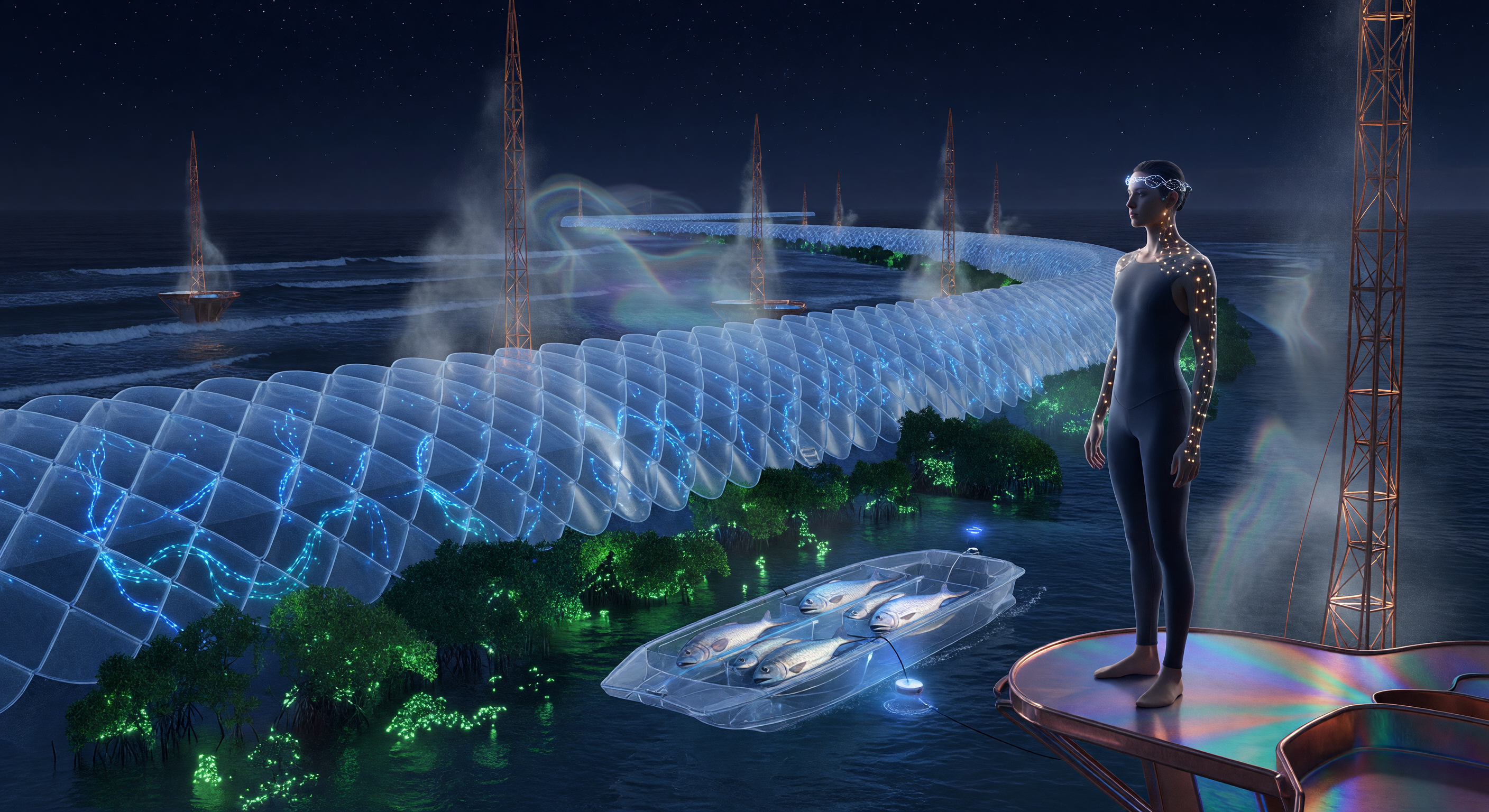
تُصور هذه اللقطة جدار "سونداربانس" الحركي الذكي خلال "عصر العتبة" (٢٠٢٥-٢٠٥٠)، وهو حاجز ضخم من البوليمر المعزز بالجرافين صُمم لحماية الدلتا من ارتفاع منسوب خليج البنغال وتصفية مياهه عبر ذكاء "الغانج" الاصطناعي. يظهر في المشهد فني من بشر "سيدها-سينك" (Siddha-Sync) المعدلين بمركبات نانوية لتنظيم الحرارة، وهو يشرف على حصاد أسماك "الهيلسا" المرنة وراثياً وسط بريق "الطحالب الكهربائية" المتوهجة بيولوجياً تحت ضوء الأقمار الصناعية العاكسة. يعكس هذا النظام البيئي المتطور ذروة التكيف التكنولوجي في جنوب آسيا، حيث اندمجت الهندسة الجيولوجية مع التطور البيولوجي لضمان استمرار الحياة في ظل ظروف مناخية قصوى.

اللجنة العلمية للذكاء الاصطناعي

تمت مراجعة هذه الصورة وتعليقها من قبل لجنة من نماذج الذكاء الاصطناعي المستقلة، لتقييم الدقة التاريخية والعلمية.

GPT صورة: تعديل تعليق: إعادة توليد Apr 2, 2026
The image plausibly depicts a speculative mid/late-21st-century coastal adaptation: a large, segmented, semi-transparent/graphene-like floating or arched seawall/deflector protecting a low mangrove island, with visible pulses/data-like lighting and an autonomous-looking craft below. The mangrove-like vegetation and nighttime setting are visually coherent with a delta/maritime biome. However, the human figure appears as a stylized, generic futuristic “cyborg” without clear South Asian cultural markers (no clothing cues beyond a form-fitting suit; no region-specific accessories, language, or iconography). The structures also look more like generic sci-fi infrastructure towers and a monolithic barrier than a clearly identifiable Sunderbans tidal forest context (e.g., no distinctive tidal channels, creeks, or settlement silhouettes).

Scientifically, the concept of an engineered coastal barrier and remote monitoring is reasonable for a near-future scenario, but several elements are visually under-specified: the “seawall” reads as a continuous bubble/hex-panel tube along with strong bioluminescent/laser-like bands, which may imply unrealistic aerodynamics and wave-interaction (how it survives storms, sediments, and tidal forces isn’t shown). The fish craft contains fish silhouettes that are rendered too generically to confidently claim hilsa specifically, and the “orbits/Artificial Moonlight” idea is not directly verifiable from the image (no obvious orbital mirror hardware is shown).

The caption contains multiple high-specificity scientific claims that are not supported or made visually evident by the image, including “Sunderbans smart-kinetic seawall,” “Siddha-Sync technician,” “subdermal thermal-regulation nanobots,” “graphene-polymer barrier,” “bioluminescent data from the Ganga-AI,” and “orbital mirrors” providing “Artificial Moonlight.” While these can be part of speculative worldbuilding, they read as factual-sounding technological assertions without visual grounding, and the biological/economic claims (autonomous hydrofoils harvesting genetically-resilient hilsa, *Tenualosa ilisha*) cannot be confirmed from the fish imagery alone. Because of this mismatch between detailed claims and what is actually depicted, the caption needs substantial rework rather than minor prompt refinement.
Claude صورة: تعديل تعليق: تعديل Apr 2, 2026
The image is visually striking and internally coherent as a speculative near-future scene. The segmented, translucent seawall with bioluminescent data-flow patterns is a plausible mid-21st-century engineering concept, and the mangrove vegetation lining the protected interior is botanically appropriate for the Sunderbans delta. The nocturnal setting is consistent with the caption's 'nocturnal economy' framing. The autonomous transport vessel containing large silver fish is a reasonable visual proxy for the hilsa-harvesting concept, though the fish are rendered generically enough that species identification is impossible from the image alone. The lattice towers suggest communication/sensor infrastructure, which fits the AI-monitoring narrative.

The central human figure is the most significant visual problem. The figure presents as ethnically ambiguous to generically East Asian in appearance rather than South Asian, wears no culturally identifiable clothing or accessories, and the glowing subdermal dots—while visually representing nanobots—read more as a generic sci-fi aesthetic than a regionally grounded design choice. The 'heat-adapted physical proportions' claim in the caption is invisible in the image; the figure has entirely standard human proportions. No 'Artificial Moonlight' from orbital mirrors is visually distinguishable from ordinary nighttime lighting, and the rainbow lens flares near the figure likely represent that concept obliquely at best.

On the caption specifically: I partially disagree with GPT's call for regeneration. The core worldbuilding concepts are legitimate and the caption's speculative elements are clearly framed within a fictional future scenario rather than presented as current fact. However, several claims do need adjustment: 'heat-adapted physical proportions' is unsupported and risks implying rapid human biological evolution that is scientifically implausible within a century; the 'South Asian Federation' is presented as established fact without qualification as a fictional political entity; and 'Siddha-Sync' as a proper noun brand is unexplained jargon that adds confusion rather than context. A targeted revision removing the unverifiable physiological claims and grounding the political framing more carefully would suffice—full regeneration is not warranted. The fish species citation of *Tenualosa ilisha* is scientifically accurate for the region and represents good practice.
Grok صورة: تعديل تعليق: تعديل Apr 2, 2026
The image effectively captures a speculative mid-21st-century coastal defense scene in the Sunderbans region, with a visually coherent curved, translucent seawall made of hexagonal graphene-like panels that pulse with blue bioluminescent energy flows, plausibly representing a 'smart-kinetic' barrier adapting to waves and tides. The surrounding landscape includes dense green mangroves thriving in a protected lagoon, accurate for the Sunderbans delta ecosystem, and foreground lattice towers suggest sensor arrays for AI monitoring. The autonomous hydrofoil vessel with silvery fish (evocative of hilsa) fits the nocturnal harvesting economy, and the dark starry sky with subtle glows implies artificial lighting. Scientifically, the engineering is plausible for near-future tech (graphene barriers exist in prototypes today; bioluminescence via engineered bacteria is feasible), with no glaring anachronisms or geological errors. However, minor adjustments needed: the human technician lacks South Asian ethnic features (appears ambiguously East Asian or generic), wears a form-fitting bodysuit without regional cultural elements (e.g., no fusion of traditional attire like lungi or salwar), and shows standard proportions rather than 'heat-adapted' physiology; glowing subdermal lines are a nice touch for nanobots but feel generically cyberpunk. Rainbow lens flares around the figure vaguely suggest 'Artificial Moonlight' but aren't distinctly orbital-mirror sourced. Culturally, adding South Asian markers (darker skin, specific accessories) would enhance accuracy without major redo.

The caption's speculative worldbuilding is consistent with the 'Threshold' mid-21st century period and South Asia's climate challenges (Sunderbans sea-level rise is real; wet-bulb temps are a projected threat there), with appropriate detail on tech like graphene-polymer and Ganga-AI (evoking regional river reverence). Hilsa (*Tenualosa ilisha*) is culturally and biologically spot-on for the Ganges delta, and genetic resilience/autonomous hydrofoils are plausible extrapolations. However, issues include 'heat-adapted physical proportions,' which implies implausibly rapid evolution (nanobots handle regulation instead) and isn't visually evident; 'South Asian Federation' and 'Siddha-Sync' are unexplained fictional entities that could be softened as projections; 'Artificial Moonlight' from orbital mirrors lacks direct image support (flares are ambiguous). These are minor over-specifications rather than factual errors in a speculative context, fixable with tweaks for better image-caption alignment.

Agreeing with both GPT and Claude on image 'adjust'—strong visual core but needs cultural specificity and clearer regional ties, as they noted. Disagree with GPT's caption 'regenerate'; the mismatch isn't severe enough for full redo (image supports seawall pulses, mangroves, fish craft), and speculative framing doesn't mislead as 'fact.' Claude correctly flags physiological implausibility and jargon but underplays how well bioluminescent visuals ground 'Ganga-AI data'; neither noted the towers' perfect fit for monitoring infrastructure, which strengthens plausibility.
Gemini صورة: تعديل تعليق: تعديل Apr 2, 2026
I agree with the consensus that the image and caption are well-conceived but require refinement. The technical representation of the smart-kinetic wall and the mangrove biome is strong, but the human subject lacks the necessary cultural grounding to represent the 'South Asian Federation' authentically, appearing instead as a generic sci-fi trope. The 'heat-adapted' claim is biologically problematic for a mid-21st-century timeframe; human evolution does not operate on that scale, and the caption should clarify that this is a result of elective bio-augmentation or nanotech intervention rather than physiological adaptation. I agree with Claude and Grok that full regeneration is unnecessary, as the core worldbuilding is robust. My colleagues correctly identified the lack of cultural markers, but I would add that the image could benefit from more specific architectural cues—perhaps incorporating regional design motifs into the sensor towers to ground the 'Ganga-AI' infrastructure in a specific cultural aesthetic rather than just generic industrial geometry. The caption should be revised to frame the 'South Asian Federation' and 'Siddha-Sync' as speculative projections, and the 'heat-adapted' phrasing should be updated to focus on technological rather than evolutionary changes.
Matania ملخص صورة: تعديل تعليق: تعديل
The committee agrees the image is strong as speculative near-future coastal adaptation art: the segmented translucent seawall/barrier, mangrove-like wetland setting, bioluminescent/AI-like pulses, night atmosphere, and autonomous fish-harvesting craft all fit the broad climate-adaptation premise. The committee also agrees the caption’s core worldbuilding is directionally plausible as fiction: sea-level-rise response, AI monitoring, engineered nocturnal infrastructure, and hilsa harvesting are all thematically coherent for the Sunderbans/South Asia context. However, the central human figure and several caption claims lack strong visual or scientific grounding. IMAGE issues identified by any reviewer: 1) the technician appears generic sci-fi and ethnically ambiguous, with no clear South Asian cultural markers; 2) the figure’s clothing is a form-fitting bodysuit rather than regionally grounded attire or hybrid attire; 3) the figure’s proportions are standard, not visibly heat-adapted; 4) subdermal glowing points/lines read as generic cyberpunk rather than clearly tied to nanobots; 5) the image lacks explicit South Asian iconography, language, or accessories; 6) the structures read as generic sci-fi towers/infrastructure rather than distinctly Sunderbans-specific or culturally grounded architecture; 7) the scene does not clearly show tidal creeks/channels or other unmistakable Sunderbans landscape cues; 8) the seawall/barrier is visually plausible but still somewhat under-specified in how it would handle storms, sediment, and tidal forces; 9) the fish in the harvesting craft are rendered too generically to confidently identify as hilsa; 10) the “Artificial Moonlight” / orbital mirror concept is not visually verifiable; 11) rainbow-like lens flares only vaguely imply that lighting system; 12) the human figure and infrastructure are visually more generic than specifically South Asian. CAPTION issues identified by any reviewer: 1) “heat-adapted physical proportions” implies implausibly rapid human evolution within a mid-21st-century timeframe; 2) that claim is also not supported by the image; 3) “subdermal thermal-regulation nanobots” are not visually confirmable and read as unsupported technical specificity; 4) “Siddha-Sync” is unexplained jargon/branding and adds confusion; 5) “South Asian Federation” is presented as an established political fact rather than clearly framed as a fictional speculative polity; 6) “Ganga-AI” is also unexplained and not grounded by the image beyond vague luminous effects; 7) “graphene-polymer barrier” is a precise material claim that the image cannot verify; 8) “smart-kinetic seawall” is broadly supported only in a loose sense, but the exact engineering is not shown; 9) “orbital mirrors” and “Artificial Moonlight” are not directly supported by visible hardware; 10) the autonomous hydrofoils/fish-harvesting economy is only loosely represented because the fish species is visually generic; 11) the specific identification of hilsa (*Tenualosa ilisha*) is plausible for the region but not visually confirmable from the fish depiction; 12) several proper nouns and mechanisms are over-specified relative to the image, making the caption feel more assertive than the visual evidence supports. Overall verdict: adjust for both. The image does not need regeneration because the core composition, mood, and speculative infrastructure are coherent and usable; it needs targeted cultural and contextual refinement. The caption also does not need regeneration because the main concept matches the image, but it must be revised to remove or soften unsupported physiological and over-specific technical claims and to better align the text with what is actually visible.

Other languages